

Capital General Directorate of Traffic Truck & Bus
Practice mode· Heavy vehicle skillsCapital General Directorate of Traffic - Bahrain Heavy Vehicle Skills Test 1
First set of questions on truck and bus operation: braking distances, load stability, blind spots, turning space and vehicle checks. Master the skills unique to heavy vehicles.
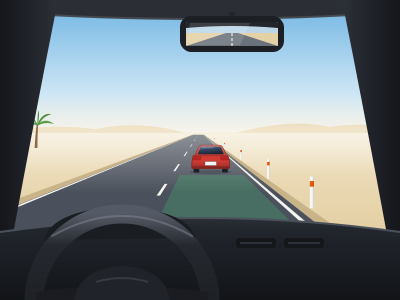
Compared with a car travelling at the same speed, a fully loaded heavy truck will generally need a stopping distance that is:
The other 12 questions in this test
Read them all. The answer and the reason for each, and the timed 22-question run, are in the Bahrain Driving Test Questions PDF.
- Q11Heavy vehicle
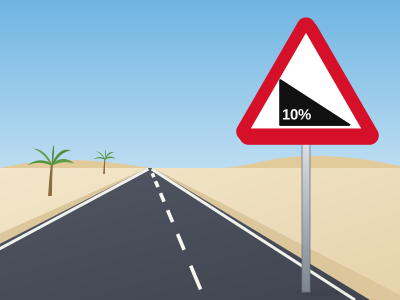
You are about to descend a long gradient and notice the 'Trucks: engage low gear' sign. What is the correct action?
- AApply the service brakes firmly now and shift to a higher gear for better engine braking
- BShift to neutral to save fuel and apply brakes as needed throughout the descent
- CReduce speed and shift to a low gear before the descent begins, using engine braking to control speed on the way down
- DThe sign applies only to vehicles over 40 tonnes; continue in the current gear
Answer and explanation in the bank
- Q12Heavy vehicle
Which situation poses the greatest risk of jackknifing on an articulated truck fitted with air brakes?
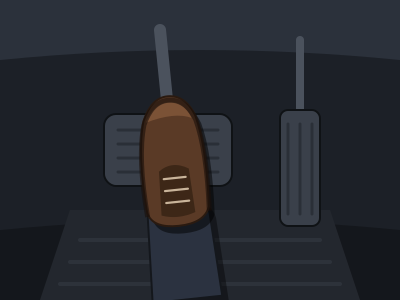
- AHard braking on a slippery surface causing the drive axles to lock while the trailer continues forward
- BApplying full brake pressure gently on a dry straight road
- CEngaging the exhaust brake on a flat road at low speed
- DReleasing the brakes gradually after a complete stop on a hill
Answer and explanation in the bank
- Q13Heavy vehicle
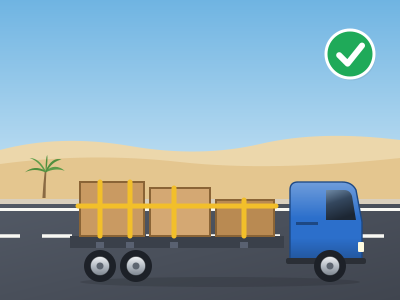
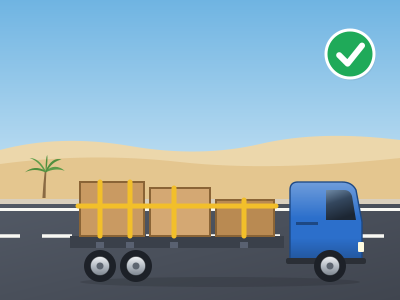
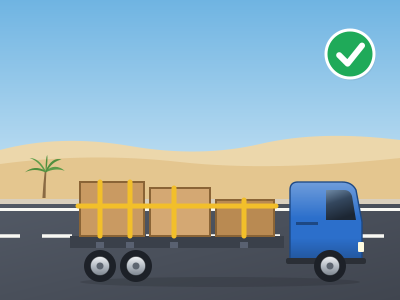
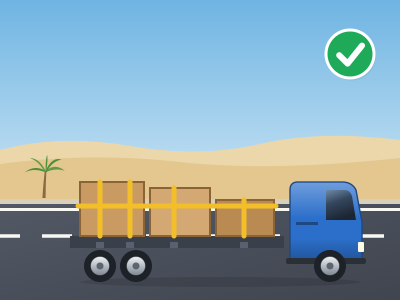
When securing cargo on a flatbed truck, what is the minimum requirement for load security?
- AThe load must be covered with a tarpaulin; straps are optional if the load is heavy enough
- BA single ratchet strap across the middle of the load is sufficient for loads under 5 tonnes
- CLoad security is the responsibility of the loading company, not the driver
- DThe load must be prevented from moving in any direction and must not project dangerously or fall onto the road
Answer and explanation in the bank
- Q14Heavy vehicle
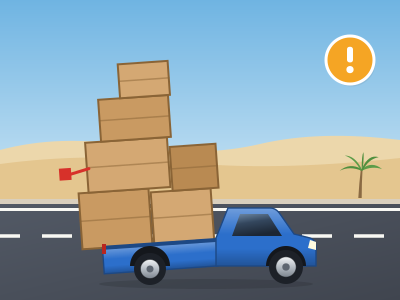
Where should the heaviest part of a cargo be positioned on a truck to optimise vehicle stability?
- AAs high as possible to keep the load away from the chassis floor
- BLow and centred over the axles to lower the centre of gravity and distribute weight evenly
- CAt the rear of the trailer to improve steering feel at the front axle
- DTowards the right side of the load bed to compensate for the driver's weight on the left
Answer and explanation in the bank
- Q15Heavy vehicle
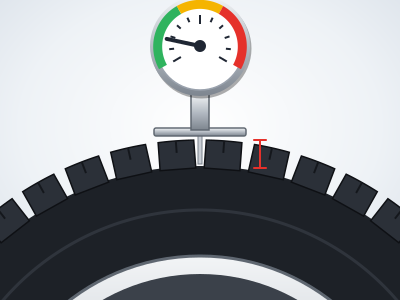
During a journey you notice your truck is pulling to one side even though the road is straight and level. What could this indicate about the load?
- AThe load is correctly distributed and the symptom is caused by road camber
- BThe load has shifted to one side, causing an uneven weight distribution that affects steering and tyre loading
- COne of the steering axle tyres is over-inflated, which is unrelated to load distribution
- DThe front axle weight is too low, meaning more cargo should be moved forward
Answer and explanation in the bank
- Q16Heavy vehicle
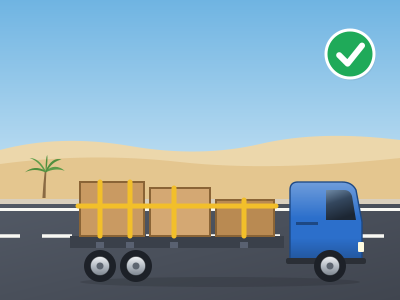
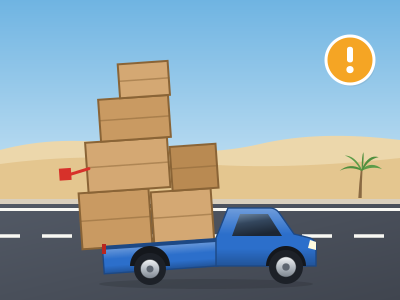
A load projects more than 1 metre beyond the rear of your truck. What is required in Bahrain? (Confirm exact distances with the General Directorate of Traffic.)
- ANo special measures are needed as long as the overall vehicle length is under 22 metres
- BThe load must be refused; projection beyond the bodywork is never permitted on Bahrain roads
- CThe projection must be marked with a red flag or light and may require a special permit depending on the length
- DOnly a rear reflective marker plate is needed, regardless of how far the load projects
Answer and explanation in the bank
- Q17Heavy vehicle
What does 'gross vehicle weight' (GVW) mean?
- AThe weight of the vehicle alone with all fluids but no cargo or passengers
- BThe maximum combined weight of the vehicle, its cargo, fuel, driver, and any passengers as specified by the manufacturer and regulator
- CThe weight recorded at the last annual vehicle inspection
- DThe weight of the cargo only, excluding the vehicle's own mass
Answer and explanation in the bank
- Q18Heavy vehicle
Your laden truck is approaching a bridge with a posted weight limit of 30 tonnes but your gross vehicle weight is 32 tonnes. What must you do?
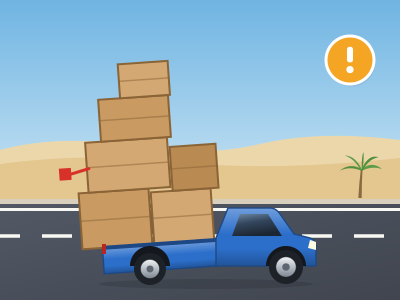
- ADo not cross. Find an alternative route or obtain a special crossing permit from the authorities before proceeding
- BCross at low speed; the weight limit has a built-in safety margin that covers 2 extra tonnes
- CDeflate the tyres slightly to reduce the load on the bridge deck
- DCross quickly so the dynamic weight on the structure is lower than the static limit
Answer and explanation in the bank
- Q19Heavy vehicle
Which of the following is a likely consequence of overloading a drive axle on a heavy truck?
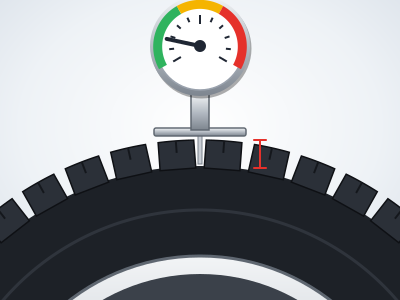
- ABetter traction on loose surfaces due to increased tyre contact
- BIncreased tyre wear, potential tyre failure, reduced braking performance, and possible prosecution for exceeding axle weight limits
- COverheating of the differential only, with no effect on brakes or tyres
- DReduced fuel consumption because the engine load is more evenly distributed
Answer and explanation in the bank
- Q20Heavy vehicle
A truck and trailer combination is stopped at a Bahrain weigh station. The front steer axle reads 8 tonnes, the drive tandem reads 19 tonnes, and the trailer tandem reads 17 tonnes. The posted steer-axle limit is 7 tonnes. What is the best immediate action?
- AArgue that the reading is within instrument error and proceed
- BShift cargo forward to balance the trailer axle
- CAccept the overload violation, pay any fine, then shift cargo rearward to reduce steer-axle loading before continuing
- DContinue driving because the gross combination weight is within overall limits
Answer and explanation in the bank
- Q21Heavy vehicle
What must a heavy vehicle driver check before driving under a low bridge or height restriction gantry?
- AThe overall height of the vehicle and any load, confirming it is less than the posted clearance
- BOnly the cab height, since the cab is always the tallest part of the vehicle
- CThe width of the road under the bridge, not the vertical clearance
- DNothing; gantry restrictions apply only to double-decker buses, not trucks
Answer and explanation in the bank
- Q22Heavy vehicle
What is the recommended approach if a heavy truck driver is unsure whether a route has sufficient clearance for the vehicle's width?
- ADrive through slowly and rely on the vehicle's wing mirrors to judge clearance
- BPlan the route in advance using maps and transport authority guidance, and obtain a wide-load permit if the vehicle exceeds the standard width limit
- CThe width of a truck never requires a permit in Bahrain as long as it is within the manufacturer's specification
- DAsk the passenger to guide from outside the vehicle while driving through narrow sections
Answer and explanation in the bank
Every answer above, with the rule it comes from, plus the full 22-question timed test.
Get the Bahrain Driving Test Questions - BHD 3What this test covers
Topics include road signs, traffic signals, right of way, roundabouts, speed limits, seat belts, fines and penalties, and the safe-driving rules specific to your vehicle category. Full question-by-question feedback with explanations is shown immediately after you finish the test above.
Frequently asked questions
How many questions is the Capital General Directorate of Traffic truck & bus theory test?
The official General Directorate of Traffic truck & bus theory test in Capital has 35 questions and you need 26 correct (75%) to pass. This practice test has 22 questions.
Is this the real exam?
These are practice questions to help you revise, written to the published rules and to what candidates report from the real test. They are not the official Bahrain exam and the real question bank, format, fees and pass mark are set by the General Directorate of Traffic (Ministry of Interior), and can change. Always confirm the current requirements with your driving school or the traffic department.
Is this practice test free?
The first 10 questions are free, with no signup, and each shows the answer and the reason. The full 22-question test, timed, is in the Bahrain Driving Test Questions PDF (BHD 3, one payment), with every question in the bank.
What does the Capital truck & bus theory test cover?
Road signs, traffic signals, right of way, roundabouts, speed limits, seat belts, penalties and safe-driving rules, plus the handling and safety topics specific to your vehicle.