

Capital General Directorate of Traffic Truck & Bus
Practice mode· Heavy vehicle skillsCapital General Directorate of Traffic - Bahrain Heavy Vehicle Skills Test 2
Second set of heavy-vehicle questions covering coupling, tunnels and bridges, passenger safety, hill starts and managing long or wide loads. Complete both tests for full coverage.
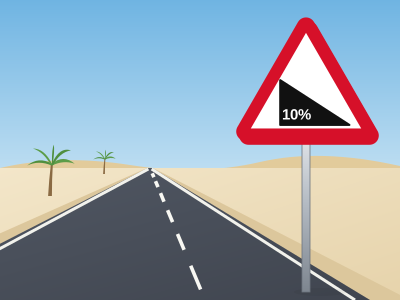
When driving a heavy truck down a long steep descent, what is the recommended technique to control speed?
The other 12 questions in this test
Read them all. The answer and the reason for each, and the timed 22-question run, are in the Bahrain Driving Test Questions PDF.
- Q11Heavy vehicle
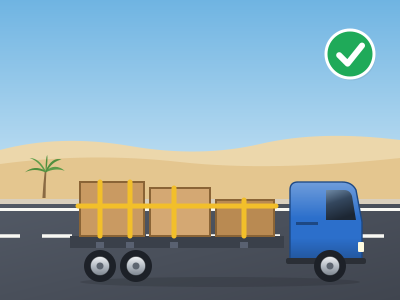
Your loaded tanker has a total height of 4.5 metres. You approach a gantry sign showing 4.2 metres clearance. What is the correct action?
- AReduce tyre pressure to lower the vehicle height and proceed
- BProceed slowly; the 0.3-metre difference is within acceptable tolerance for road gantry measurements
- CStop before the gantry and find an alternative route; do not attempt to pass
- DDrive through in the centre of the lane to maximise headroom at the arch crown
Answer and explanation in the bank
- Q12Heavy vehicle
On a left-hand-drive truck operating in Bahrain (right-hand traffic), which side has the largest blind spot?
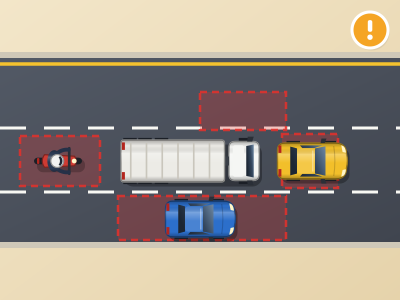
- AThe left side, because the driver sits on the left and cannot see directly to the left without leaning
- BThe right (passenger) side, because the driver is furthest from the right side of the cab
- CDirectly in front of the cab, behind the engine cover
- DBoth sides are equally blind because the cab is symmetrical
Answer and explanation in the bank
- Q13Heavy vehicle
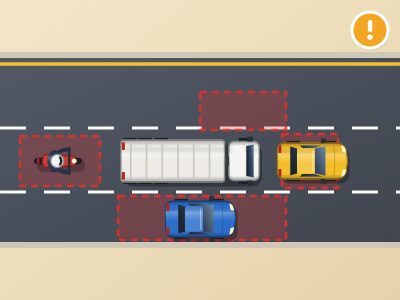
Which mirror is most important for monitoring the right-side blind spot on a left-hand-drive truck in Bahrain?
- AThe interior rear-view mirror, which gives the widest angle of view to the rear
- BThe left-hand door mirror, because it is closest to the driver and easiest to read
- CNo mirror is needed on the right side because other road users must give way to trucks
- DThe right-hand wide-angle (convex) and flat wing mirror combination, adjusted to cover the right side as much as possible
Answer and explanation in the bank
- Q14Heavy vehicle
A cyclist is riding alongside the right side of your left-hand-drive truck at a junction. Why is this especially dangerous?
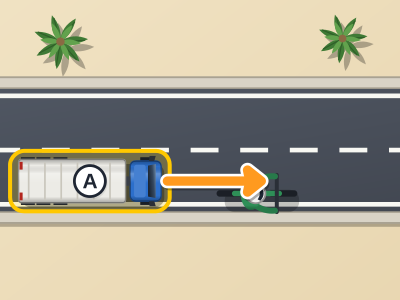
- ACyclists are not permitted on roads used by heavy trucks in Bahrain
- BCyclists always have right of way so the danger is minimal
- CThe right side is the largest blind zone for the driver, making it very difficult to see the cyclist before turning right
- DThe danger only exists at night when mirrors are hard to read
Answer and explanation in the bank
- Q15Heavy vehicle
You are about to move off from a roadside stop. Your mirrors are correctly adjusted. Which additional action is most important before pulling away to the right?
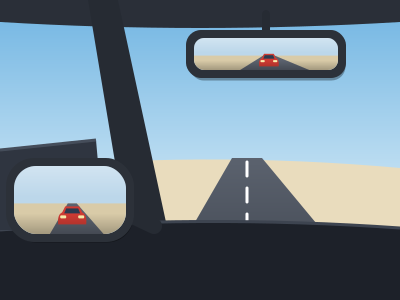
- ASound the horn continuously for 5 seconds to warn all nearby road users
- BCheck the left mirror only, because traffic in Bahrain passes on the left
- CNo additional check is needed if the mirrors are correctly set; trust the mirrors
- DCheck the right-side mirror and also turn your head to do a physical blind-spot check on the right before signalling and moving
Answer and explanation in the bank
- Q16Heavy vehicle
What is 'tail swing' on an articulated truck and when is it most likely to cause an accident?
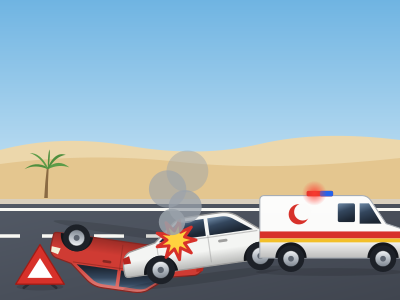
- AThe tendency of the trailer to overtake the cab when the brakes are applied hard
- BThe swaying of a tanker body caused by liquid surge during braking
- CThe outward sweep of the rear of the trailer in the opposite direction to the turn when the driver steers
- DThe vibration of the cab caused by unbalanced rear tyres at high speed
Answer and explanation in the bank
- Q17Heavy vehicle
Why should the driver of a long articulated truck start a right turn from as far right in the lane as safely possible?

- ATo allow faster overtaking vehicles to pass on the left before the turn is complete
- BBahrain traffic rules require trucks to position to the right at all junctions regardless of turn direction
- CTo give the trailer the widest possible arc so it does not mount the kerb or strike objects on the inside of the turn
- DTo reduce tail swing, which only occurs when the vehicle starts the turn from the left
Answer and explanation in the bank
- Q18Heavy vehicle
You are driving an articulated truck and need to make a tight left turn. A motorcyclist is waiting at the junction on your left. What should you do?
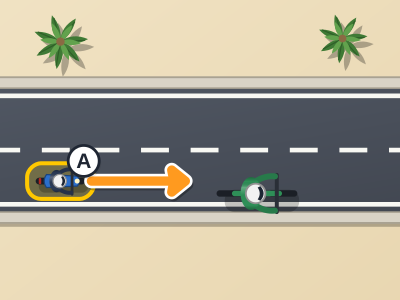
- AComplete the turn quickly so the motorcyclist has minimal time in the danger zone
- BSound the horn and proceed; the motorcyclist should know to stay clear of trucks
- CWait for the motorcyclist to move fully out of your path, then complete the turn slowly while checking mirrors for the trailer's sweep through the turn
- DPull slightly right to signal your intent and proceed at normal turning speed
Answer and explanation in the bank
- Q19Heavy vehicle
What is meant by a high centre of gravity on a heavy vehicle and why does it matter?
- AIt means the engine is mounted high, which improves fuel economy on flat roads
- BIt refers to the height of the cab above the road surface, which affects driver visibility only
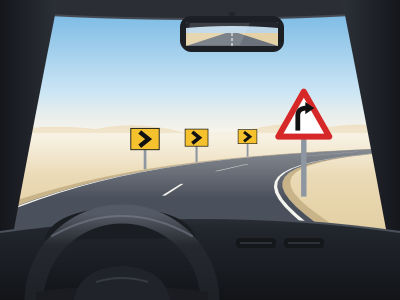
- CIt means the vehicle's mass is concentrated high above the ground, making it more likely to roll over when cornering or changing direction
- DIt describes the ideal suspension setting for carrying heavy loads on motorways
Answer and explanation in the bank
- Q20Heavy vehicle
A tanker carrying liquid is only half full. Why might this be more dangerous in terms of rollover than a full tanker?
- AA half-full tanker is always lighter so it has better handling in all conditions
- BA half-full tanker sits lower, reducing the centre of gravity and making it harder to see over obstacles
- CThe liquid insulates the tank walls, causing the tanker to overheat, which has no direct effect on rollover
- DThe free liquid surface can surge violently when the driver brakes or steers, creating unpredictable forces that can tip the vehicle
Answer and explanation in the bank
- Q21Heavy vehicle
You are approaching a roundabout at 50 km/h with a high-sided loaded trailer. What is the main risk?
- AThe trailer doors may open on the approach due to centrifugal force
- BThe trailer will jackknife because roundabouts require steering input in both directions
- CThe risk is no greater than for a car; modern truck suspension handles roundabouts safely
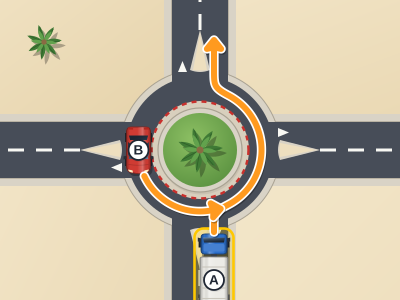
- DThe vehicle may roll over if the entry speed is too high, because lateral forces on a high centre of gravity can exceed the tipping limit of the tyres
Answer and explanation in the bank
- Q22Heavy vehicle
What does 'dynamic rollover threshold' mean for a heavily loaded tanker?
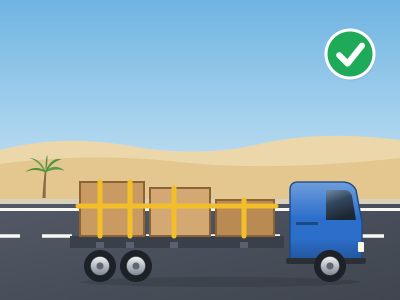
- AThe level of lateral acceleration at which the vehicle will start to tip onto its side, which is lower for high-centre-of-gravity vehicles
- BThe maximum speed at which the tanker can travel on a public road in Bahrain
- CThe point at which the trailer brakes engage automatically to prevent jackknifing
- DThe speed at which tyre grip is lost on a wet surface, measured in lateral G-force
Answer and explanation in the bank
Every answer above, with the rule it comes from, plus the full 22-question timed test.
Get the Bahrain Driving Test Questions - BHD 3What this test covers
Topics include road signs, traffic signals, right of way, roundabouts, speed limits, seat belts, fines and penalties, and the safe-driving rules specific to your vehicle category. Full question-by-question feedback with explanations is shown immediately after you finish the test above.
Frequently asked questions
How many questions is the Capital General Directorate of Traffic truck & bus theory test?
The official General Directorate of Traffic truck & bus theory test in Capital has 35 questions and you need 26 correct (75%) to pass. This practice test has 22 questions.
Is this the real exam?
These are practice questions to help you revise, written to the published rules and to what candidates report from the real test. They are not the official Bahrain exam and the real question bank, format, fees and pass mark are set by the General Directorate of Traffic (Ministry of Interior), and can change. Always confirm the current requirements with your driving school or the traffic department.
Is this practice test free?
The first 10 questions are free, with no signup, and each shows the answer and the reason. The full 22-question test, timed, is in the Bahrain Driving Test Questions PDF (BHD 3, one payment), with every question in the bank.
What does the Capital truck & bus theory test cover?
Road signs, traffic signals, right of way, roundabouts, speed limits, seat belts, penalties and safe-driving rules, plus the handling and safety topics specific to your vehicle.