

Northern General Directorate of Traffic Light vehicle
Practice mode· Right of way & safetyNorthern General Directorate of Traffic - Bahrain Right of Way Practice Test
Tests your understanding of priority rules: unmarked junctions, roundabouts, emergency vehicles, merging lanes and more. Getting right of way right can prevent serious accidents.
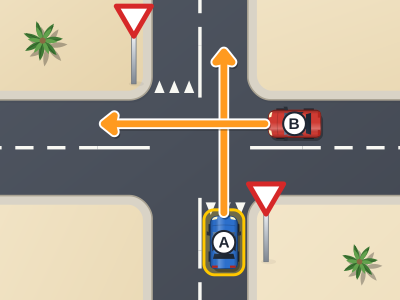
You are travelling east at an unmarked crossroads. A vehicle is approaching from the south, which is your right. What should you do?
The other 12 questions in this test
Read them all. The answer and the reason for each, and the timed 22-question run, are in the Bahrain Driving Test Questions PDF.
- Q11Right of way
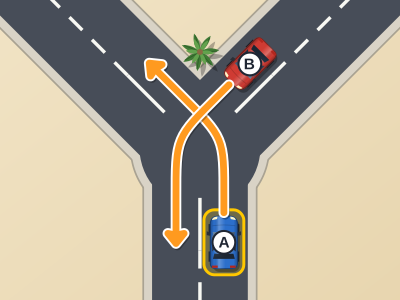
At an unmarked Y-junction, two roads fork from one road. You are on the left fork and a vehicle is coming from the right fork. Who gives way?
- AThe vehicle from the right gives way to you.
- BThe vehicle making the sharper turn gives way.
- CNeither gives way; both proceed simultaneously without concern.
- DYou give way to the vehicle from the right fork, because it is on your right.
Answer and explanation in the bank
- Q12Right of way
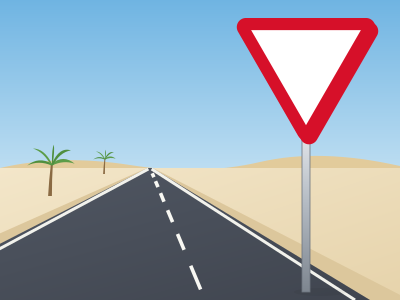
At a T-junction controlled by a GIVE WAY sign, how must you proceed?
- AProceed if no vehicle is within 50 metres.
- BGive way only to traffic approaching from the right.
- CThe sign means slow down only; no yielding is required if the road looks clear.
- DSlow or stop sufficiently to give way to all traffic on the main road before entering.
Answer and explanation in the bank
- Q13Right of way
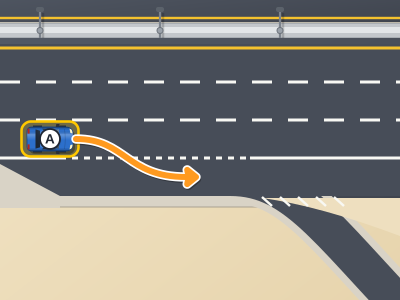
You are exiting a side street at a T-junction with a main road. A vehicle on the main road is approaching but is some distance away. When may you proceed?
- AAs soon as you see any gap in the main road traffic.
- BWhen the approaching vehicle is more than 100 metres away.
- COnly after making eye contact with the other driver.
- DOnly when you are certain you can complete the manoeuvre without causing the main-road vehicle to brake or swerve.
Answer and explanation in the bank
- Q14Right of way
You are on a one-way street. Which direction should you check for traffic before turning into it?
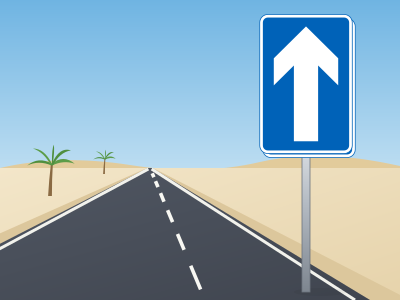
- ABoth directions, because pedestrians and cyclists may be moving against the vehicle flow.
- BOnly in the direction of the vehicle flow.
- COnly to the right; traffic is permitted from one direction only.
- DNo check is needed; one-way streets are always clear of oncoming traffic.
Answer and explanation in the bank
- Q15Right of way
On a one-way street a vehicle is approaching you head-on. What should you do?
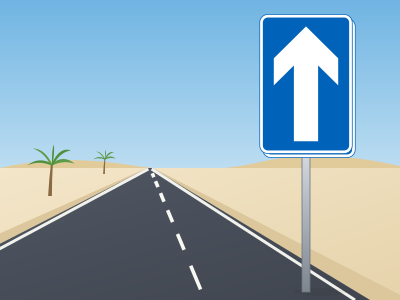
- AStop safely and signal the driver; one of you is travelling in the wrong direction.
- BContinue; the other driver is in the wrong and must reverse.
- CFlash your headlights and maintain speed to assert priority.
- DReverse immediately to the nearest junction without checking behind you.
Answer and explanation in the bank
- Q16Right of way
When turning right from a one-way street onto a two-way road, which lane of the two-way road should you turn into?
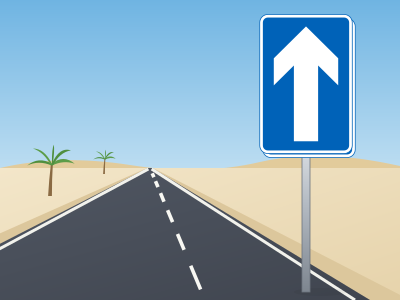
- AThe left-hand lane of the two-way road.
- BEither lane; lane choice when exiting a one-way street is unrestricted.
- CThe lane furthest from the centre line.
- DThe right-hand lane of the two-way road.
Answer and explanation in the bank
- Q17Right of way
You are joining a motorway or expressway from an on-ramp. Who has priority?
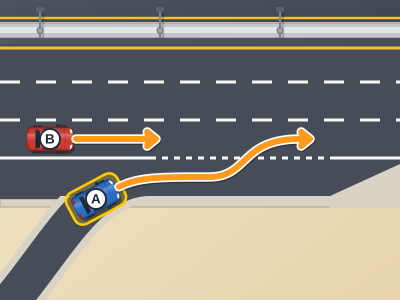
- ATraffic already on the motorway; you must match speed and merge safely.
- BYou, because you are entering from the right.
- CThe first vehicle to reach the merge point.
- DThe vehicle travelling at the higher speed.
Answer and explanation in the bank
- Q18Right of way
You are on the motorway in the outer (right-hand) lane. A vehicle on an on-ramp is trying to merge. What should you do if it is safe?
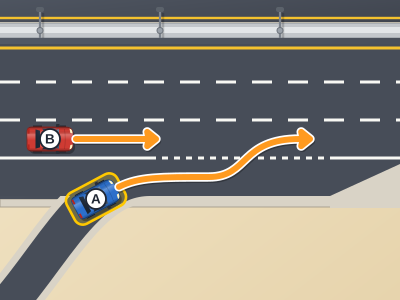
- AMaintain your speed and position; the merging vehicle must yield.
- BMove to the left lane to make room for the merging vehicle.
- CBrake sharply to let the merging vehicle in.
- DFlash your headlights to tell the merging driver to wait.
Answer and explanation in the bank
- Q19Right of way
You want to leave a motorway at an upcoming exit. When should you move into the right-hand exit lane?
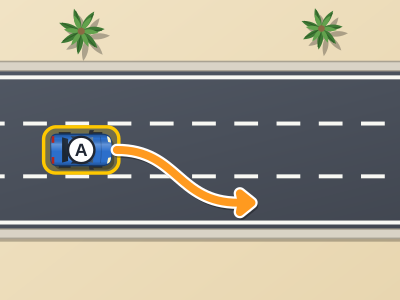
- AAt the last moment to avoid slowing traffic behind you.
- BIn good time before the exit, after checking mirrors and signalling.
- COnly once you can clearly see the exit sign.
- DAfter passing the exit sign, then manoeuvre quickly across lanes.
Answer and explanation in the bank
- Q20Right of way
You have missed your motorway exit. What should you do?
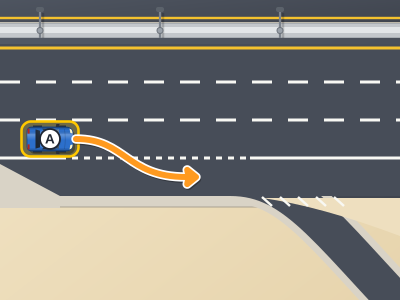
- AReverse along the hard shoulder to reach the exit.
- BContinue to the next exit; never reverse or make a U-turn on a motorway.
- CStop on the hard shoulder and wait for a safe moment to return.
- DMake a U-turn at the next gap in the central reservation.
Answer and explanation in the bank
- Q21Right of way
What is the key difference between a STOP sign and a GIVE WAY sign?
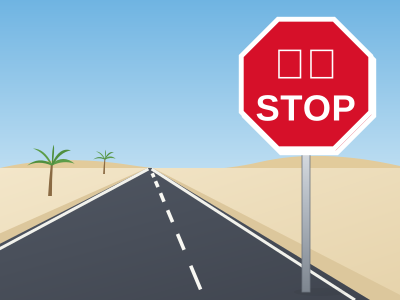
- AAt a STOP sign you must come to a complete halt; at a GIVE WAY sign you must yield but may proceed without stopping if it is safe.
- BA STOP sign means stop for exactly 3 seconds; a GIVE WAY sign means slow to 20 km/h.
- CA GIVE WAY sign requires a full stop; a STOP sign only requires slowing.
- DBoth signs require a complete stop before proceeding.
Answer and explanation in the bank
- Q22Right of way
You approach a STOP sign at night and the road appears completely empty. Must you still stop?
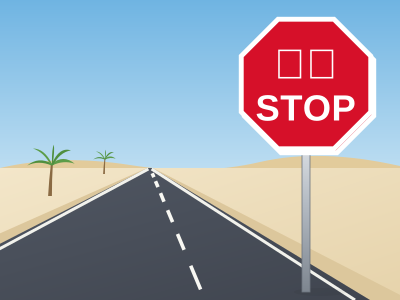
- ANo; you may proceed slowly if the road is clearly empty.
- BOnly if the stop line is painted and clearly visible.
- COnly if other vehicles are present.
- DYes; a STOP sign always requires a complete halt, regardless of conditions.
Answer and explanation in the bank
Every answer above, with the rule it comes from, plus the full 22-question timed test.
Get the Bahrain Driving Test Questions - BHD 3What this test covers
Topics include road signs, traffic signals, right of way, roundabouts, speed limits, seat belts, fines and penalties, and the safe-driving rules specific to your vehicle category. Full question-by-question feedback with explanations is shown immediately after you finish the test above.
Frequently asked questions
How many questions is the Northern General Directorate of Traffic light vehicle theory test?
The official General Directorate of Traffic light vehicle theory test in Northern has 35 questions and you need 26 correct (75%) to pass. This practice test has 22 questions.
Is this the real exam?
These are practice questions to help you revise, written to the published rules and to what candidates report from the real test. They are not the official Bahrain exam and the real question bank, format, fees and pass mark are set by the General Directorate of Traffic (Ministry of Interior), and can change. Always confirm the current requirements with your driving school or the traffic department.
Is this practice test free?
The first 10 questions are free, with no signup, and each shows the answer and the reason. The full 22-question test, timed, is in the Bahrain Driving Test Questions PDF (BHD 3, one payment), with every question in the bank.
What does the Northern light vehicle theory test cover?
Road signs, traffic signals, right of way, roundabouts, speed limits, seat belts, penalties and safe-driving rules, plus the handling and safety topics specific to your vehicle.