In This Guide
- Quick answer: what PACI does and how to renew
- PACI's role: why it matters beyond just the card
- Three Kuwait residents, three Civil ID stories
- Renewing online via Sahel app (step by step)
- How to check your Civil ID status
- Home delivery: how to request it
- Kuwait Mobile ID app: the legal alternative to carrying the card
- The address update requirement: a frequent gotcha
- Expired Civil ID: what the consequences are
- Civil ID renewal for dependents
- Edge cases and special situations
- Common problems and fixes
- Need help with your Kuwait Civil ID or residency paperwork?
Quick answer: what PACI does and how to renew
Last verified: July 2026 against MOI Kuwait and PACI service information.
The Public Authority for Civil Information (PACI) at paci.gov.kw issues and renews Civil IDs for everyone in Kuwait, citizens and residents alike. As a resident, you renew your Civil ID through the Sahel app or the PACI online services portal at services.paci.gov.kw.
The fee, settled
The confusion you may see online between KWD 5 and KWD 2 resolves simply: the Civil ID smart card renewal fee is KWD 5, and the KWD 2 is a separate, optional home-delivery fee paid after the card status shows "Ready." They are two different charges, not two versions of the same fee. The amount shown at the KNET payment step is the authoritative figure for your specific transaction; if something looks off, call PACI on 1889988 before paying.
Processing typically takes 3-10 working days. For Kuwait residency (iqama) fees and the December 2025 changes that affect renewals priced alongside the Civil ID, see the iqama section later in this guide. For other Kuwait services, see our Kuwait national ID services page.
This guide walks through every step of the Sahel and PACI portal flows, the Kuwait Mobile ID as a card alternative, three persona scenarios covering on-time renewal, delivery delays, and an expired card alongside an expired iqama, plus the eight categories of blocker we see most often.
PACI's role: why it matters beyond just the card
PACI (Public Authority for Civil Information) is the civil registry authority for Kuwait. It is not just about the physical card. PACI maintains the underlying civil record linked to your Civil ID number, which is the master reference for employment, banking, government services, healthcare, and increasingly the private sector (telcos, utilities, payments).
When your Civil ID expires, your record is still there. But an expired card creates practical problems: banks, employers, and government offices regularly ask to see a current, valid card. Some services require it for authentication. Keeping the card current is effectively mandatory for day-to-day life in Kuwait.
PACI vs MOI: the division of labour
It is worth distinguishing PACI from MOI. PACI handles civil identification (the Civil ID itself, the underlying personal data record). MOI handles residency permits (iqama), traffic, and security functions. These two are linked but separate, and a problem with one can stall the other. A common confusion: the Civil ID renewal and the iqama renewal are different transactions with different fees and different portals (Sahel app for PACI, MOI services for iqama).
PACI services are accessible through the PACI portal and through the Sahel app, Kuwait's main government services app. The Sahel Kuwait portal is the recommended route for most residents in 2026.
Three Kuwait residents, three Civil ID stories
Three scenarios with the actual costs and steps that played out.
Persona 1: Linda, smooth Sahel renewal
Linda works in finance in Kuwait City. Her Civil ID expires 30 May 2026. She opens Sahel on 1 May, navigates to PACI Services, selects Renew Civil ID, confirms her address (unchanged), and pays via KNET. The portal shows KWD 5. New card is ready 8 May. She requests home delivery (KWD 2). Card arrives 12 May. Total cost: KWD 7. Total touch time: about 15 minutes across two sessions on her phone.
Persona 2: Ahmed, address mismatch blocker
Ahmed moved from Salmiya to Hawally in January 2026 and did not update his address with PACI. His Civil ID expires 1 June. On 25 May he tries to renew via Sahel and the flow errors at step four with "address mismatch." He realises he needs to update the address first. He uses Sahel's PACI Services - Update Residence Address feature with a copy of his new tenancy contract. Address change processes in two days. He retries the renewal on 28 May and it goes through smoothly. KWD 5 renewal + KWD 2 delivery + zero late fees because he caught it inside the validity window. Total cost: KWD 7. Lesson: address updates are the most common silent blocker; resolve before initiating renewal.
Persona 3: Saif, expired Civil ID and iqama together
Saif's Civil ID expired 1 February 2026 alongside his iqama. He moved jobs mid-2025 and the renewal flow stalled when his new employer's PRO went on extended leave. By 1 June 2026 (120 days past expiry), he discovers his bank has frozen his account and his car insurance auto-renewal failed because the linked Civil ID was expired. Kuwait does not publish a single confirmed daily fine rate for expired Civil IDs in officially accessible 2026 sources, but the practical consequences are severe. He needs to: confirm exact current Civil ID fee at services.paci.gov.kw, renew the iqama through MOI (which is the new KWD 20/year employee rate effective 23 December 2025), then renew the Civil ID. Estimated bill: KWD 20 iqama + KWD 5 Civil ID + KWD 2 delivery = KWD 27 before any MOI fine on iqama overstay. The harder cost is the frozen banking, the cancelled insurance and the conversation with the new employer. Lesson: PACI and MOI are separate but interdependent; lapse one, you sabotage the other.
Renewing online via Sahel app (step by step)
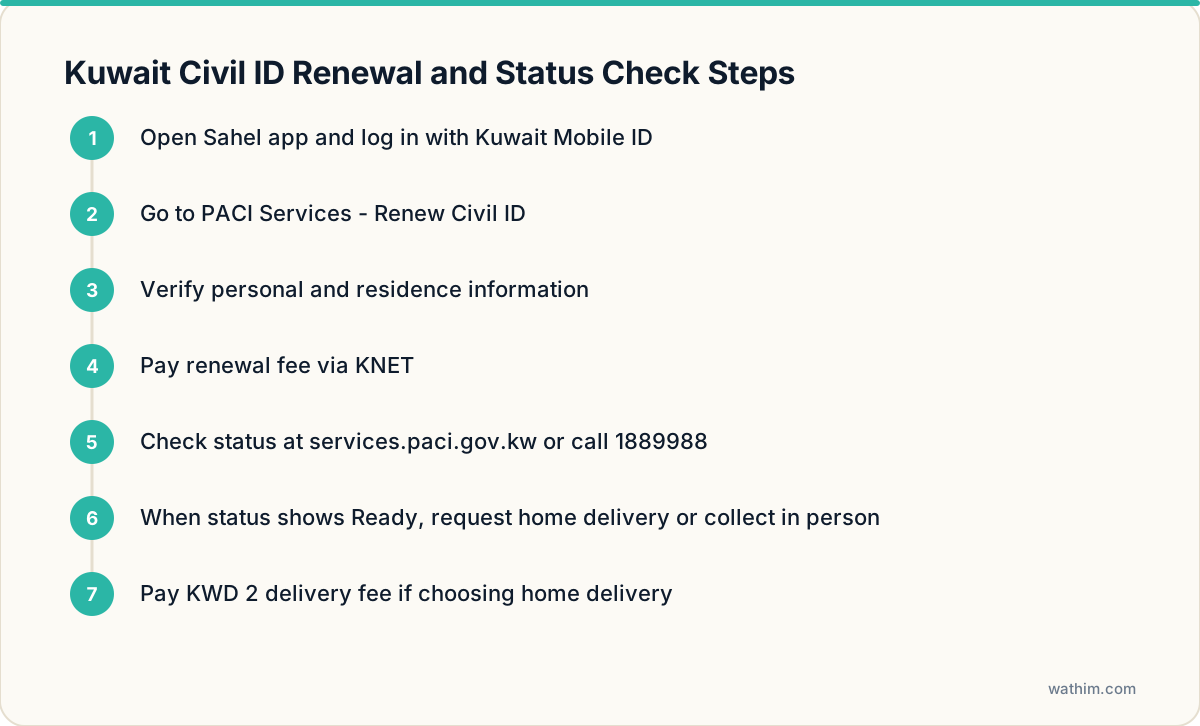
The Sahel app is Kuwait's official government services app and the fastest way to renew your Civil ID:
- Download the Sahel app from the Play Store or App Store. Confirm the publisher is the official Kuwait Government / e-Government Authority.
- Log in using Kuwait Mobile ID. Kuwait Mobile ID is the national digital identity system, linked to your Civil ID number and registered phone. If you do not have Kuwait Mobile ID set up, you will need to do that first at a PACI office or through the Sahel app setup flow (biometric capture is required).
- Navigate to PACI Services then Renew Civil ID.
- Verify your personal and residence information. If your address has changed, update it before proceeding (see the address section below).
- Pay the renewal fee via KNET. KNET is Kuwait's domestic card payment network, accepted for all government service payments. The amount shown is the authoritative figure for your transaction; this is the moment to resolve the KWD 5 vs KWD 2 question for your specific case.
- Receive a confirmation and an application reference number. Your card will be processed within 3-10 working days.
- Monitor the status at services.paci.gov.kw or call 1889988. When status shows "Ready," arrange collection or request delivery for an additional KWD 2.
The PACI website at services.paci.gov.kw provides the same service in a browser if you prefer not to use the app. Log in with your Civil ID number and Kuwait Mobile ID credentials. The browser flow is often easier for residents with two or more dependents to renew at the same time.
When the app is the better tool
Sahel is better for: status notifications via push, fingerprint/face-ID re-authentication during the flow, on-the-go delivery requests. The PACI website is better for: bulk dependent renewals, uploading higher-quality document scans, and complex address changes that need an in-person follow-up booking.
How to check your Civil ID status
Checking your Civil ID application or card status takes about 30 seconds:
- Online: Go to services.paci.gov.kw, find the Civil ID Status Inquiry service, and enter your 12-digit Civil ID number. Status shows instantly.
- Hotline: Call 1889988 (PACI direct line). Have your Civil ID number ready. Available during PACI working hours.
- Sahel app: Under PACI Services, the status of your latest application is displayed on the main screen after login. Push notifications fire when status changes.
What each status means
| Status | Meaning | Next step |
|---|---|---|
| Under Process | Card is being produced | Wait; standard 3-10 working days |
| Ready | Card printed and waiting for collection/delivery | Request delivery (KWD 2) or collect from PACI South Surra |
| Collected | Card has been picked up or delivered | None |
| Expired | Card validity has passed | Initiate renewal immediately |
| Rejected / Hold | Application has been flagged | Call 1889988 for reason and remediation |
If status is Ready, do not wait too long to collect or request delivery. Cards sit in the queue for a limited period before the application status resets and you may need to refile.
Home delivery: how to request it
PACI offers a home delivery service for Civil ID cards that avoids a trip to the South Surra office. Here is how it works:
- Wait for your card status to show "Ready" at services.paci.gov.kw or on the Sahel app.
- Log in to services.paci.gov.kw or the Sahel app.
- Select the Card Delivery service under PACI Services.
- Confirm your delivery address. The address must match your registered residence in the PACI database; the delivery service does not accept arbitrary addresses (no offices, no relatives' homes unless registered).
- Pay the KWD 2 delivery fee via KNET.
- The card is delivered within a few working days after the delivery request is placed.
Collection alternative
You can collect in person from the PACI South Surra office. Bring your original passport for verification. Some smart kiosks around Kuwait also allow card collection, though availability varies and some kiosks are restricted to specific transaction types. The kiosks are useful if you live near a major mall or government complex; the South Surra office is the universal fallback.
Delivery taking longer than expected
If you requested delivery and the card has not arrived after five working days, call 1889988. The most common cause is an address mismatch between your PACI record and the delivery address you entered. Confirm both are identical and resubmit if needed.
Kuwait Mobile ID app: the legal alternative to carrying the card
Since 2023, the Kuwait Mobile ID app has been accepted as a legally valid alternative to the physical Civil ID card for most purposes in Kuwait. This means you can verify your identity at government offices, banks, and many private sector interactions using the app on your smartphone.
How to use it
Download the Kuwait Mobile ID app, register with your Civil ID number and biometric verification (fingerprint or face ID, depending on phone). The app generates a QR code linked to your live civil record. Scanning the QR code at any compatible reader (MOI, PACI, many banks, telcos) pulls your verified identity directly from the database.
When the physical card is still needed
The app does not replace the physical card entirely. Some situations still require the physical card:
- Certain banking procedures, especially account opening at branches.
- Some travel-document interactions, especially land border crossings.
- Some older government offices that have not deployed QR readers.
- Property transactions at the Ministry of Justice.
But for daily government service interactions, the app has genuinely reduced the urgency of carrying the physical card at all times. Many residents now keep the physical card at home and use the app on the go.
A related note: iqama fees changed in December 2025
Kuwait iqama (residency permit) fees were raised significantly in December 2025. For private/government-sector employees the fee is now KWD 20 per year. Investors pay KWD 50/year, and self-sponsored residents pay KWD 500/year. Dependents pay KWD 20 per person per year. Domestic workers under Kuwaiti-family sponsors pay KWD 10/year, with higher reported rates for additional helpers and for expat sponsors. If you are renewing your iqama alongside your Civil ID, factor these into the budget. See the note in the Kuwait services hub and the linked family sponsorship guide.
The address update requirement: a frequent gotcha
Kuwait requires the address on your Civil ID to match your actual registered residence. This is enforced more actively than in some other GCC countries, especially since PACI tightened its address linkage rules. If you have moved since your last Civil ID renewal and have not updated your address, the renewal may stall or produce an error at step four of the Sahel flow.
How to update your address before renewal
- Through the Sahel app under PACI Services - Update Residence Address.
- At a PACI office in person (South Surra is the largest).
- For employer-provided accommodation, an employer letter on letterhead confirming the address.
Address update requires a tenancy contract or a letter from your landlord, plus your Civil ID and passport. For employer-provided accommodation, the employer letter typically suffices. Processing is usually 1-2 working days.
Why this is enforced
Kuwait uses the registered address for census, voting (citizens), service delivery, and emergency response. An incorrect address means government correspondence goes nowhere and certain services (mostly utility and licensing) get delayed. PACI takes the enforcement seriously and has reduced tolerance for mismatched records over the past three years.
Get the address updated first. Trying to renew with an outdated address is one of the most common reasons the online flow fails silently at step four with a generic error.
Expired Civil ID: what the consequences are
Unlike some Gulf countries, Kuwait does not publish a clear daily fine rate for expired Civil IDs in officially accessible 2026 sources. The Kuwait iqama overstay rate is also unconfirmed in current sources, which is one of the genuinely under-documented areas of Kuwait residency law. What is well-documented is that an expired Civil ID creates practical blocks rather than predictable financial penalties.
Practical consequences of an expired Civil ID
- Banks freeze or restrict account access and cannot process new transactions requiring identity verification. KYC re-checks fail.
- Government services including PACI, MOI, and Ministry of Health transactions are blocked or severely limited.
- Employers may flag expired cards through payroll systems and request immediate renewal; some employers withhold the next salary credit until the card is current.
- Insurance renewals (car, health, home) that auto-link to your Civil ID can fail at policy roll-over, leaving you uninsured.
- Telco contracts may not renew or upgrade until KYC is current.
- Travel: while the passport is the primary travel document, some land borders reference the Civil ID number, and ferry tickets often check it.
Worked example: car insurance auto-renewal failure
Imagine your car insurance auto-renews on 1 March and your Civil ID expired 1 February. The insurer's KYC sweep on 28 February fails because the Civil ID is past validity. The policy lapses 1 March. You have an accident on 5 March: you are personally liable for damages because you were uninsured. Repair cost KWD 1,500 plus third-party claims. The cost of letting the Civil ID lapse compounded into a four-figure expense unrelated to the renewal fee itself.
Practical advice
Renew before it expires. There is no reported grace period equivalent to Qatar's 90-day window. Renewal can be done up to three months before the expiry date, so you can start early with no penalty. If your Civil ID has been expired for a long time alongside an expired iqama, both need addressing in the right order: typically iqama first (through MOI), then Civil ID (through PACI). Speak to your PRO or contact Wathim to sort both together.
Civil ID renewal for dependents
Dependents (spouse and children) each have their own Civil ID number and their own renewal cycle. The primary sponsor is responsible for initiating dependent renewals through PACI. The process mirrors the main resident renewal: Sahel app, PACI portal, or in-person at a PACI office.
Children under 18
For children under 18, the parent or legal guardian handles the renewal. Children born in Kuwait are issued a Civil ID at birth registration; the hospital usually initiates the application during the birth-registration step, so the card is ready within weeks of birth. Children born abroad who join the family in Kuwait need a new Civil ID application after the residency permit is issued through MOI.
Family sponsorship salary threshold
For the financial requirements to sponsor family members in Kuwait, the minimum salary threshold was raised: you need KWD 800 per month to sponsor a spouse and children. This is verified by PACI and MOI when processing dependent permits. The KWD 800 threshold is enforced strictly; if your salary drops below this mid-residency, dependent renewals may be flagged for additional review or denied. For more detail on GCC-wide family sponsorship thresholds, see our family sponsorship salary guide.
Worked example: family renewal sequence
Linda (the persona from earlier) has a husband and two children as dependents. The optimal sequence: she renews her own Civil ID first, confirms the address is correct across all family records, then renews each dependent through her account on the Sahel app. Four KWD 5 renewals + delivery is roughly KWD 28 if KWD 5 applies across all and she delivers separately, or less if she requests batch collection at the South Surra office. The iqama renewals run through MOI separately for KWD 20/dependent/year on the new December 2025 schedule.
Edge cases and special situations
Lost or stolen Civil ID
Report immediately at any PACI office or through Sahel. A replacement is issued for a fee (separate from renewal). The old card is invalidated in the system immediately; anyone trying to use it for KYC will fail. Until the replacement arrives, the Kuwait Mobile ID app covers most daily interactions.
Name change (marriage, deed poll)
Update your passport first with the new name, then update PACI records before renewing the Civil ID. If you renew the Civil ID under the old name after the passport has been updated, the documents diverge and create issues later for travel and banking.
Out of Kuwait at renewal time
You can start the renewal online while abroad if no biometric capture is required. If biometrics are needed (typically for a first-time renewal or after a long gap), you need to be in Kuwait. The application can sit pending until you return.
One hard limit under the December 2025 residency rules: your iqama now lapses if you stay outside Kuwait for more than 6 months (4 months for Article 20 domestic workers). A lapsed iqama takes the Civil ID down with it, so if you are on an extended stay abroad, plan a return trip inside that window or your renewal problem becomes a full re-entry and re-residency problem.
Name spelling mismatch with passport
A common issue for residents whose passport spelling differs from the Arabic-transliteration PACI record. This can block renewal if PACI cannot reconcile the two. Fix: visit a PACI office in person with both documents and request a correction to the underlying record before retrying the online renewal.
Domestic helpers
Domestic helpers have a separate sponsor-employer relationship under the Domestic Workers Department. Civil ID renewal still goes through PACI but the iqama process is different from standard employment. On the December 2025 schedule, the KWD 10/year rate applies to domestic workers sponsored by Kuwaiti families. For expatriate sponsors, reported figures describe a KWD 50/year base covering up to two helpers, then KWD 400/year for the first additional helper and KWD 500/year for the second additional; treat these expat-sponsor figures as reported rather than confirmed and verify with MOI before budgeting.
Renewal during sponsor transfer
If you are mid-transfer between employers (changing iqama sponsor), Civil ID renewal can stall because the underlying residency status is in flux. Complete the iqama transfer through MOI first, then renew the Civil ID. Doing them in parallel often results in one or both stalling.
Kuwait Mobile ID after phone change
Kuwait Mobile ID is paired to a specific device via biometrics and the SIM. If you change phones or transfer SIM, the app must be re-registered on the new device, which requires OTP to the registered mobile number. If that number has also changed, you need to visit a PACI office to update it first.
Civil ID for a newborn before naming finalisation
If you have a newborn and the legal name has not been finalised (some families wait for naming ceremonies), the Civil ID application can be filed with a placeholder and amended later. Discuss with PACI; do not just delay, because the 60-day window for newborn registration runs regardless.
Common problems and fixes
Kuwait Mobile ID login failing
Kuwait Mobile ID requires biometric setup (fingerprint or face ID) tied to your Civil ID. If you recently changed phones, you need to re-register on the new device. This requires OTP verification to your registered mobile number. If that number has changed, visit a PACI office to update it.
KNET payment declined
KNET payments occasionally fail if the transaction amount exceeds daily online limits set by your Kuwaiti bank. Call your bank to temporarily raise the limit or visit a PACI kiosk to pay in person using the same card.
Status showing "Ready" for a long time with no card delivered
If you requested delivery but it has been more than five working days, call 1889988. Delivery sometimes stalls if the address on file does not match what was entered in the delivery request. Confirm both addresses are identical.
Renewal blocked: "records not matching"
This typically means a discrepancy between your passport details (especially name spelling or date of birth) and the PACI record. Visit a PACI office in person to correct the underlying record before attempting the online renewal again. Bring both your passport and the existing Civil ID.
Fee amount shown differs from what was expected
The standard structure is KWD 5 for the Civil ID renewal itself plus an optional KWD 2 home-delivery fee; sources that quote "KWD 2" for renewal are usually conflating the delivery charge with the card fee. The amount shown during the KNET payment step in the app or portal is the authoritative current figure for your specific transaction. If you are unsure, call 1889988 before paying.
Sahel app crashing on biometric step
Common on older Android devices. Update the OS and the Sahel app to the latest version. If still crashing, use the browser route at services.paci.gov.kw on a desktop or laptop.
Iqama expired alongside Civil ID
Renew the iqama first through the MOI channels at the new December 2025 fees (KWD 20/year for standard employees), then the Civil ID. Trying to renew the Civil ID when the underlying iqama is expired produces silent errors.
Need help with your Kuwait Civil ID or residency paperwork?
Civil ID renewal sounds like a one-stop task but often surfaces underlying issues: address mismatches, outdated sponsor details, an iqama renewal that needs to happen at the same time, or KNET payment failures linked to bank-side limits. Wathim handles Kuwait residency and ID services for individuals and companies.
If you are dealing with a blocked renewal, an expired Civil ID plus an expired iqama, a Kuwait Mobile ID that will not re-register after a phone change, or you just want someone to handle the coordination so you do not have to chase PACI and your PRO at the same time, contact us.
Useful reading: GCC overstay fines compared, family sponsorship salary requirements, the certificate attestation guide, and the Kuwait services hub.
Run your numbers: confirm your end-of-service in our Kuwait indemnity calculator and any catch-up exposure in the Kuwait overstay fine calculator. Renewals, deliveries, and address changes now run through the Sahel app and the PACI portal; Kuwait Mobile ID is becoming the default sign-in.
Want this handled for you? Wathim runs Civil ID renewal in Kuwait end to end — brief the desk and we will take the filing, the follow-ups and the portal chasing off your plate.
Related reading: PAM Kuwait work permit guide.
Frequently Asked Questions
Use the Sahel app (log in with Kuwait Mobile ID, go to PACI Services then Renew Civil ID) or the PACI portal at services.paci.gov.kw. Pay via KNET. Processing takes 3-10 working days. You can request home delivery for a separate KWD 2 fee once the card is ready, or collect in person from the PACI South Surra office or compatible smart kiosks. The whole online flow takes about 15 minutes if your address and passport details are current in the PACI record.
The Civil ID smart card renewal fee is KWD 5. Home delivery is a separate, optional KWD 2 fee paid after the card status shows Ready; the two charges are often conflated online, which is where the KWD 5 vs KWD 2 confusion comes from. The amount shown at the KNET payment step is authoritative for your transaction. If in doubt, confirm on services.paci.gov.kw or call PACI on 1889988 before paying.
Go to services.paci.gov.kw and use the Civil ID Status Inquiry service with your 12-digit Civil ID number. The result shows instantly. You can also call PACI on 1889988 during working hours with your Civil ID number ready, or check via the Sahel app under PACI Services where status appears on the main screen with push notifications when it changes. The same statuses (Under Process, Ready, Collected, Expired) appear across all three channels.
Yes, the Kuwait Mobile ID app is legally accepted as a valid identity alternative at most government offices, banks, and private sector locations. It generates a QR code linked to your live civil record. Some situations still require the physical card: certain banking procedures (especially branch account opening), property transactions at the Ministry of Justice, some land border crossings, and offices that have not deployed QR readers. For day-to-day government and retail interactions the app is enough.
Banks restrict or freeze identity-dependent transactions, government service access is blocked or limited, employer payroll systems may flag the lapse, and insurance auto-renewals can fail because KYC checks reference the Civil ID. There is no widely published grace period equivalent to some other Gulf countries and the daily overstay fine rate is not confirmed in 2026 sources. The practical advice is to renew before it expires; you can start up to three months early without penalty.
Wait for the card status to show Ready at services.paci.gov.kw or in Sahel, then log in and select the Card Delivery service under PACI. Pay the KWD 2 delivery fee via KNET. Confirm your registered address matches where you want the card delivered; the delivery service only sends to the address registered in your PACI record. Delivery takes a few working days. If nothing arrives within five working days, call 1889988 and check the address match.
Common causes: outdated address in the PACI system (update via Sahel app first, then retry), name or date-of-birth mismatch between your passport and PACI record (needs an in-person correction at a PACI office), Kuwait Mobile ID login issues after a phone change (re-register the app), expired iqama upstream (renew the iqama through MOI first), or a passport with insufficient validity. Call 1889988 for the specific error code if the cause is not obvious from the step where the flow fails.
The iqama (residency permit) fee increase effective 23 December 2025 is a separate charge from the Civil ID renewal fee. Iqama renewal now costs KWD 20 per year for standard private/government employees, KWD 50/year for investors, KWD 500/year for self-sponsored residents, KWD 20 per dependent per year, and KWD 10/year for domestic workers under Kuwaiti-family sponsors (higher reported rates apply for expat sponsors and additional helpers). Civil ID renewal and iqama renewal are often coordinated by PROs at the same time, but they are separate fees, separate portals (PACI vs MOI), and separate processes.
Stuck on a Government Service Step?
Wathim publishes free plain-English guides to GCC visas, IDs, driving licences, attestation, and fines. If a fee table looks off or a step is missing, tell us and we will update the guide. You can also book a free guidance call with our GCC services desk.

Wathim Editorial
GCC Services Desk
The Wathim team writes plain-English guides to GCC government services. We track ICP, GDRFA, MOHRE, Absher, Muqeem, Qiwa, Metrash, LMRA, ROP Oman, and MOI Kuwait so expats can plan visa, residency, ID, and licence steps without guesswork.