In This Guide
- The thresholds at a glance, with the data conflict for Oman flagged honestly
- UAE: AED 4,000/month, housing rules that matter, and the unresolved parents threshold
- Saudi Arabia: SAR 4,000/month, higher for larger families, plus the dependent fee on top
- Qatar: QAR 10,000/month, or QAR 6,000 with employer housing for technical roles
- Kuwait: KWD 800/month, strictly enforced, accommodation proof required
- Bahrain: BD 400/month for spouse and children, BD 1,000 for parents
- Oman: OMR 150 to OMR 600/month, the genuine data conflict
- Salary proof: what immigration actually wants to see
- Housing requirements: what each country expects to see
- Sponsoring parents: the hard category across every GCC country
- What if you are below the salary threshold?
- Newborns abroad: getting them on the family visa cleanly
- Edge cases the standard guide skips
- Common problems and fixes
- Bring your family over without the back-and-forth
The thresholds at a glance, with the data conflict for Oman flagged honestly
Every GCC country requires the principal visa holder to earn above a minimum salary before they can sponsor family members. The thresholds differ significantly across the six countries, and one (Oman) has a genuine conflict between ROP's own page and press reports that no amount of research has resolved cleanly. Below is the most complete honest summary as of mid-2026.
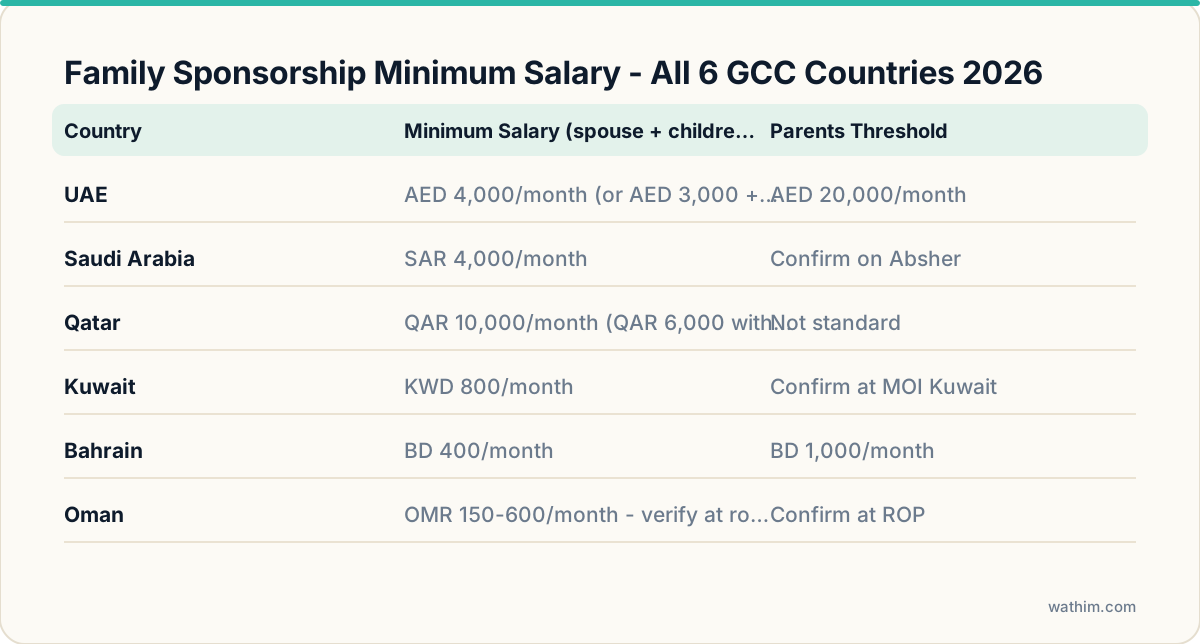
| Country | Minimum (spouse + children) | Key extra rules | Confidence |
|---|---|---|---|
| UAE | AED 4,000/month (or AED 3,000 + employer housing) | Parents: unresolved, AED 20,000 (or AED 19,000 + 2-bed) under a 2013 rule versus AED 10,000 on GDRFA Dubai's current page. Older guidance gave AED 10,000 for a woman sponsoring her husband; the current u.ae page sets no separate figure. | VERIFIED (spouse and children); PARTIAL (parents) |
| Saudi Arabia | SAR 4,000/month | SAR 5,000-7,000+ for 3-4+ dependants. Raised from SAR 3,500. | PARTIAL |
| Qatar | QAR 10,000/month (no housing); QAR 6,000/month (technical roles with employer housing) | QAR 5,000/month for family visit visas in technical/specialised professions. | VERIFIED |
| Kuwait | KWD 800/month | Raised from KWD 500 on 28 January 2024; strictly enforced from Dec 2025. | VERIFIED |
| Bahrain | BD 400/month (spouse + children) | BD 1,000/month to sponsor parents or adult children 24+. | VERIFIED |
| Oman | OMR 150-600/month (ROP's own page says OMR 600; OMR 150 is from 2023 press reports quoting an ROP official) | Genuine data conflict; verify at ROP before applying. | PARTIAL |
Sources: UAE multiple 2026 guides; Saudi Arabia Absher guidelines (partial); Qatar Fragomen + MOI clarification (verified); Kuwait Arab Times, Fragomen (verified); Bahrain Interior Minister statement + Gulf Daily News (verified); Oman ROP's own page vs 2023 press reports (conflicting; see Oman section).
The structural read across the GCC: thresholds rose almost everywhere in the last 24 months. Kuwait went from KWD 500 to KWD 800. Bahrain restructured parents-sponsorship to BD 1,000. Saudi Arabia's floor moved from SAR 3,500 to SAR 4,000. Qatar's QAR 10,000 has been steady but the QAR 6,000 housing-tied lower band is increasingly relied on. Plan for higher thresholds, not lower; the historical direction is one-way.
UAE: AED 4,000/month, housing rules that matter, and the unresolved parents threshold
The UAE threshold for sponsoring a spouse and children is AED 4,000 per month. If your employer provides accommodation, the salary floor drops to AED 3,000 per month; the housing benefit counts as part of the qualifying package.
Sponsoring parents
Sponsoring parents in the UAE requires a higher threshold, and the figure is unresolved: AED 20,000 per month, or AED 19,000 with a minimum 2-bedroom home, under a 2013 rule that is still widely repeated, against AED 10,000 with a suitable tenancy and an AED 5,000 guarantee on GDRFA Dubai's current parents category, under its humanitarian residence service. We cannot reconcile the two; confirm with ICP or GDRFA before planning around either. Parents are one of the hardest categories to sponsor in the UAE, and many expats with comfortable salaries do not meet it. The de-facto practical route for most families is extendable family visit visas rather than long-term residency.
Women sponsoring a husband
Older guidance, from an archived u.ae page, gave AED 10,000 per month (or AED 8,000 with accommodation) for a woman sponsoring her husband. The current u.ae family page, updated 28 September 2026, sets no separate figure: it says employees can sponsor their families regardless of job title at AED 4,000, or AED 3,000 with accommodation. Many guides still repeat the old figure, so confirm with ICP or GDRFA before assuming either.
Worked example: UAE family of four
Vikram, a senior accountant, earns AED 18,000/month including allowances and employer-provided villa accommodation. He wants to sponsor his wife and two school-age children. The AED 4,000 threshold (or AED 3,000 with housing) is comfortably exceeded. Documents needed: salary certificate, tenancy contract or employer accommodation letter, attested marriage certificate, attested birth certificates for the children, medical fitness clearances, health insurance for each family member.
- Visa fees per family member: AED 1,000-1,500 typical
- Medical fitness per family member: AED 250-500
- Health insurance per family member per year: AED 1,500-5,000 depending on plan
- Emirates ID per family member: approximately AED 370
- Total cash outlay for the first year of family residency: roughly AED 15,000-25,000 excluding the underlying ICP/GDRFA service fees on the principal residence
How to apply
- ICP Smart Services portal for non-Dubai emirates
- GDRFA portal for Dubai-issued visas
- WPS-registered salary payments are the strongest proof of qualifying income
- The UAE family sponsorship service handles the full application end-to-end
Saudi Arabia: SAR 4,000/month, higher for larger families, plus the dependent fee on top
Saudi Arabia's minimum family sponsorship salary is SAR 4,000 per month for a standard family (spouse plus children). This was raised from the previous SAR 3,500 floor; confirm the current figure at Absher or with HR, as exact thresholds for specific situations can differ from published general guidelines.
Sliding scale for larger families
For larger families (3-4 or more dependants), the threshold reportedly increases to SAR 5,000-7,000+. The exact sliding scale for additional dependants is not officially published in a single source; ask the Jawazat office or check Absher for your specific eligibility.
The dependent fee compounds the picture
Saudi Arabia is unique in the GCC for charging an ongoing monthly dependent fee on top of the salary qualification. The dependent fee is SAR 400 per dependent per month (SAR 4,800 annually), paid by the expatriate sponsor through Absher or SADAD. Children are not exempt: Jawazat clarified in January 2018 that a wife, sons under 18 and all daughters count as dependants (Arab News, 2 January 2018). A family of four (wife and two children) is SAR 14,400 a year in dependent fees alone, on top of the salary requirement that gates the visa in the first place. See our Saudi dependent fee guide for the full mechanics.
Documents typically required
- Valid iqama with at least 3 months remaining
- Salary certificate from employer
- Attested marriage certificate (for spouse)
- Attested birth certificates (for children)
- Medical fitness certificates for all family members
- Health insurance for sponsored family members
- Saudi national address registered in Absher
Worked example: Saudi family of four
Saleem earns SAR 12,000/month at a Riyadh logistics company. His wife, son (12) and daughter (15) are all dependants paying SAR 400/month each; children are not exempt.
- Visa application processing: standard government fees through Absher
- Family iqama renewal annually: SAR 500 per adult dependant + Absher service fees
- Dependent fee: 3 x SAR 400 x 12 = SAR 14,400 per year
- Family health insurance: SAR 5,000-8,000 typical for the four lives
- Annual ongoing family cost (post-visa): roughly SAR 20,000-25,000
Apply via Absher (Individuals) under Family Services. The Saudi family sponsorship service assists with the full process.
Qatar: QAR 10,000/month, or QAR 6,000 with employer housing for technical roles
Qatar has one of the highest family sponsorship thresholds in the GCC. The standard requirement is QAR 10,000 per month. If the employer provides family housing recorded in the employment contract, the threshold drops to QAR 6,000 per month for private-sector employees in technical or specialised roles. There is a third, lower category: QAR 5,000 per month applies for family visit visas (not full residency sponsorship) in technical and specialised professions.
What counts as salary in Qatar
The MOI criteria (December 2023) state the QAR 10,000 and QAR 6,000 figures but do not say whether they mean basic or total salary. Applying them to basic salary is reported practice, not a published rule. On that reading, housing allowance, transport allowance and bonuses do not count, and a worker earning QAR 8,000 basic plus QAR 3,000 housing allowance may be treated as below the threshold despite a total package of QAR 11,000. Get your contract and salary certificate to itemise each component.
Why the threshold is high
Qatar's relatively high threshold means a significant portion of the expatriate workforce, particularly lower-income construction and service-sector workers, cannot sponsor families to live in Qatar. This is part of Qatar's deliberate workforce-management policy and is not expected to be relaxed materially in the near term.
Worked example: Qatar family of three on the housing-tied threshold
Ali is a mechanical engineer at a Qatari oil services company. Basic salary QAR 7,500; employer provides company accommodation. He sits below the QAR 10,000 main threshold but above the QAR 6,000 housing-tied threshold.
- Eligibility: yes, on the QAR 6,000 technical-role-with-housing route
- Documents: company accommodation letter (mandatory), attested marriage certificate, attested birth certificate for the child, salary certificate showing basic of QAR 7,500
- QID renewal for spouse and child: QAR 500/year each (1-year option) or QAR 900/year each (3-year option)
- Health card: QAR 100/year for each family member (non-Qatari expat rate)
- Family processing typically takes 4-8 weeks once the principal's QID is current
How to apply
The application process in Qatar is employer-mediated for most workers. The employer initiates the family visa application through the MOI Qatar portal. Workers in free zones may have a different process depending on their zone authority. See our Qatar family sponsorship service for the current document list and processing timeline.
Kuwait: KWD 800/month, strictly enforced, accommodation proof required
Kuwait raised its family sponsorship minimum salary to KWD 800 per month, up from the previous KWD 550. The increase was widely reported and is considered strictly enforced; Kuwait's immigration authorities check salary documentation carefully and the KWD 800 figure is not negotiable in practice.
What KWD 800 actually is
KWD 800 converts to approximately USD 2,600/month or AED 9,500/month at mid-2026 exchange rates, making it one of the higher effective thresholds in the region when converted. Few entry-level expatriate roles in Kuwait reach this level; the threshold effectively limits family sponsorship to mid-career professionals.
Kuwait-specific rules
- The sponsor must hold a valid residence (iqama) with at least 3 months remaining
- Housing: Kuwait immigration requires proof of adequate accommodation, typically a tenancy contract with sufficient rooms for the family size
- The sponsor's sector matters: government employees sometimes face different rules than private sector workers; confirm at the PACI portal or MOI Kuwait
- Dependent visa fees rose to KWD 20/year per dependant from 23 December 2025
- Family-join non-spouse/non-children categories: KWD 200/year
Worked example: Kuwait family of four
Rashid earns KWD 950/month as a mid-level finance professional at a Kuwaiti bank. He wants to sponsor wife and two children.
- Eligibility: yes, exceeds KWD 800 with margin
- Annual residence renewal for the family: 4 x KWD 20 = KWD 80/year
- Civil ID renewals: approximately KWD 5 each per cycle (5 years validity in most cases)
- Health insurance for family: KWD 50-100/person/year private; mandatory MoH expat fees also apply
- Tenancy contract: typically a 2-bedroom in Hawally or Salmiya costs KWD 300-450/month rent, separate from sponsorship qualification but required as proof
- Annual family residency upkeep: roughly KWD 400-600 in government fees plus rent
How to apply
Applications go through the MOI Kuwait family visa system, increasingly via the Sahel app. The Kuwait family sponsorship service covers the full application process. Verify your specific salary calculation method with HR before assuming you qualify, particularly for variable-pay roles.
Bahrain: BD 400/month for spouse and children, BD 1,000 for parents
Bahrain's threshold for sponsoring a spouse and children is BD 400 per month, the lowest among the GCC countries in nominal terms and verified from the Interior Minister's official statement. This is a genuine threshold, not a floor that immigration officers ignore in practice.
The BD 1,000 layer for parents and adult children
For sponsoring parents or adult children aged 24 and over, Bahrain requires a higher salary of BD 1,000 per month. The BD 400 threshold applies specifically to the immediate nuclear family unit (spouse and minor children). The BD 1,000 layer is a relatively recent addition to Bahraini sponsorship rules.
Practical Bahrain notes
- Documents must be attested; marriage and birth certificates go through the Bahrain attestation chain (or apostille, since Bahrain is a Hague member)
- Proof of accommodation is required: a tenancy agreement in the sponsor's name
- Health insurance for family members is mandatory
- CPR (Central Population Register) cards are issued to family members; renewed alongside the work permit cycle
Worked example: Bahrain family of three
Mariam, a teacher, earns BD 550/month at a Manama international school. She wants to sponsor husband and 4-year-old child.
- Eligibility: yes, exceeds BD 400 with margin
- Marriage and birth certificates: apostilled in home country (Bahrain accepts apostille); Arabic translation by Bahrain-approved translator
- Tenancy contract: 2-bedroom apartment in Adliya BD 350-500/month
- CPR cards for spouse and child: nominal fee at IGA; confirm at iga.gov.bh
- Family health insurance: BD 150-400 per person per year typical
- Family visa fees through Bahrain eGov: approximately BD 50-100 per family member
Sponsoring parents in Bahrain
If Mariam's salary were BD 1,100/month, she could also sponsor her elderly mother in Bahrain. Below BD 1,000 the parents route is closed; only the spouse-and-children option is available.
Apply through the Bahrain eGovernment portal (bahrain.bh) or via LMRA for work-related family connections. The Bahrain family sponsorship service handles document preparation and application submission.
Oman: OMR 150 to OMR 600/month, the genuine data conflict
Oman's family sponsorship threshold has a genuine data conflict that we cannot resolve here without an official clarification. ROP's own Family Joining Visa page states OMR 600 per month, with a senior job by GCC standards (checked October 2026). OMR 150 per month comes from February 2023 press reports quoting a senior ROP official; no decision number was cited and ROP has issued no formal statement.
What this likely means
The high figure is the one on the official page. The plausible explanations for the gap are that the OMR 150 cut applied to a narrower category, that it was never written onto the main family joining visa page, or that ROP has not updated its page. We do not know which, so plan against OMR 600.
Our recommendation
Do not assume you can sponsor family on OMR 150/month without first confirming with the ROP portal directly or calling the ROP helpline. If you earn between OMR 150 and OMR 600, an in-person or phone inquiry to ROP is essential before starting the application; the cost of a wrong assumption is the rejected application fee, time lost, and family planning disrupted. We will not invent a number to fill this gap; the risk is too high for your household.
Worked example: Oman family of three at OMR 700/month salary
Sanjay earns OMR 750/month as a mid-level IT professional in Muscat. He wants to sponsor wife and one young child.
- Eligibility under ROP's published figure (OMR 600): clear with margin
- Eligibility under the 2023 press-reported figure (OMR 150): clearly exceeded
- Resident cards for spouse and child: OMR 5/year each under the November 2025 reform
- 10-year card option: OMR 50 per dependant per decade
- Health insurance for family: OMR 200-500 per family per year typical
- Tenancy: 2-bedroom apartment in Al Khuwair OMR 250-400/month
If you earn between OMR 200 and OMR 599
This is the danger zone. The 2023 press reports say you qualify; ROP's own page says you do not. Concrete steps: call ROP and ask for written confirmation; arrange a Sanad centre consultation to confirm in person; consult with the Oman family sponsorship service for a current-case read before committing to documents and fees.
The full Oman resident card mechanics, including the 10-year validity and OMR 10/day overstay rule, are in our Oman resident card renewal guide.
Salary proof: what immigration actually wants to see
Meeting the salary threshold on paper is not always enough. How you prove that salary matters, and there are common traps.
WPS and electronic salary records
All six GCC countries now run a Wage Protection System: Qatar and Kuwait enacted theirs in 2015, Oman launched in July 2023, and Bahrain made it mandatory for all private employers from February 2026. Salaries processed through WPS create an automatic electronic record that immigration authorities can verify. A WPS salary record is stronger proof than a salary certificate. Workers paid outside WPS (cash, informal arrangements) face much harder verification challenges.
Contract vs actual salary
Your employment contract may show a base salary below the threshold even if your total package (allowances, housing, transport) is above it. Some countries count total package; others count base only.
- UAE: Counts total package including allowances
- Qatar: reported to apply the QAR 10,000 threshold to basic salary; the published MOI criteria do not say
- Saudi Arabia: Usually basic salary; specific allowances may count case by case
- Kuwait: Strict on basic salary; KWD 800 is the basic salary figure
- Bahrain: Total package generally counted
- Oman: Practice varies; ask at ROP
Bank statements
All six GCC countries will ask for recent bank statements (typically 3-6 months) showing salary credits. Irregular or missing credits raise flags. If you have months where salary arrived late or in an unusual format, prepare an explanation letter from your employer.
Recent pay cut or salary change
If your salary recently dropped to near the threshold level due to a pay cut or job change, some countries will ask for a longer salary history or a letter confirming the current salary is stable and ongoing. A single month above the threshold is not always sufficient; immigration officers sometimes look at the pattern.
Variable pay and commissions
Commission-heavy or bonus-heavy compensation structures are harder to prove for sponsorship purposes. Where possible, ask HR to confirm a fixed monthly minimum that exceeds the threshold; that anchors the qualification regardless of variable pay swings.
Housing requirements: what each country expects to see
Most GCC countries require the sponsor to prove they have adequate housing before family members can join. What counts as adequate varies.
| Country | Housing requirement | What counts |
|---|---|---|
| UAE | Tenancy contract in sponsor's name | Studio or 1-BR minimum for spouse; 2-BR minimum for parents sponsorship |
| Saudi Arabia | Saudi national address registered in Absher | Any registered residential address |
| Qatar | Tenancy contract, or family housing provided by the employer | Employer family housing recorded in the employment contract unlocks the QAR 6,000 threshold for technical roles |
| Kuwait | Tenancy contract with sufficient rooms | Bedrooms must reasonably accommodate family size; assessed by immigration |
| Bahrain | Tenancy contract or property ownership | Sponsor's address must be in their name |
| Oman | Tenancy contract or ownership | Address registered with municipality |
What does not count
Living in employer-provided shared accommodation (common in construction and hospitality sectors) typically does not qualify for family sponsorship. Your own separate accommodation is usually required. Even if you have a sponsorship-qualifying salary, sharing a labour camp room with three other workers does not unlock family sponsorship in most GCC countries.
The Qatar housing-allowance trick
Qatar's QAR 6,000 lower threshold for technical roles requires family housing provided by the employer and recorded in the employment contract, not just a housing allowance line on your salary slip; a separate HR letter may not be enough if the contract does not show it. If your employer pays you a housing allowance and expects you to find your own accommodation, you are on the QAR 10,000 main threshold, not the QAR 6,000 lower one. The accommodation must actually be provided in kind.
Sponsoring parents: the hard category across every GCC country
Bringing parents to live with you in the GCC is significantly harder than sponsoring a spouse and children. Every GCC country either requires a much higher salary or effectively makes parents ineligible under standard residence rules.
| Country | Parents sponsorship rule | Practical reality |
|---|---|---|
| UAE | Unresolved: AED 20,000/month (or AED 19,000 + 2-BR housing) under a 2013 rule, versus AED 10,000 with a suitable tenancy and an AED 5,000 guarantee on GDRFA Dubai's current page | Confirm with ICP or GDRFA; visit visas are the common route |
| Saudi Arabia | Reportedly SAR 7,000+ for families including parents; not officially published as a single tier | Confirm at Jawazat for your specific situation |
| Qatar | Parents not routinely sponsored under standard family visa | Visit visas the practical route; check MOI for current rules |
| Kuwait | Parents sponsorship exists but requirements strict | Confirm at MOI Kuwait |
| Bahrain | BD 1,000/month required | Achievable for mid-career professionals |
| Oman | Confirm at ROP given the existing threshold conflicts | Treat as case-by-case |
The visit-visa workaround
For extended visits (not permanent sponsorship), most GCC countries offer visit visas with multiple extendable periods. This is the practical route for most expats who want to have elderly parents nearby for a few months each year without meeting the permanent sponsorship threshold. UAE in particular has matured visit-visa products that allow parents to stay 60-180 days at a stretch with renewable extensions.
Insurance is the hidden complication
Most parents-sponsorship cases stall on health insurance, not on salary. Insuring elderly relatives at GCC standards is expensive, and many private insurers either decline above a certain age or charge premium rates that exceed the visa fees by an order of magnitude. Budget AED 10,000-30,000 per year per elderly parent for credible insurance coverage in UAE; rates in other GCC countries are similar.
What if you are below the salary threshold?
Being below the salary threshold does not mean your family cannot visit or stay temporarily. Options exist.
- Visit visas: Family members can enter on tourist or visit visas and extend them. In UAE, visit visas can be extended multiple times. In Qatar, family visit visas have a lower income threshold (QAR 5,000 for technical workers). Works for extended stays but not long-term residency.
- Wait for a salary increase: Most thresholds are based on current documented salary. A raise or promotion that takes you above the threshold makes you immediately eligible.
- Formalise housing benefit: In UAE, if your employer provides housing or formal housing allowance, the threshold drops from AED 4,000 to AED 3,000. If you are at AED 3,200 with no formal housing benefit, ask your employer to formalise an allowance or provide accommodation; it might unlock eligibility.
- Negotiate basic salary uplift: Where countries count basic salary only (Qatar particularly), an internal restructure of your package to increase basic at the expense of allowances can unlock eligibility without raising total cost to the employer.
- Dual income: In UAE, working spouses can hold their own residency visa (not sponsored by you) if they are employed; the income threshold for your sponsorship then applies to you alone, and your spouse's independent visa covers their residency.
- Free-zone employer change: Some free zones have different requirements or specific worker categories with relaxed family rules. Worth investigating if your current employer is the binding constraint.
Decision table: below threshold
| Your situation | Best route |
|---|---|
| 10-20% below threshold, raise expected in 6 months | Wait; use visit visas in the interim |
| 10-20% below threshold, no raise prospects | Negotiate package restructure or housing formalisation |
| Below threshold but spouse is independently employable | Spouse holds own visa; you sponsor children only (rules vary by country) |
| Significantly below threshold, long-term stay desired | Visit-visa cycle; pursue career progression strategy; reconsider country |
| Just below housing-tied threshold (UAE AED 3,000) | Get formal employer housing letter; recalculate eligibility |
Do not misrepresent
Never try to misrepresent your salary to meet a threshold. Bank statement verification catches this, and a rejected application with evidence of misrepresentation can result in a ban from future applications. The short-term gain of an inflated salary certificate is heavily outweighed by the long-term cost of a flagged file.
Newborns abroad: getting them on the family visa cleanly
A baby born outside the GCC while one parent holds a GCC residence visa needs to be added to the family visa system. This is time-sensitive in most countries.
| Country | Deadline to add newborn | What you need |
|---|---|---|
| UAE | 120 days from birth | Attested birth certificate, vaccination records, passport |
| Saudi Arabia | Standard dependent registration window (typically 90 days) | Birth certificate attested via apostille (Saudi accepts) or full chain depending on origin |
| Qatar | As soon as birth certificate is available and attested | Marriage certificate already on file; attested birth certificate |
| Kuwait | Similar; act within 90 days where possible | Attested birth certificate; spouse's iqama record current |
| Bahrain | Standard process; apostille route accepted | Apostille birth certificate; CPR for the newborn |
| Oman | Add to family file before next sponsor renewal | Attested birth certificate; resident card application at OMR 5/year |
Practical sequence
For families with one parent in the GCC and one in the home country when a birth occurs, the process is: home country birth registration, attestation chain or apostille, then GCC family visa addition. Plan for 2-4 weeks of attestation processing alongside the birth registration paperwork.
Names and documents
One small but important detail: ensure the newborn's name on the birth certificate matches what will appear on the passport. Inconsistent spellings between birth certificate and later passport cause downstream attestation rejections that are slow to resolve. The family sponsorship service for your country can give you the current document list and timeline.
Edge cases the standard guide skips
Sponsor changes jobs mid-cycle
When the principal changes employers, the residency visa is cancelled and reissued under the new sponsor. Family members' visas are tied to the principal's residency. There is a transition window (typically 2-4 weeks) during which family visas need updating to match the new principal residency. Missing this window puts family members in technical overstay.
Wife with own employment visa
In UAE specifically, a wife with her own employment visa is under her employer's sponsorship, not her husband's. This is fine legally but means if she leaves her job, she needs a new visa rather than automatic transfer to husband's sponsorship. Understand which visa type each family member holds; do not assume the household is on a single sponsorship.
Sponsorship while pregnant
If the spouse becomes pregnant during the sponsorship application process, some countries (notably UAE) include extra medical fitness considerations. Health insurance must cover maternity for the policy to be accepted at visa renewal. Some maternity coverage has waiting periods; check before relying on the policy for upcoming birth.
Adopted children
Adopted children's documentation is more complex than birth children's. The adoption decree must be attested through the full chain (or apostille route) and may require additional supporting documents proving the adoption is legally recognised in both the home country and the destination GCC country. Build extra time and expect questions.
Sponsoring step-children
Step-children require additional documentation showing the relationship and may require the consent of the biological parent. Rules differ by country; confirm with the relevant immigration authority.
Family sponsorship and the family-visa salary inversion
An odd structural feature: some workers earn enough to qualify for family sponsorship under the principal-residency category but not enough to bring elderly parents. They end up sponsoring a young family in the destination country while their own parents remain home; the family-visit visa workaround for parents becomes the main planning lever.
Sponsor death or major illness
If the principal sponsor dies or becomes seriously incapacitated, family members' visas are at risk because the underlying residency is tied to the principal. Most GCC countries provide a grace window for dependants to either find new sponsorship (a working family member's job) or depart. Time-pressured and emotionally complex; engaging professional help is usually appropriate.
Common problems and fixes
Application rejected: salary not meeting threshold
Check whether allowances count toward the threshold in your country. Get a new salary certificate explicitly stating all components and total package value. If your salary genuinely is below the threshold, visit visas are the interim option while you wait for a raise or restructure.
Marriage certificate not accepted: attestation issue
The attestation chain must match the exact requirements for your destination country. An apostille will not work for UAE or Qatar (which need the full chain). Verify the attestation chain is complete and that the document is translated by a certified translator into Arabic if required. See our attestation guide.
Employer refusing to issue salary certificate for family visa
Some employers are reluctant to issue salary certificates for personal visa purposes. Your salary certificate is a right, not a favour. If the employer refuses, escalate to the labour ministry (MOHRE for UAE, MHRSD for Saudi Arabia).
Child's visa not matching parent's expiry date
GCC immigration systems do not automatically synchronise a child's visa expiry with the parent's. When the parent renews, the children's visas must be renewed separately (though usually as part of the same batch). Missing one creates an unlawful-stay situation for the child.
Wife's visa shows her employer, not husband's sponsorship
In UAE especially, a wife with her own employment visa is under her employer's sponsorship, not the husband's. If she leaves her job, she needs a new visa, not automatic transfer.
Dependent fees in arrears blocking renewal (Saudi Arabia)
Unpaid SAR 400/month dependent fees block both Iqama renewal and exit/re-entry visas. Clear the SADAD balance before the renewal cycle.
Bring your family over without the back-and-forth
Family visa applications involve more documents, more attestation, and more moving parts than most GCC government processes. Getting one detail wrong (the wrong attestation chain, a salary certificate in the wrong format, a housing document that does not match) means rejection and restart.
Our team handles family sponsorship applications across all six GCC countries, including document preparation, attestation coordination, salary-eligibility analysis, and application submission. Contact us with your country, family size, and current salary situation and we will tell you what you need and how long it takes.
Related posts: Saudi dependent fee guide, certificate attestation for the GCC, Saudi Iqama renewal complete guide, GCC overstay fines, and Oman resident card renewal.
Run your numbers: sponsorship costs compound, so use the Saudi dependent fee calculator and Saudi Iqama cost calculator for KSA, the UAE and Emirates ID fine calculators for the UAE, and the Qatar EOSB calculator if a job change is on the table. Applications run through Absher, ICP, GDRFA, and Metrash.
Related reading: UAE family residence visa complete guide, Saudi family residence visa and dependent iqama, Kuwait family visa (Article 22) guide, Oman family joining visa guide.
Frequently Asked Questions
AED 4,000 per month. If your employer provides accommodation, the threshold drops to AED 3,000 per month (u.ae, updated 28 September 2026). To sponsor parents, the figure is unresolved: AED 20,000 a month, or AED 19,000 with a two-bedroom home, under a 2013 rule that is still widely repeated, but GDRFA Dubai's current parents category, under its humanitarian residence service, lists AED 10,000 with a suitable tenancy and an AED 5,000 guarantee. We cannot reconcile the two, so confirm with ICP or GDRFA before planning around either. Older guidance gave AED 10,000 for a woman sponsoring her husband; the current u.ae page sets no separate figure.
QAR 10,000 per month without employer housing. For private-sector employees in technical roles with employer family housing recorded in the employment contract, the threshold is QAR 6,000/month. The MOI criteria do not say whether this is basic or total salary; basic-only is reported practice, so get the components itemised. Family visit visas (not full residency) have a lower threshold of QAR 5,000 for technical and specialised professions.
Yes. Kuwait raised the minimum family sponsorship salary to KWD 800 per month, up from the previous KWD 550. This is strictly enforced as of 2026 and is widely reported across Kuwaiti news sources. The KWD 800 is the basic salary figure; allowances do not count toward it.
BD 400 per month for a spouse and children, verified from the Interior Minister's official statement. To sponsor parents or adult children aged 24 or over, the requirement is BD 1,000 per month. The BD 400 threshold is genuinely the working floor; it is not a paper figure that immigration officers ignore.
Conflicting data. ROP's own Family Joining Visa page says OMR 600/month with a senior job by GCC standards (checked October 2026). OMR 150 comes from 2023 press reports quoting a senior ROP official, with no formal ROP statement. Plan against OMR 600 and verify directly at rop.gov.om or by calling ROP before making decisions based on the lower figure. We do not invent a number; the risk is too high for family planning.
Yes. If your employer provides accommodation (or a formal housing allowance), the UAE threshold drops from AED 4,000 to AED 3,000 per month. The housing benefit counts as part of the qualifying package. You need either an employer accommodation letter or a formal housing allowance line on your salary to use the lower threshold.
It depends on the country. In the UAE the figure is unresolved: AED 20,000/month (AED 19,000 with 2-bedroom housing) under a 2013 rule, versus AED 10,000 on GDRFA Dubai's current page. Bahrain requires BD 1,000/month. Saudi Arabia's exact threshold for families including parents is unpublished but likely in the SAR 7,000+ range. Qatar typically does not routinely sponsor parents under the standard family visa. Most GCC countries offer extendable visit visas as the practical alternative to full parental sponsorship.
Your family members are sponsored under your residency, which is tied to your employer. When you change jobs, your old residency is cancelled and a new one issued. This triggers a renewal requirement for all family members' visas too. Plan for a transition period of 2-4 weeks during which family visas need updating to match your new residency. Missing this window puts family members in technical overstay.
Stuck on a Government Service Step?
Wathim publishes free plain-English guides to GCC visas, IDs, driving licences, attestation, and fines. If a fee table looks off or a step is missing, tell us and we will update the guide. You can also book a free guidance call with our GCC services desk.

Wathim Editorial
GCC Services Desk
The Wathim team writes plain-English guides to GCC government services. We track ICP, GDRFA, MOHRE, Absher, Muqeem, Qiwa, Metrash, LMRA, ROP Oman, and MOI Kuwait so expats can plan visa, residency, ID, and licence steps without guesswork.