In This Guide
- Quick answer: how to check your LMRA permit and what renewal really costs
- LMRA expat search: step-by-step, with the parts the LMRA help text skips
- Reading your permit status: what each result code actually means in practice
- Work permit renewal fees explained: where the BD 395 comes from
- Renewal process step-by-step: what HR does and what you do
- Worked examples: solo worker, family worker, blocked-permit recovery
- Flexi-permit and mobility: the real options if your sponsor is the problem
- What actually happens if your work permit expires
- CPR: the Bahrain ID card linked to (but separate from) your permit
- Edge cases the standard renewal guide skips
- Common problems and fixes
- Skip the paperwork
Quick answer: how to check your LMRA permit and what renewal really costs
Go to lmra.gov.bh, open the Expat Management System (EMS), choose Expat Search, and enter your passport number or CPR (Central Population Register) number plus your nationality. The result loads in seconds and shows permit number, type, expiry date, status, and current employer. No login required, no account needed, no fee for the check itself.
The renewal cost is where most workers and HR managers get blindsided. The "BD 172 for 2 years" figure that has been on every recruiter's WhatsApp forward since 2023 is gone. The current April 2026 schedule from lmra.gov.bh sets a 2-year combined renewal at BHD 390 plus the BHD 5 admin fee, so BD 395 all-in. The change is not a glitch; LMRA raised the permit fee and added a separate health-care component, and the health fee now makes up almost half the total.
| Duration | Permit Fee (BHD) | Health Care Fee (BHD) | Admin (BHD) | All-in Total (BHD) |
|---|---|---|---|---|
| 6 months | 52.5 | 45 | 5 | 102.5 |
| 1 year | 105 | 90 | 5 | 200 |
| 2 years | 210 | 180 | 5 | 395 |
Source: lmra.gov.bh/en/page/show/120 and /en/page/show/133, last updated April 2026. The "BD 172" figure that still appears in many older HR templates and forum posts is a pre-2024 number. Anyone budgeting renewals for a team in 2026 should be working off BD 395 per two-year cycle, not BD 172.
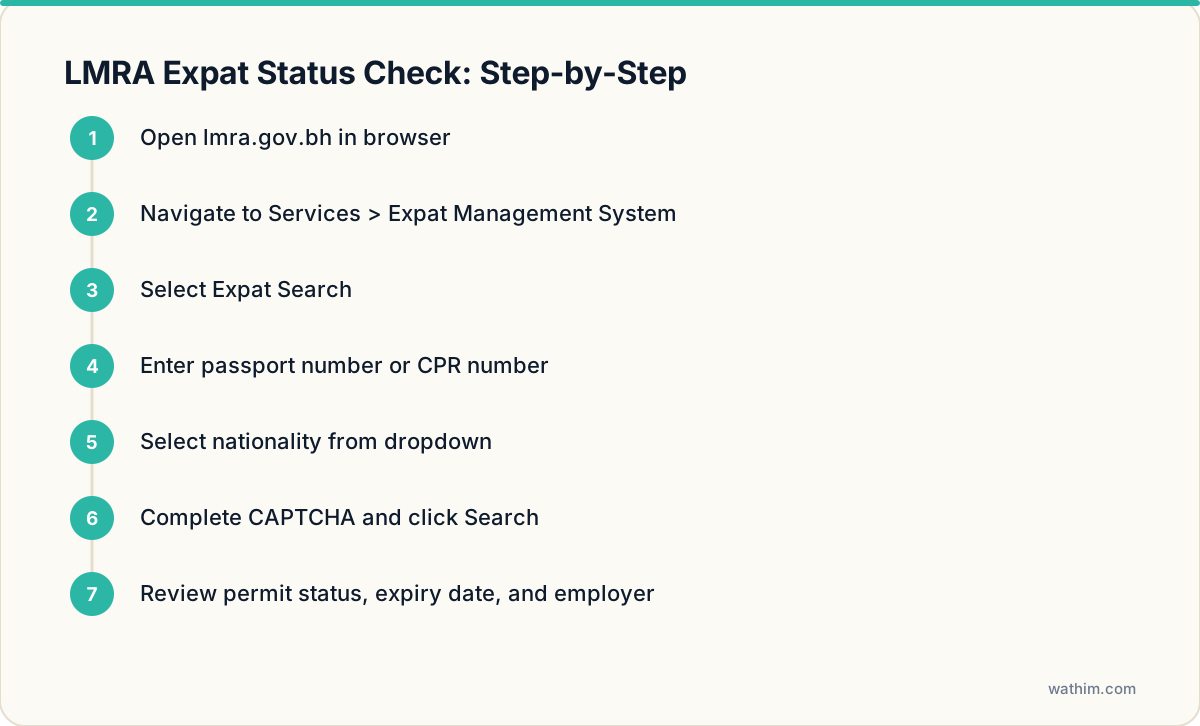
LMRA expat search: step-by-step, with the parts the LMRA help text skips
The official LMRA help text reads cleanly but skips the small frictions that cause "No Record Found" messages on the first try. Here is the actual user flow, including the parts that go wrong.
- Open lmra.gov.bh in any browser. Mobile is fine; the EMS works on small screens.
- From the top navigation, go to Services then Expat Management System. If the menu has changed, use the site-wide search bar with the term "EMS" or "Expat Search".
- Choose Expat Search. The form has two tabs: by passport number and by CPR number. Either works for an active permit.
- Enter the number as printed, with no spaces and no dashes. Passport numbers are case-sensitive in the system; if your passport shows "L1234567" enter it exactly that way.
- Select your nationality from the dropdown. This must match your passport-issuing country precisely. Indian dual-document holders sometimes select the wrong entry and get a no-record result.
- Complete the CAPTCHA. If the image will not load on mobile, switch to desktop.
- Click Search. The permit record loads instantly.
What the result tells you
- Work Permit Number: The reference LMRA and your employer use in all paperwork.
- Permit Type: Standard work permit, domestic worker, flexi-permit, dependant, or special category.
- Expiry Date: Gregorian calendar; this is the one that matters for travel.
- Status: Active, Expired, Under Process, Cancelled, or Blocked.
- Employer Name: The sponsor of record. If this is wrong after a transfer, you have an actionable problem to flag.
Common false-negative causes: passport renewed since the permit was issued (old number still on record; search by CPR instead), brand-new permit that has not yet propagated through the system (allow 24-48 hours), or nationality mismatch in the dropdown. If the search keeps failing, call LMRA on 17506055 with your CPR ready.
For deeper authenticated queries, the LMRA portal and the Bahrain eGovernment portal both offer logged-in business and personal services.
Reading your permit status: what each result code actually means in practice
The EMS returns one of a small set of status codes. The labels are simple; the implications are not. Here is what each really means and what you should do next.
| Status | What it means | What to do today |
|---|---|---|
| Active | Permit current, sponsor recognised, you can work legally | Diary the expiry 90 days out; otherwise nothing |
| Expired | Permit lapsed; you are no longer authorised to work; daily fines accumulate | Push HR same-day; if unresponsive, escalate to LMRA worker protection |
| Under Process / Pending | A renewal or new permit is in the pipeline | Wait 48 hours, recheck; if still pending after 7 days, ask HR for payment reference |
| Cancelled | Permit formally ended (resignation, termination, closure) | Confirm next step: new employer transfer, flexi-permit, or exit; the legal grace is days, not weeks |
| Blocked | LMRA hold, usually due to employer arrears on the monthly levy or unresolved complaint | The worker cannot unblock it; employer must clear arrears at LMRA |
Worked example: turning an "Under Process" into a confirmed renewal
Rajesh, a quantity surveyor, sees "Under Process" on EMS three weeks before his permit expiry. His HR insists the renewal was "filed." The right move: ask HR for the LMRA payment reference number (a 12-digit alphanumeric string). If they cannot produce it within 24 hours, the payment never cleared. Standard LMRA processing is 3 to 7 working days after payment clears; a payment "instruction" sitting in the corporate bank is not the same as a cleared transaction. In Rajesh's case, the bank rejected the corporate payment for an unrelated compliance hold; HR had not been told. The renewal moved to Active 48 hours after payment was reattempted from a different account.
If you cannot get a clear answer from HR within 48 hours of finding an unexpected status, contact LMRA's helpline on 17506055 or visit the work permit service desk for a paid status escalation.
Work permit renewal fees explained: where the BD 395 comes from
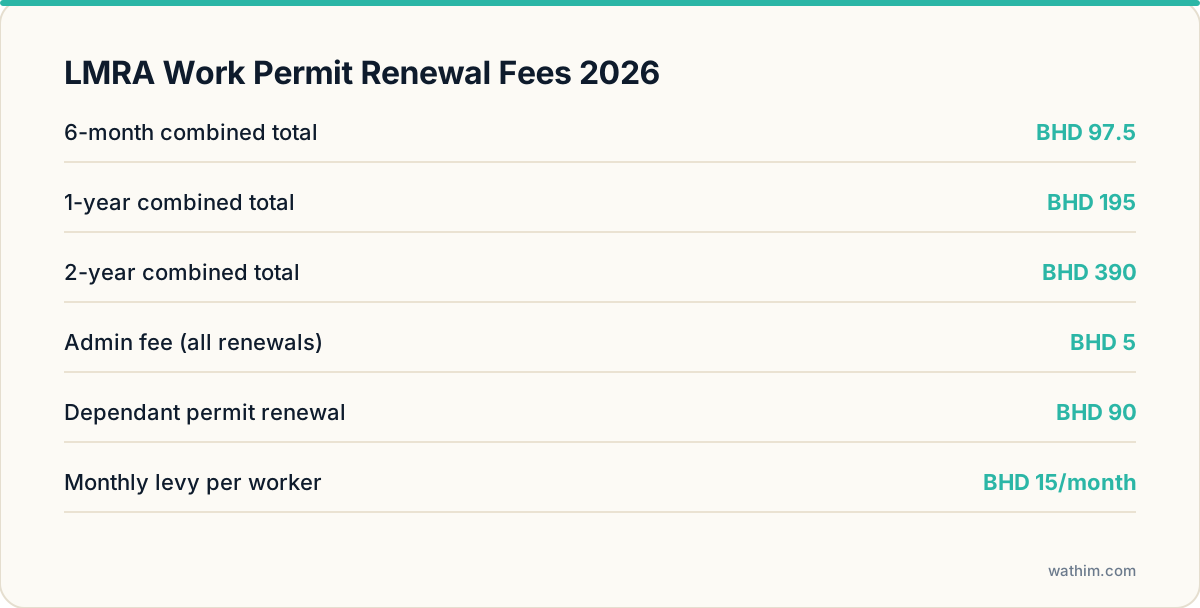
The renewal fee on lmra.gov.bh splits into two mandatory components plus a fixed admin charge. Both components are paid at the same time through the LMRA portal.
The two-year 2026 calculation, line by line
- Work permit fee (24 months): BHD 210
- Basic health care fee (24 months): BHD 180
- Admin fee (per transaction): BHD 5
- All-in total: BHD 395
That number, BD 395 over two years, is what HR teams should be putting into expat budgets. A team of 50 workers on rolling 2-year renewals carries approximately BD 19,750 per cycle in LMRA renewal cost alone, before any monthly levy or new-hire fees.
Why the old BD 172 number is wrong
BD 172 was the combined permit-and-health figure on the pre-2024 schedule. LMRA restructured the schedule and increased the health-care component substantially. The current health-care fee at 24 months (BHD 180) on its own is close to the entire pre-2024 combined figure. Recruiters quoting BD 172 are working off material that has not been updated; verify against lmra.gov.bh/en/page/show/133 every time.
Who pays
Bahraini labour law places the work permit fee obligation on the sponsoring employer, not on the worker. An employer attempting to pass the renewal cost on to the worker is in violation of LMRA regulations. The closest GCC parallels are Saudi Arabia's work permit levy (SAR 9,600 a year, employer pays) and the UAE's similar employer-paid licence fees. None of the GCC fee regimes legally pass renewal cost to the employee. The full cross-country picture is in our GCC fees and overstay comparison.
Monthly levy: the running cost behind every active permit
Separately from the renewal, LMRA charges a Registered Worker Permit fee of BHD 15 per worker per month. This is not a one-off and it is not bundled into the renewal price; it is a continuous monthly invoice on the employer's LMRA account. Workers should know it exists because the most common reason a permit appears as "Blocked" in EMS is that the employer has fallen behind on the monthly levy. The block lifts when the arrears are cleared.
Renewal process step-by-step: what HR does and what you do
LMRA renewals are employer-led. Your role as the worker is to make sure your documents are clean and your CPR is current. Here is the full sequence.
- T-60 days: HR opens the EMS renewal queue. Renewals can be initiated up to 60 days before expiry. HR runs an EMS report for workers due in the next two months and starts the document collection.
- T-50 days: documents submitted. Required: valid passport with at least 6 months remaining, current work permit copy, recent passport-sized photo on white background. For some occupations a renewed professional licence or trade certificate is also needed.
- T-45 days: health certificate (where required). A medical fitness certificate from an LMRA-approved clinic may be required for specific nationalities or permit categories. Approved clinics take 3-5 working days; non-approved clinics' results are rejected outright. Confirm the current approved list on lmra.gov.bh.
- T-30 days: fee payment. Employer pays the BHD 395 (for 2 years) through the LMRA online portal using a corporate BENEFIT card or bank transfer. Partial payments are rejected; the exact amount has to land in one go.
- T-25 to T-18 days: LMRA processing. Standard processing is 3 to 7 working days after the payment clears. A Fawri express service is sometimes available for an additional fee; check availability at lmra.gov.bh because it has been on and off.
- T-14 days: CPR renewal at IGA. Once the work permit renewal is approved, the CPR card is renewed through the IGA portal at iga.gov.bh. CPR is typically renewed alongside the work permit; the standalone fee for expat CPR is not published as a separate line item on the IGA website and should be confirmed at iga.gov.bh/en/servicedetails.aspx.
- T-0: new permit reference live in EMS. The permit reference appears immediately on EMS once LMRA approves. Physical documentation, where any is issued, can be collected from LMRA headquarters in Juffair or sent by mail for bulk renewals.
If you want LMRA to handle the renewal end-to-end for a team, our Bahrain work permit service covers document chasing, fee payment, and EMS confirmation.
Worked examples: solo worker, family worker, blocked-permit recovery
Three scenarios most readers actually face.
Example 1: Solo worker, 2-year renewal, clean record
Sara, a 28-year-old hospitality professional, has a 2-year permit due 30 June 2026. Her CPR and passport are valid through 2028. She has no medical certificate requirement under her nationality category. Her employer's LMRA account is current on the monthly levy.
- LMRA work permit fee: BHD 210
- Basic health care fee: BHD 180
- Admin fee: BHD 5
- CPR renewal at IGA: nominal, confirm at iga.gov.bh
- Employer total: BHD 395, paid in one transaction.
Processing from payment to Active status: 5 working days. Sara confirms the new expiry on EMS herself.
Example 2: Family worker with dependant permit
Joseph holds a 1-year permit due August 2026; his wife Anu is on a dependant permit linked to his sponsorship. Renewal costs:
- Joseph's permit (1 year all-in): BHD 200
- Anu's dependant permit renewal: BHD 90 fixed, regardless of the principal's period
- Family total: BHD 290 for this cycle.
If Joseph upgrades to a 2-year permit, his cost jumps to BHD 395 but Anu's dependant permit fee stays BHD 90. Aligning durations is usually cheaper than letting them drift.
Example 3: Blocked permit recovery
Mohammed's EMS shows "Blocked". HR confirms the company is BHD 6,750 behind on monthly levies (45 workers x BHD 15 x 10 months) due to a cash-flow squeeze. The renewal cannot proceed until the arrears are cleared.
Sequence to recovery: employer clears the BHD 6,750 arrears at LMRA. LMRA lifts the block within 1 to 3 working days. Mohammed's renewal then runs the standard process. If the employer cannot clear the arrears, the worker's practical options are a flexi-permit (self-sponsored, see the next section) or exit. The worker is not personally on the hook for the levy arrears.
Flexi-permit and mobility: the real options if your sponsor is the problem
Bahrain's flexi-permit was designed to give expatriates a route out of sponsorship dependency. As of 2026 it is still available but with some practical constraints worth knowing before you bet your residency on it.
What the flexi-permit gives you
- Self-sponsored status: you are not tied to a single employer
- Right to work for multiple employers simultaneously or sequentially
- Same fee schedule as the standard work permit (use the BD 395 / 2-year figure for budgeting)
- Requires a registered Bahraini bank account in your name
- Popular among freelancers, skilled tradespeople, beauty-and-wellness professionals, drivers, and service-sector independents
What it does not give you
- It does not unlock all professions equally; some regulated occupations still require an employer sponsor
- It does not replace the need for individual project clients to comply with their own labour obligations
- It does not automatically convert to a standard work permit if you join a single employer; that transfer follows the standard EMS flow
Mobility rules for standard permit holders
If you are on a standard permit and the relationship with your employer has broken down (unresponsive HR, refusal to renew, withholding documents), Bahrain's labour rules let you transfer to a new employer in defined circumstances without losing status. The relevant route depends on whether the transfer is employer-initiated or worker-initiated; the conditions differ. The complaint and transfer initiation channel is at lmra.gov.bh/en/page/show/complaints.
One absolute, regardless of permit type: passport retention by employers is prohibited under Bahraini law. If your passport is being withheld, that is not a grey area; it is a complaint to LMRA. The Bahrain mobility rules and complaint flow are summarised on the work permit transfer service page.
What actually happens if your work permit expires
An expired Bahrain work permit is not a notification in your email; it is a status that triggers downstream consequences. Here is the realistic sequence.
- Day 1 after expiry: you are no longer authorised to work. Continuing to work exposes both you and the employer to LMRA fines.
- Daily fine accumulation. Overstay fines for residence-linked permits run BHD 2 to 10 per day depending on permit type. LMRA does not publish a single flat rate that applies to every category; the correct number for your permit is on lmra.gov.bh under your specific category. As a working number, mid-range BHD 6 per day costs roughly BHD 180 a month.
- Airport alert. Travellers flagged at Bahrain International Airport with expired permits can be stopped, required to pay outstanding fines on the spot, or detained pending an employer guarantee. Departure with unpaid fines triggers a ban risk regardless of how long the overstay is.
- Re-entry ban risk. Departing without clearing fines first is the most common ban trigger. The fines themselves are recoverable; a ban is harder to reverse.
- Family-permit knock-on. Dependant permits linked to your sponsorship are affected when the principal lapses. A wife and children on dependant permits will also lose authorised status.
Worked example: 45-day overstay
If your permit expired 45 days ago and you have not yet acted, the fine at the mid-range BHD 6 per day is BHD 270. Add the still-pending renewal cost (BD 395 for a 2-year permit, or BD 200 for 1 year), and the all-in catch-up is between BD 470 and BD 665 plus any specific late-action charges LMRA applies in your category. The 2026 emergency waiver (February to 8 June 2026) has expired; do not assume any current grace.
If your employer has not renewed and is unresponsive, contact LMRA's worker protection line. You are not deported for one day of permit expiry, but the longer the delay the more complicated and expensive the recovery. The full GCC comparison is in GCC overstay fines compared.
CPR: the Bahrain ID card linked to (but separate from) your permit
Your CPR (Central Population Register) card is Bahrain's national identity document for residents. It is separately numbered and separately issued from the LMRA work permit but the two are linked in the government database. A current CPR unlocks:
- Bank account opening and access to financial services (banks will not move on an expired CPR)
- Health-services registration including primary-care enrolment
- Tenancy contract signing
- Most government eServices on the Bahrain eGovernment portal
- Mobile phone post-paid contracts and utility account changes
CPR renewal is handled by the Information and eGovernment Authority (IGA) at iga.gov.bh, not by LMRA. For expats, the CPR validity is typically tied to the residence/work permit validity. When your employer renews your work permit, ensure the CPR is renewed in the same window; letting one expire while the other is current creates a separate set of frictions (the bank will reject an expired CPR even if your LMRA status is active).
What is not officially published
The standalone CPR renewal fee for expats is not listed as a single line item on the IGA website. In practice the fee is nominal when done alongside the LMRA renewal; the standalone amount should be confirmed at iga.gov.bh/en/servicedetails.aspx or at an IGA service centre. We do not publish a specific number here because the source data is not stable.
For a full national-ID handling package we offer a Bahrain national ID service that includes CPR renewal alongside the work permit.
Edge cases the standard renewal guide skips
The standard flow handles 80 percent of renewals. The remaining 20 percent is where most of the frustration lives.
Permit issued under an old passport
If your current LMRA permit was issued more than 5 years ago under a previous passport, the passport-number search on EMS may return "No Record Found". Use the CPR-number search instead. The CPR is permanent; the passport rotates every 10 years.
Renewal due while you are out of country
The renewal can technically be filed in EMS while you are abroad on annual leave, but only if the employer holds your documents and signature where required for medicals. Some categories require a fresh medical that can only happen in-country. Confirm with HR before booking long leave during a renewal window.
Health certificate from the wrong clinic
Approved-clinic results are accepted; non-approved-clinic results are rejected outright with no refund of the medical fee. Always confirm the clinic is on the LMRA approved list published on lmra.gov.bh before booking. This single point of friction accounts for a disproportionate share of failed first-attempt renewals.
Domestic worker renewal
Domestic workers follow a different fee category and a slightly different documentary chain via the sponsor (typically an individual rather than a corporate). Sponsors should consult the specific domestic-worker schedule on lmra.gov.bh rather than assuming standard work-permit numbers apply.
Permit transfer mid-cycle
If you transfer to a new employer mid-cycle, the existing permit is cancelled and a new permit is issued under the new sponsor. Any remaining health-care fee on the cancelled permit is generally not refunded; the new employer pays a fresh new-permit fee. Transfers cost the new employer roughly the same as a fresh permit issuance.
You discover a labour-violation flag on your record
If a labour complaint or unresolved violation is sitting against your file, EMS may show "Blocked" even when both you and the employer believe everything is current. The fix is to identify the open file at LMRA's complaints desk, resolve it (which can require a settlement or formal closure of a labour case), then ask LMRA to lift the block. This is rare but unrecoverable through self-service.
Common problems and fixes
"No Record Found" on LMRA search
Usually a data entry issue. Try CPR instead of passport, or the other way round. New permits take 24-48 hours to appear in EMS after the employer files. If you renewed your passport recently and your permit still references the old number, the CPR route is your reliable fallback.
Employer says renewal is filed but EMS still shows "Expired"
Payment has not cleared. Ask HR for the LMRA payment reference number and check the transaction status in the employer portal. LMRA processing does not begin until payment is confirmed; a pending bank transfer is not the same as a cleared one.
Permit shows "Blocked"
LMRA has placed a hold, almost always for unpaid monthly levies or an unresolved complaint against the employer's file. The employer must log into the LMRA business portal, see the outstanding balance, pay arrears, and then contact LMRA to lift the block. Workers cannot do this themselves.
Health certificate rejected
The clinic was not on LMRA's approved list. Re-do the medical at an approved centre; the rejected fee is not refunded.
Employer wants you to pay the renewal fee
Bahrain labour law places the work permit fee on the employer. If an employer tries to pass this cost on to you, that is a labour violation. File a complaint with LMRA's worker protection division at lmra.gov.bh/en/page/show/complaints.
Cancelled permit and you need to stay
A cancelled permit gives you a defined window (typically days, not weeks) to either transfer to a new employer, switch to a flexi-permit, or arrange exit. Do not wait; the practical window closes faster than people expect.
Skip the paperwork
LMRA renewals look procedural on paper and then become a workload sink in practice: fees, medical bookings, CPR renewal at IGA, monthly levy bookkeeping, and the occasional blocked-permit recovery. For an individual single-employer worker it is manageable. For HR teams handling 20 to 200 workers, the cycle compounds and small errors trigger rework that costs more than the original renewal fee.
Our team handles the full employer-side LMRA renewal process: document collection, payment confirmation, EMS status tracking, and CPR coordination at IGA. Contact us and we will sort it so you can focus on the work the company actually exists to do.
Also useful: overstay fines across the GCC, family sponsorship salary requirements, certificate attestation guide, and the Oman resident card 10-year change.
Run your numbers: indemnity exposure rises with renewal fees, so model both in our Bahrain end-of-service calculator before any contract decision. Permit details, payments, and complaints now sit inside the LMRA portal, with Bahrain.bh eGov for citizen-side services and BenefitPay for payment.
Want this handled for you? Wathim runs LMRA work permits in Bahrain end to end — brief the desk and we will take the filing, the follow-ups and the portal chasing off your plate.
Frequently Asked Questions
Yes. Go to lmra.gov.bh, navigate to the Expat Management System (EMS), and use the Expat Search tool. Enter your passport number or CPR number, choose nationality, complete the CAPTCHA, and the result loads instantly. No account or login is required and there is no fee for the check.
BHD 395 all-in: BHD 210 work permit fee plus BHD 180 basic health care fee plus BHD 5 admin fee. These are the official LMRA rates as of April 2026 from lmra.gov.bh. The widely circulated BD 172 figure for 2-year renewal is outdated and predates the post-2024 fee restructure. Budget BD 395 per worker per 2-year cycle.
The employer pays. Bahraini labour law places the permit fee obligation on the sponsoring company. An employer attempting to recover this cost from the worker is in violation of LMRA regulations and can be reported through the worker protection complaint channel at lmra.gov.bh/en/page/show/complaints.
BHD 15 per month per registered expatriate worker. It is an ongoing employer obligation separate from the renewal fee. It matters to workers because the most common reason an active permit shows as Blocked in EMS is that the employer has fallen behind on the monthly levy. The block lifts when the arrears are cleared; the worker cannot resolve it directly.
From day one after expiry, you are no longer authorised to work and daily fines (BHD 2 to 10 depending on category) start accumulating. You face airport risk and a potential re-entry ban if you depart without clearing fines. The 2026 emergency waiver expired on 8 June 2026; standard enforcement is back in force. Escalate to HR or LMRA worker protection on day one.
A self-sponsored work permit that lets the holder work for multiple employers without being tied to a single sponsor. Fees match the standard schedule (BD 395 for 2 years all-in). Holders need a Bahraini bank account. It is popular with freelancers, skilled tradespeople, and service-sector independents. Not every profession qualifies, so check the current eligible occupations list on lmra.gov.bh before assuming you can switch.
Yes. The work permit is issued by LMRA; the CPR is issued by IGA at iga.gov.bh. They are linked but renewed through separate transactions. Best practice is to renew both in the same window; letting one lapse while the other is current creates problems with banking, tenancy, and government services that depend specifically on a current CPR.
File a worker protection complaint directly with LMRA at lmra.gov.bh/en/page/show/complaints or call 17506055. Bahraini law prohibits employers from retaining worker passports. If the employer is unresponsive, mobility rules can allow you to transfer to a new employer or switch to a flexi-permit. Do not let the situation drift past the expiry date if it is avoidable; the recovery cost rises sharply once daily overstay fines start.
Stuck on a Government Service Step?
Wathim publishes free plain-English guides to GCC visas, IDs, driving licences, attestation, and fines. If a fee table looks off or a step is missing, tell us and we will update the guide. You can also book a free guidance call with our GCC services desk.

Wathim Editorial
GCC Services Desk
The Wathim team writes plain-English guides to GCC government services. We track ICP, GDRFA, MOHRE, Absher, Muqeem, Qiwa, Metrash, LMRA, ROP Oman, and MOI Kuwait so expats can plan visa, residency, ID, and licence steps without guesswork.