

General Traffic Department (MOI)
Kuwait Driving Theory Test
Practice for the Kuwait driving theory test (the computer-based knowledge test taken through the General Traffic Department). Timed mock exams and topic tests with the answer and an explanation for every question, written from the public Kuwait traffic rules and the standard GCC road signs.
- 20 questions · 18 to pass (90%)
- 10 minutes
- 2 wrong allowed
- English, Arabic, Urdu
First 10 questions of every test free, answer and reason shown. No signup. Road signs quiz
Try one now
From the Kuwait bank · road signs
What does this sign mean?

Pick an answer to see the reason.
Every question in the bank is explained like this.
All 772 Kuwait questions, KWD 1.5 →Where is your test?
Reported format. The Ministry of Interior's own practice test (ttd.moi.gov.kw) shows the format: 20 questions with a 10-minute total timer, in Arabic, English, Urdu or Hindi, with 3- or 4-option and true/false questions. It does not show a pass mark; 18 correct out of 20 (90%) is reported by kuwaitlocal.com (18 May 2026) and autoviatest.com (October 2026).
Pass first time, not on the retake
PDF + onlineKuwait Driving Test Questions PDF (MCQ)
Every question in the Kuwait bank as timed mock exams at the reported 20-question length, topic drills, and a list of the questions you keep getting wrong, on your phone.
- Questions in the bank
- 772
- questions, all explained
- Real test
- 20 Q · 10m
- real test, 90% to pass
- Full exam papers
- 3 × 20
- full exam papers
- Timed online mocks at the 20-question length, marked against 90%
- Your weak topics tracked on your phone, no account
- The printable pack included: 3 full exam papers, plus all 481 questions by topic
A retake
KWD 12
The bank, once
KWD 1.5
KWD 4 KWD 1.5one payment, no subscription
3 full papers + 772 questions, timed mocks
Get the Kuwait bankPractice questions written from the public rules, not the authority's own bank.
Choose your governorate
The theory test is run by each governorate’s own authority, so pick where you are testing. Every governorate gets its own branded practice with a distinct set of questions.
How to prepare in three steps
Pick your governorate
Choose where you are testing so the branding and questions match your licensing authority (General Traffic Department).
Drill and mock
Warm up by topic with instant feedback, then sit a full timed mock exam just like the real test.
Review and retake
Read the explanation for every miss, then retake until you clear the pass mark comfortably.
Kuwait driving test questions with answers
Practice questions with the answer and the reason, from the free sample of the same bank our Kuwait tests run on: road signs, then rules and right of way, then safety and the 2025 fines. Each one is here because it tests something candidates routinely get wrong. Pick an answer; the explanation under it is the part worth reading.
Road sign questions
Sign questions are the cheapest marks on the paper because they are pure recognition, and the most dangerous ones to be vague about, because a 90% pass mark gives you no room to guess.
What does this sign indicate, and which direction must you travel around it in Kuwait?
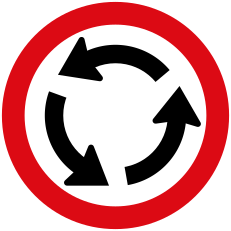
Pick an answer to see the reason.
What does this sign prohibit?
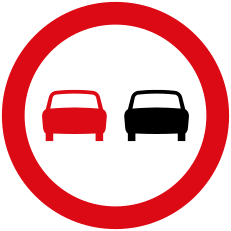
Pick an answer to see the reason.
On which type of road would you most likely encounter this sign in Kuwait?
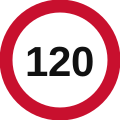
Pick an answer to see the reason.
The roundabout question catches drivers who learned in a country that drives on the left, such as India, Pakistan, Sri Lanka or the UK: the sign looks the same everywhere, the direction you travel around it does not. And notice how the 120 question is asked. It does not ask what the sign means, which everyone knows; it asks where you would expect to see it. Kuwait's paper often tests a sign from an unexpected angle, so you need to know what each sign tells you to do and where it belongs, not just its name.
Road rules and right-of-way questions
Rules and right of way together make up the largest share of the bank: the keep-right rule, overtaking, unmarked junctions, failed signals and school buses.
On a multi-lane road in Kuwait, which lane should you normally drive in when not overtaking?
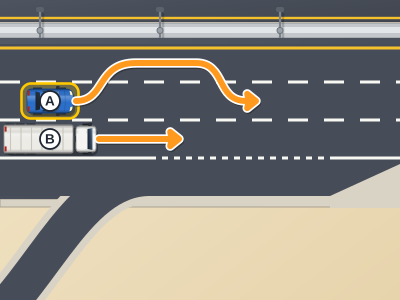
Pick an answer to see the reason.
On which side of the road should you overtake another vehicle in Kuwait?
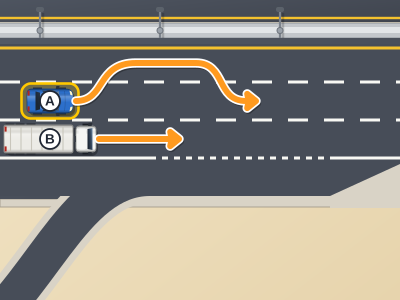
Pick an answer to see the reason.
You arrive at an unmarked crossroads at the same time as a vehicle approaching from your right. Who has priority?
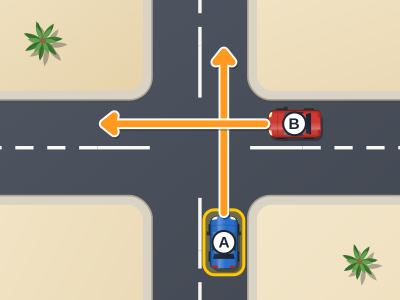
Pick an answer to see the reason.
Traffic lights at a junction have failed and no police officer is directing traffic. How should you treat the junction?

Pick an answer to see the reason.
A school bus has stopped with its warning lights flashing and is dropping off children. What must you do?
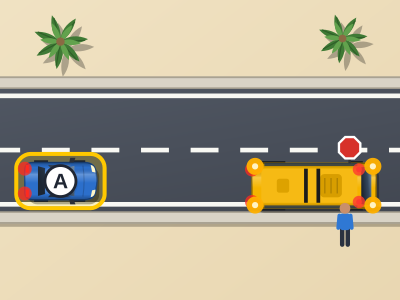
Pick an answer to see the reason.
The unmarked crossroads and the failed traffic lights are the same rule asked twice: when nothing else decides priority, give way to the right. The paper likes to wrap that rule in a scenario and see whether you recognise it. If you can answer both without hesitating, you have the rule.
Safety and penalty questions: the 2025 fines
What is the recommended minimum following distance behind the vehicle in front under normal dry conditions on a Kuwaiti highway?

Pick an answer to see the reason.
Under Kuwait's amended Traffic Law, in force since 22 April 2025, what is the settlement fine for using a handheld mobile phone while driving?
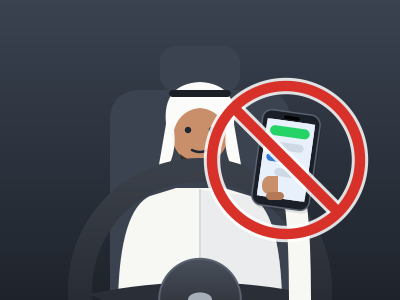
Pick an answer to see the reason.
What does Kuwait law require when a young child travels in a car?
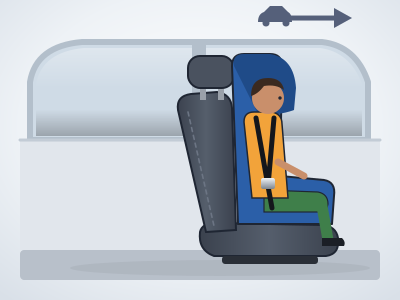
Pick an answer to see the reason.
The penalty questions are where old knowledge fails people. Kuwait's amended Traffic Law came into force on 22 April 2025 and raised most fines sharply: the phone fine was KD 5 and is now KD 75. Signs travel between Gulf countries; fines do not, so anyone revising from older material, or from what they learned elsewhere, is revising the wrong numbers. These are the figures our GCC theory test comparison publishes for Kuwait under Decree-Law 5 of 2025:
| Offence | Fine under the 2025 law | Before |
|---|---|---|
| Using a handheld phone while driving | KD 75 | KD 5 |
| Not wearing a seatbelt | KD 30 | KD 10 |
| Child under 10 in the front seat | KD 50 | - |
| Running a red light | KD 150 settlement; a felony if it goes to court | - |
Sources: Kuwait Times (January and April 2025) and Gulf News (April 2025).
Points are less certain than fines. Kuwait also runs a points ladder whose first step is a three-month suspension at 14 points. That ladder is reported from 2023 and we have not confirmed that it survived the 2025 law unchanged, so treat points questions with care and learn the fines first.
These come from the free sample. Get all 772 Kuwait questions in the online bank · KWD 1.5 →
The Kuwait test format, and how sure each figure is
| What you need to know | The figure | How sure it is |
|---|---|---|
| Questions | 20, multiple choice | Reported by kuwaitlocal.com (May 2026) and autoviatest.com; no MOI page publishes it |
| Pass mark | 18 of 20 (90%) | Same sources; the highest pass mark in the Gulf after Qatar |
| Time limit | Not confirmed | Our mock exams allow 20 minutes, a minute a question, as a conservative choice |
| Languages | English and Arabic | Only these two are reported |
| Where you sit it | Touchscreen at a GTD test centre, on your first visit before the practical | Reported by kuwaitlocal.com (May 2026) |
| Fee | KWD 12 per test-centre visit (KWD 5 administrative + KWD 7 practical) | kuwaitlocal.com, October 2026 |
You will find other figures online, usually older or undated, and some pages describe a written test rather than a computer one. Until the Ministry publishes a format, treat any figure, ours included, as something to confirm with your driving school. Our advice is to prepare for the strict version: if your centre turns out to be more lenient you have lost nothing; if you prepared for 75% and the paper wants 90%, you have lost a visit.
What 90% means in practice
Most people revise by trying to raise their average score. That works on a paper with a 75% pass mark, where a weak topic is absorbed by strong ones. It does not work in Kuwait. With 20 questions drawn across five topics you will see roughly four from each, and three wrong answers anywhere is a fail. One shaky topic is enough to sink the paper, however well you know the rest.
| Your weakest topic | Likely questions on the paper | What happens |
|---|---|---|
| You know it at 95% | About 4 | Usually all correct; you pass with room to spare |
| You know it at 75% | About 4 | One wrong is likely; add one slip elsewhere and you are at the limit |
| You know it at 50% | About 4 | Two wrong is likely; any third mistake on the paper fails you |
The topic mix is an estimate from the balance of the bank, not a published blueprint, but the arithmetic holds whatever the exact split: the paper rewards having no weak topic, not a high average. On a paper this short the bigger risk is not the clock but hesitating over a sign you half-know and talking yourself out of the right answer.
What is on the Kuwait paper: the five topics
The questions are drawn from the same five subjects every Gulf authority tests, written to Kuwait's own rules and fine schedule. Our bank is built in the same shape; these are the counts for the car (light vehicle) track, read straight from the bank:
| Topic | Questions in our bank | What it tests | Free practice |
|---|---|---|---|
| Road signs and signals | 61 | Recognising regulatory, warning and mandatory signs at a glance | Road signs test 1 |
| Traffic rules | 70 | Lanes, overtaking, roundabouts, U-turns, signalling | Road rules test 1 |
| Right of way | 70 | Junctions, roundabouts, pedestrians, emergency vehicles, school buses | Right of way test |
| Safe driving | 70 | Following distance, braking, heat and tyres, mirrors and blind spots | Safe driving test |
| Penalties and fines | 70 | Fines and points under the 2025 Traffic Law amendments | Fines and black points test |
The paper is mostly the same whoever you are. Riders and truck and bus candidates sit this shared material plus their own questions: start with the Kuwait motorcycle theory tests or the Kuwait truck and bus tests once the shared topics are at the same 90% standard, because they are most of your paper.
Why candidates get Kuwait test questions wrong
The wrong answers people choose are not random. They fall into five patterns, and almost every Kuwait theory fail we hear about comes from one of them.
- Give Way treated as Stop, or Stop treated as Give Way. A Stop sign means a full halt every time, even on an empty road. A Give Way sign means slow down and yield, stopping only if traffic requires it. The paper asks this from several directions.
- Left-hand habits. Drivers who learned on the left get roundabout direction, overtaking side and the keep-right rule wrong under pressure, even when they drive correctly in Kuwait every day. Recognising the right answer on a screen is a different skill from doing it by habit.
- Answering the question you expected. "What does this sign mean?" and "where would you see this sign?" have different answers. Read the stem twice.
- Old fines. The 2025 amendments changed most of the penalty numbers. Anything learned before April 2025 is suspect.
- The plausible distractor. Many wrong options sound reasonable, such as "pass slowly on the right side of the bus" or "you have priority because signals are not working". The right answer is usually the most cautious lawful one.
The first two patterns are about recognition under time pressure, and the cure is repetition until the answer is automatic. The last three are about reading, and the cure is sitting full timed papers so you practise reading carefully when it counts.
A revision plan for an 18-out-of-20 paper
Because the pass mark punishes any weak topic, revise topic by topic first and only then move to full papers. This order works:
- Signs first. Sit road signs test 1 and road signs test 2. Do not move on until you recognise every sign without reading the options.
- Rules and right of way. Work through road rules test 1, then the right of way test. Say the rule behind each answer out loud; if you cannot, you guessed.
- Penalties. Learn the 2025 fines as a table, then test yourself with the fines and black points test.
- Safe driving. Following distance, braking, tyres in the heat and blind spots, from the safe driving test.
- Full timed papers last. Start with mock test 1 and mock test 2 on the clock.
The booking rule: do not book until you score 19 or 20 on full mocks, more than once. An 18 in practice is not a pass waiting to happen; it is a fail waiting for one unlucky question. Write down every question you get wrong, with the rule, and re-sit those before anything new.
On the free route you see the first 10 questions of each test, so the free tests are good for checking whether a topic is solid, not for full rehearsal. Full 20-question papers are in the printable pack, and timed 20-question mocks are in the online bank.
Kuwait test centres, fees and what a fail costs
Before any of this matters, check eligibility. Expatriate applicants in Kuwait face salary, residence and education conditions, including the widely reported KD 600 salary threshold, and those conditions change by ministerial decision; in Kuwait eligibility stops more people than the test does. Our Kuwait driving licence guide covers them. If you already hold a foreign licence, run it through the driving licence conversion checker first: some nationalities are reported to sit only the theory test, some only the road test, some neither.
- Booking. Through the MOI portal or the Sahel app, or through your driving school, which often coordinates the GTD appointment for you. See our MOI Kuwait portal guide.
- Where. GTD test centres reported at Shuwaikh, South Surra, Ahmadi and Jahra (kuwaitlocal.com, May 2026). The standard is national, but slot availability varies by governorate.
- On the day. The theory test is taken on a touchscreen on your first visit, before the practical. Results are usually given the same day.
Each visit to the test centre is reported at KWD 12, made up of a KWD 5 administrative fee and a KWD 7 practical test fee (kuwaitlocal.com, October 2026), with no stated limit on attempts. Kuwait has one useful quirk: if you pass the theory paper and fail the practical, the theory paper is not repeated on the retest visit. Figures of KD 150-300 you may see online are totals including driving school, not the test-centre fee.
The money is small. What a fail really costs is the wait for another slot and another day off work, which is why the plan above aims for a first-attempt pass. For what follows the theory paper, see the Kuwait road test guide.
How to get your Kuwait driving licence
Obtaining a driving licence in Kuwait is managed by the General Traffic Department (GTD), which operates under the Ministry of Interior (MOI). The process involves an eye test, a theory (written) test, mandatory practical training at an approved driving school, and a road test administered by a GTD examiner. Kuwait applies specific eligibility conditions to expatriate residents, and these conditions have changed over time and may change again; they can include restrictions based on residency category, profession, educational qualification, or minimum salary. This guide covers the light-vehicle (private car) licence journey. Always confirm current eligibility and procedural requirements directly with the General Traffic Department before you begin, as rules are updated by ministerial decision without advance public notice.
The step‑by‑step journey
- 1
1. Confirm Expatriate Eligibility
Before anything else, verify that your residency category and personal circumstances currently qualify you to apply for a driving licence in Kuwait. Historically, certain visa categories, salary thresholds, or academic qualifications have been required for some expat nationalities, but these criteria are set by MOI ministerial decision and change periodically. Bring your Civil ID and passport to the nearest GTD office, or check the MOI Kuwait website or app, to confirm you are eligible at the time you intend to apply. Do not assume prior information online or from third parties is current. Confirm the current eligibility requirements with the General Traffic Department.
- 2
2. Obtain an Eye Test Certificate
Visit an MOI-approved optician or medical centre to obtain a standard vision test certificate. The certificate must confirm your eyesight meets the minimum standard required for driving. If you wear corrective lenses, this will normally be noted on your licence. The certificate is typically valid for a limited period, so do not obtain it too far in advance of your application. A list of approved centres may be available at the GTD or on the MOI portal. Confirm current requirements with the General Traffic Department.
- 3
3. Enrol at an Approved Driving School and Submit Your Application
Kuwait requires most applicants to train through a GTD-approved driving school. Enrol, submit your documents (see Documents section), and pay the applicable fees. The driving school typically lodges your file with the GTD on your behalf, or they will direct you to submit directly at a GTD office. Confirm the current enrolment and submission procedure with your chosen school and with the General Traffic Department, as administrative arrangements differ between schools and governorates.
- 4
4. Theory (Written) Test
Once your application file is accepted, you will be scheduled for a theory test. The test assesses knowledge of Kuwait traffic rules and road signs. It is typically taken at the driving school or at a GTD testing centre. Results are usually available the same day. If you do not pass, you may re-sit after a waiting period; confirm re-sit rules with the GTD. Confirm scheduling, format, and pass requirements with the General Traffic Department.
- 5
5. Practical Driving Lessons
After passing the theory test, you undertake a required number of practical driving lessons with an instructor at your approved driving school. The minimum number of lessons is set by the GTD and has varied over time; confirm the current requirement with the General Traffic Department. Lessons cover vehicle control, manoeuvers, road positioning, and traffic rules in practice. Additional lessons beyond the minimum may be taken privately with your school.
- 6
6. Road Test (Practical Examination)
The GTD examiner conducts the road test, typically using a vehicle provided by the driving school. The examiner will assess your ability to handle the vehicle safely, obey traffic signals, perform standard manoeuvers, and conduct yourself appropriately on public roads. Common reasons for failure include improper observation at junctions, insufficient control of speed, incorrect lane discipline, poor reverse parking technique, and failure to yield appropriately. If you fail, you will wait a specified period before re-sitting. Confirm re-sit waiting periods and any associated fees with the General Traffic Department.
- 7
7. Licence Issuance and Collection
On passing the road test, the GTD processes your licence. In many cases the driving school handles the administrative submission. The licence is either collected from the GTD office or from the driving school depending on the current procedure. Processing time can vary; confirm expected collection time with the General Traffic Department. Your licence will state any corrective-lens conditions and the vehicle category it covers.
What to bring: documents checklist
- Valid Civil ID (Iqama)
- Original passport with valid residency visa
- Eye test certificate from an MOI-approved optician or medical centre
- Passport-sized photographs (typically on a white background; confirm exact count and specifications with the GTD)
- Salary certificate or employer letter (may be required for some expat applicants to demonstrate eligibility; confirm with the GTD)
- Educational qualification certificate (may be required for certain nationalities or visa categories; confirm with the GTD)
- Completed GTD application form (typically obtained at or from the driving school)
- Any additional documents required by the specific driving school or GTD office
Each stage in detail
Eye test
An eye test from an MOI-approved optician or medical centre is required before the application can proceed. The test assesses visual acuity to the minimum standard set by the MOI for driving a light vehicle. Corrective lenses are permitted and will be noted on the licence if required. The certificate has an expiry window; confirm the current validity period and approved centre list with the General Traffic Department before booking.
Theory (knowledge) test
The Kuwait theory test is a computer-based test taken on a touchscreen at the General Traffic Department test centre. The Ministry of Interior's own practice test (ttd.moi.gov.kw) shows the format: 20 questions to answer in 10 minutes, in Arabic, English, Urdu or Hindi. Most questions have 3 or 4 options and some are true/false; signs and kerb markings are shown as pictures, and many questions cover the 2025 traffic law's fines and penalties. The pass mark is reported as 18 out of 20 (90%), though the Ministry does not publish it. Results are given on the day, and a waiting period applies before a re-sit.
Road test
The road test is conducted by a GTD traffic examiner, normally using a vehicle supplied by the driving school. The examiner accompanies the applicant on a route covering public roads, roundabouts, junctions, and a manoeuvring section that typically includes reverse parking and possibly a three-point turn. Common reasons for failure include: insufficient observation at junctions and when merging; failure to check mirrors appropriately; poor speed management; incorrect or late signalling; difficulty with reverse parking or bay manoeuvres; failure to yield to pedestrians; and general hesitation or erratic vehicle control. Specific assessment criteria and scoring are set by the GTD and should be confirmed with the General Traffic Department before your test.
Converting a foreign licence
Kuwait does allow holders of certain foreign driving licences to convert to a Kuwaiti licence without completing the full test process, subject to conditions. The list of eligible countries and the conditions for conversion are determined by the MOI and have changed over time. Conversion typically requires the foreign licence to be valid and original, accompanied by an official Arabic translation if it is not already in Arabic, plus standard identity documents. Some nationalities may be required to sit only the theory test, only the road test, or no tests at all, while others may need to complete the full process regardless. Do not rely on any fixed list of eligible countries without confirming with the General Traffic Department, as the list is periodically revised. Confirm the current foreign licence conversion eligibility and process with the General Traffic Department.
How to book
Appointments and services can be accessed through multiple channels. The MOI Kuwait official website (moi.gov.kw) and the MOI mobile application (available for iOS and Android; search for the official MOI Kuwait app) provide online services including appointment booking for some GTD functions. In practice, many applicants initiate the process by visiting or calling an approved driving school directly, as the school coordinates the GTD appointment and administrative submission on the applicant's behalf. GTD offices in each governorate also accept walk-in enquiries, though demand can mean waiting times. Confirm current booking procedures, including whether online booking is mandatory or optional for your governorate, with the General Traffic Department or your chosen driving school.
Fees
Fees are paid at several stages: application registration, theory test, practical lessons (set by the driving school and negotiated at enrolment), road test, and licence issuance. Driving school lesson packages vary in price depending on the school and the number of lessons included. GTD fees for tests and issuance are set by the MOI and have changed with regulation updates. As a general indication, total costs across the full process have historically ranged from a few tens of Kuwaiti Dinars to over a hundred Kuwaiti Dinars in aggregate when including school fees, but this range should not be treated as current or binding. Confirm the current fee schedule for each stage with the General Traffic Department and with your chosen driving school before committing.
Typical timeline
The overall timeline from starting the process to receiving a licence varies significantly depending on appointment availability at the GTD, how quickly each stage is passed, and administrative processing times. A realistic expectation for someone who passes every stage on the first attempt is roughly two to four months from initial enrolment to licence collection, though some applicants complete it faster and others take considerably longer if re-sits are needed or if GTD appointment slots are constrained. Confirm current typical waiting times with the General Traffic Department and with your chosen driving school.
Tips to pass
- Verify your expat eligibility status before paying any fees or enrolling at a driving school; eligibility conditions change by ministerial decision and may not be widely publicised.
- Choose a GTD-approved driving school and ask specifically about the current minimum lesson requirement, included services, and what happens if you need a re-sit, before signing any enrolment contract.
- Book your eye test only when you are ready to proceed with the application, as the certificate has a limited validity window and you do not want it to expire before your GTD appointment.
- Study Kuwait traffic law and road signs using official or well-regarded materials; pay particular attention to roundabout right-of-way rules, speed limits across zones, and pedestrian crossing obligations, as these feature prominently in the theory test.
- During practical lessons, ask your instructor to specifically practise reverse parking and any manoeuvres required for the road test at your GTD centre, as these are common failure points.
- Keep clear photocopies and photographs of all your documents before submission, and track any receipts for fees paid; GTD processes can require resubmission and having copies prevents delays.
Passing the Kuwait theory test
The Kuwait theory (knowledge) test is 20 multiple-choice questions with a 90% pass mark, so you need 18 correct answers. The Ministry of Interior's own practice test (ttd.moi.gov.kw) shows the format: 20 questions with a 10-minute total timer, in Arabic, English, Urdu or Hindi, with 3- or 4-option and true/false questions. It does not show a pass mark; 18 correct out of 20 (90%) is reported by kuwaitlocal.com (18 May 2026) and autoviatest.com (October 2026). It is administered by each governorate’s own authority, so where you test matters. Start with road signs and signals, then move on to right of way, roundabouts, speed limits and penalties, and finish with full timed mock exams so the 10-minute format feels familiar on the day.
Every question here comes with the correct answer and a short explanation drawn from the public traffic rules, so you learn the reasoning rather than memorising answers. Pick your governorate above to get practice matched to your licensing authority.
Other GCC countries
Testing elsewhere in the Gulf? Practise for another country’s theory test.
Kuwait driving test guides
Kuwait theory test FAQs
The Kuwait light-vehicle theory test has 20 multiple-choice questions and you need 18 correct to pass, which is 90%. You get about 10 minutes to complete it. The question count and pass mark can vary by governorate and by vehicle class, so confirm the details with your governorate's authority. The Ministry of Interior's own practice test (ttd.moi.gov.kw) shows the format: 20 questions with a 10-minute total timer, in Arabic, English, Urdu or Hindi, with 3- or 4-option and true/false questions. It does not show a pass mark; 18 correct out of 20 (90%) is reported by kuwaitlocal.com (18 May 2026) and autoviatest.com (October 2026).
You need 90% to pass, which is 18 of 20 questions correct. Our mock exams score you against the same 90% pass mark so you always know where you stand before the real test.
The Kuwait theory test is commonly available in English, Arabic, Urdu and Hindi. Exact language and interpretation options are set by the licensing authority, so confirm what is offered at your test centre when you book.
The theory test is run by each governorate's own authority: Al Asimah (Capital) (General Traffic Department), Hawalli (General Traffic Department), Al Farwaniyah (General Traffic Department), Mubarak Al-Kabeer (General Traffic Department), Al Ahmadi (General Traffic Department) and Al Jahra (General Traffic Department). Choose your governorate above to get practice matched to that authority's branding, question count and pass mark.
Fees are set by the governorate's authority and approved driving schools and can change, so we do not quote a fixed price. In most cases you register with an approved driving school or the traffic department, complete the required lectures, then sit the theory (knowledge) test at an approved centre. Always confirm the current fee and steps with your driving school or the authority before booking.
The first 10 questions of every Kuwait mock exam and topic test are free, with no account or signup, and each shows the answer and the reason. The full tests, timed at the real length and marked against the pass mark, are in the Kuwait question bank, for one payment.
Multiple-choice questions on five subjects: road signs, traffic rules (lanes, overtaking, roundabouts, U-turns), right of way (junctions, pedestrians, emergency vehicles, school buses), safe driving (following distance, braking, tyres, mirrors) and penalties under the Traffic Law as amended in April 2025.
The General Traffic Department does not publish its question bank, and we have not found an official Kuwait question book or PDF from the Ministry of Interior. Lists that circulate online often carry fines from before the 2025 law. This page has practice questions with answers and reasons, and every practice test on Wathim shows its first 10 questions free. The full bank is available as a printable pack or an online bank, for one payment.
Each test-centre visit is reported at KWD 12, made up of a KWD 5 administrative fee and a KWD 7 practical test fee (kuwaitlocal.com, October 2026), with no stated limit on attempts. If you pass the theory and fail the practical, the theory paper is not repeated on the retest visit. Figures of KD 150-300 online include driving school.
KD 75 under the amended Traffic Law in force since 22 April 2025, up from KD 5. If the case goes to court instead of being settled, the penalty can be up to three months in prison and/or a fine of KD 150 to 300. Hands-free use remains permitted.
No. The General Traffic Department does not publish its live bank, and anyone selling the real paper is not being straight with you. These are original practice questions written from the public Kuwait traffic rules and the standard GCC road signs, to the reported 20-question format.
When you can score 19 or 20 out of 20 on full timed mock exams more than once. With a 90% pass mark, an 18 in practice leaves no room for one unlucky question on the day.
Possibly not. Kuwait lets holders of some foreign licences convert without the full test process, but the list and conditions change by ministerial decision. Check your licence with the Wathim conversion checker and confirm with the General Traffic Department before enrolling at a school.
Ready for the real licence?
Practise here, then let Wathim handle the paperwork. We manage Kuwait driving-licence issuance, transfer and conversion for expats, end to end.