

What an RTA mock test is, and what it should do for you
An RTA mock test is a full practice paper that copies the Dubai theory (knowledge) exam: the same kind of picture-led multiple-choice questions, a running timer, one question at a time, and a pass or fail verdict at the end. The point is not to read answers. The point is to find out, before you pay for a real appointment, whether you can reach the pass line under pressure.
The Dubai test is run by the Roads and Transport Authority (RTA) and taken on a computer at your driving institute. A good mock gives you three things the handbook cannot: a score, a list of the topics where you drop marks, and the reason behind every answer you got wrong. Our four Dubai practice tests mocks do exactly that, and the first questions of each are free with no signup.
This page explains the real exam format, how to use the mocks, how to read your score, what a failed attempt costs, and a ten day plan that walks you from your first attempt to a safe margin above the pass mark. If you are in another emirate, the topics are the same across the UAE, so the mocks still apply. Start from the UAE driving theory test hub and pick your region.
The real RTA theory test format at a glance
Dubai driving institutes and the RTA publish the format in slightly different ways, which is why you see different numbers on different sites. Here is the picture that matches our country data and what candidates report from the real test.
| Item | What to expect |
|---|---|
| Test name | RTA Theory (Knowledge) Test |
| Questions | 40 multiple-choice items for the light vehicle test, including the hazard section |
| Correct answers to pass | 30 out of 40, which is 75% |
| Time | 30 minutes |
| Where | On a computer at your driving institute in Dubai |
| Languages | Arabic and English, with interpretation in Urdu, Hindi and Malayalam among others |
| Vehicle categories | Light vehicle (car), motorcycle, and heavy vehicle (truck and bus), each with its own paper |
Older guides quote 23 correct out of 35 questions (65%). That is outdated. Since July 2015 the Dubai test also includes a hazard perception section of short video clips, and the pass line most schools quote today is 75%. From 1 January 2027 new federal rules set 75% as the minimum for the theory test in every emirate, so the direction of travel is clear: the pass line is not getting easier.
Why the exact question split matters less than your margin
Some schools describe the paper as 35 text and picture questions plus 5 hazard clips. Others simply say 40 questions. You cannot control that split. What you can control is how far above 30 out of 40 you score in practice, because that margin is what absorbs a bad question, a misread sign or a nervous start.
How our RTA mock tests work
We built four full-length mock papers for the light vehicle test, plus topic tests for the areas where candidates lose marks. Every mock is sized and timed like the real paper: 40 questions, 30 minutes, 30 correct to pass.
- A running 30 minute timer, so you practise pacing as well as knowledge.
- A picture with most questions, the way the real test is written: signs, junction scenes, driver views.
- The correct answer and a short reason after every question, so a wrong answer teaches you the rule.
- A verdict at the end that tells you how far you are from the pass line.
- Questions written to the published road rules and to what candidates report from the real test. They are not official RTA questions, and we do not claim they are.
Start with the free questions
Every mock opens with free questions and no signup. Use them as a cold check: do not revise first, just sit the test and see where you land. That first score is your honest baseline. Open RTA mock test 1 now if you want to begin.
Move through the four mocks in order
Mocks RTA mock test 1, RTA mock test 2, RTA mock test 3 and RTA mock test 4 cover different questions, so repeating one is not the same as moving on. Do not retake a mock the same day; wait until you have fixed the topics it exposed. Treat each mock as a rehearsal with the timer on and your phone silent.
Use topic tests for repair, not for show
When a mock shows a weak area, go to the matching topic test: road signs test 1 and road signs test 2 for signs, road rules test 1 and road rules test 2 for road rules, the right of way test for junction priority, the safe driving test for following distance and weather, and fines and black points test 1 for penalties. Then go back to a fresh mock.
What the questions look like
RTA style questions are short, practical and visual. They rarely ask you to recite a law number. They ask what you do when you see a sign, who has priority at a junction, or what the safe action is in a given situation. Here are three examples of the kinds of pictures you should be able to read instantly.

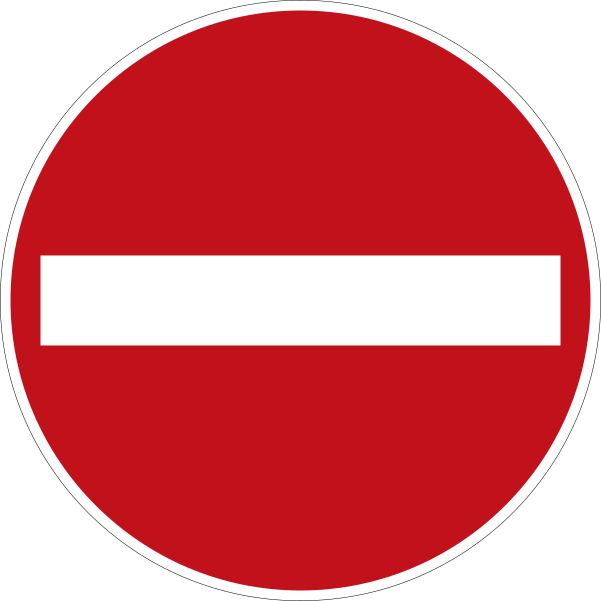
Sign questions test colour and shape first. Red rings forbid, red triangles warn, blue discs instruct. Many failed answers come from knowing the meaning of a sign but misjudging a look-alike, for example a no stopping sign against a no parking sign. Drill them in road signs test 1 and road signs test 2.
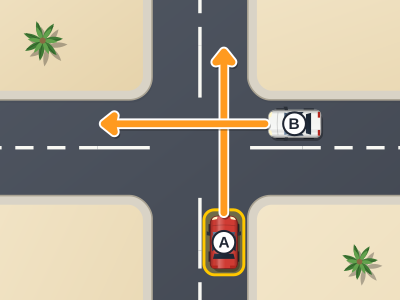
Priority questions show a top-down junction with cars labelled A and B. Read who is turning, who is going straight, and which road has a sign. Roundabouts in the UAE are driven anticlockwise and the traffic already on the roundabout has priority. The right of way test is built around exactly this skill.
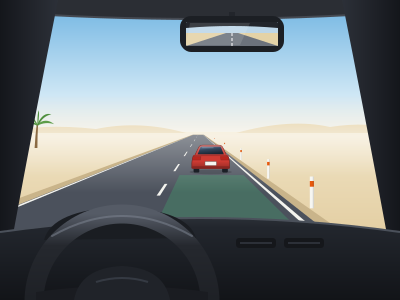
Safe driving questions ask what you do with distance, speed and lights when visibility drops. They reward the cautious answer. If two options look close, the safer one is almost always the one the test wants.
Topics on the test and where to drill each
Nobody outside the RTA can give you an official percentage split by topic, and we will not invent one. What candidates consistently report is a spread across signs, rules, priority, safe driving, penalties and the hazard clips. The table below maps each area to what you need to know and the free practice that targets it.
| Topic | What you need to know | Where to practise |
|---|---|---|
| Road signs | Shape and colour families, warning versus prohibition, Arabic and English text | road signs test 1 and road signs test 2 |
| Road rules | Lane discipline, overtaking, U-turns, horn and light use, school zones | road rules test 1 and road rules test 2 |
| Right of way | Unsigned junctions, roundabouts, emergency vehicles, pedestrians | right of way test |
| Safe driving | Following distance, fog, rain, sandstorms, fatigue, seat belts, child seats | safe driving test |
| Fines and black points | Which offences carry fines, black points, impoundment or licence suspension | fines and black points test 1 and fines and black points test 2 |
| Hazard clips | Spotting a developing hazard early and reacting at the right moment | Covered in the full mocks RTA mock test 3 and RTA mock test 4 |
Do not skip the boring topics
Fines and black points questions feel like trivia, but they are easy marks once you have seen them a few times. Candidates who ignore them often finish a mock one or two marks short. Those are the marks that decide a pass or a fail at 30 out of 40.
The hazard perception clips
Since July 2015 the Dubai test includes a hazard section made of short video clips. You watch a clip of a road situation, then answer questions about what the developing hazard is or what you should do. Reports from schools describe about five clips of roughly 25 seconds each. Treat that as the typical shape, not a guarantee.
How to approach a hazard clip
- Watch the whole clip before you decide. The hazard is often not the first thing that moves.
- Ask what could change in the next three seconds: a pedestrian stepping out, a car door opening, a vehicle pulling from a side street.
- Prefer the answer that increases your margin: slow down, cover the brake, keep a gap.
- Do not choose a dramatic action such as swerving when a controlled slowdown is available.
How to practise without a clip bank
The full timed mocks and the safe driving test build the same habit: read the scene, name the hazard, pick the cautious action. The RTA app also has a free practice test for Dubai that you can use alongside ours so you see more than one set of questions.
Do not leave hazard questions until the last minute. They arrive near the end of a 30 minute paper, when your attention is lowest. Practising the full paper with the timer on is the only way to train that.
Dubai printable theory pack
609 questions with the answer and the rule, 3 full papers at the real length. One payment, no account.
Fail on the day
AED 200+
Pass first time
AED 15
- 3
- Full papers
- 609
- Questions
- printable
That's 2.5 fils a question, every answer explained.
What failing the RTA theory test costs you
Failing is not just a bruised ego. Every Dubai knowledge test appointment is paid for, and a fail puts you back in the queue. Here is what the published costs and rules look like.
| Item | Amount or rule |
|---|---|
| Knowledge test appointment | AED 220 (AED 200 for the test plus AED 20 Knowledge and Innovation fee) |
| Moving to an earlier slot | AED 300 |
| Retest after a fail | A new paid appointment, so another AED 220 or more |
| Six month rule | If you do not take a knowledge, yard or road test within six months of your last appointment, your training file is suspended |
| Waiting time | Set by slot availability at your institute, not by a fixed RTA delay |
The money is the smaller cost. A fail also delays your lessons and your yard and road tests, because you cannot move to the next stage until you pass. If you are paying for a driving package by the month, or taking leave to attend, every failed attempt stretches that bill. See what to do after failing the theory test for the full retest process.
The cheapest way to revise
A mock costs you nothing to fail. A real appointment does not. Sit mocks until you are comfortably above 30 out of 40, and for a wider bank of questions use the printable papers for Dubai or the full bank, which cover every topic with explanations.
What your mock score means
A score only helps if you know what to do with it. Use this table to decide whether to book, keep practising or go back to basics. Scores are out of 40 to match the real paper.
| Your mock score | What it means | What to do |
|---|---|---|
| Below 24 of 40 | You are missing core rules or signs | Go back to the handbook and the topic tests, then retake a fresh mock in a few days |
| 24 to 29 of 40 | A near miss. This is where most fails live | Find the topics you dropped marks on and repair them before booking |
| 30 to 33 of 40 | You would just pass, but one bad question fails you | Do not book yet. Sit two more mocks |
| 34 to 36 of 40 | A realistic margin for most candidates | Book when two mocks in a row land here |
| 37 or more of 40 | Strong. Nerves are your only remaining risk | Book, and rest the night before |
The pass line is a floor, not a target. A score of exactly 30 means one slip on the day turns a pass into a fail. Plan to clear it by at least four marks on two separate mocks before you pay for an appointment.
Why two mocks in a row beat one good score
One strong score can be luck, for example a mock where the questions happened to match what you revised. Two scores in a row, on different papers, are much harder to fluke. That is why we suggest moving through RTA mock test 2 and RTA mock test 3 before you commit to a date.
The mistakes that fail people, and the fix for each
These are patterns that come up again and again in what candidates report after a failed attempt. They are mostly habits, not knowledge gaps, and you can fix them in practice.
| Mistake | Why it costs marks | Fix |
|---|---|---|
| Reading the picture, not the question | You answer what you see, not what is asked | Read the question stem first, then look at the picture |
| Mixing up look-alike signs | No stopping, no parking and no entry share colours and shapes | Drill road signs test 2 until the differences are automatic |
| Guessing at unsigned junctions | Priority rules feel obvious until they are not | Name who is turning and who is straight, every time |
| Rushing the last ten questions | Time pressure causes misreads at the end | Practise the full 30 minute timed paper |
| Ignoring penalties | Fines and black points questions are easy marks | Run fines and black points test 1 and fines and black points test 2 |
| Revising from one source only | You learn the wording, not the rule | Use the handbook, the RTA app and a second question bank |
The overconfidence trap
Many candidates who hold a licence from another country assume the test will be easy. The Gulf rules differ in places: roundabout direction, speed limits, fines and the way hazard clips are asked. Do at least two mocks before booking, however experienced you are.
A ten day plan from first mock to booking
This plan assumes about 45 to 60 minutes a day. If you have a fixed appointment, count back from it. If you do not, treat day ten as the earliest day you should consider booking.
- Day 1: Sit RTA mock test 1 cold with the timer on. Do not revise first. Write down your score and the topics you missed.
- Day 2: Read the sign sections of the RTA handbook and run road signs test 1.
- Day 3: Run road signs test 2 and fix every look-alike sign you got wrong.
- Day 4: Study junction and roundabout priority, then run the right of way test.
- Day 5: Run road rules test 1 and road rules test 2. Note lane discipline and overtaking rules.
- Day 6: Run the safe driving test and study distance, fog, rain and sandstorm rules.
- Day 7: Run fines and black points test 1 and fines and black points test 2 so penalties stop being surprises.
- Day 8: Sit RTA mock test 2 under exam conditions. Compare with day 1.
- Day 9: Repair only the topics that dropped marks on day 8, then sit RTA mock test 3.
- Day 10: Sit RTA mock test 4. If you score 34 or more on two papers in a row, book. If not, repeat days 5 to 9.
Spreading practice over days works better than one long session, because you forget less. If you prefer paper, the printable papers for Dubai give you the same questions to work through away from a screen.
Test day checklist
A good plan can still be spoiled by small things on the day. Run through this list the evening before.
- Check your appointment time and the exact institute location. Leave early; Dubai traffic is unforgiving.
- Bring your Emirates ID or other ID that your institute requires, and any file or document it asked for.
- Choose your language at the start of the test and confirm it before you begin.
- Eat and drink beforehand. A 30 minute test is short, but a headache costs marks.
- Silence your phone and follow the centre rules.
- Sleep properly the night before rather than cramming.
During the test
Read each question fully, then look at the picture. If you do not know an answer, make your best choice and move on rather than burning time. Keep an eye on the clock: aim to finish the first 30 questions with at least ten minutes left for the hazard clips and a final check.
If it does not go your way
If you fail, do not rebook the same day in frustration. Work out where you lost marks, repair them and follow the steps in what to do after failing the theory test. A short, focused gap beats an instant retake that fails again.
Other emirates and other vehicle tests
The signs and rules are shared across the UAE, but format, fees and booking differ by emirate. If you are testing in Abu Dhabi, read the Abu Dhabi theory test guide and use Abu Dhabi practice tests. If you are in Sharjah, start with the Sharjah theory test guide and the Sharjah practice tests. Candidates in Ajman, Ras Al Khaimah, Fujairah and Umm Al Quwain can use the same mocks for the shared rules and signs.
Motorcycle and truck and bus
Motorcycle candidates have their own papers: start with motorcycle mock test 1 and the wider set of motorcycle theory tests. Heavy vehicle candidates should use truck and bus mock test 1 and the other truck and bus theory tests. Each is a 40 question, 30 correct style paper, so the same margin rule applies.
Coming from a foreign licence
Whether you must sit the theory test at all depends on your nationality and licence country. Check with the RTA or your institute before you assume you are exempt. If you do have to sit it, the mocks are built for exactly that situation.
How to practise so you pass first time
The most reliable route is simple: baseline, repair, rehearse, book. Sit a cold mock to see where you stand, repair the topics that cost you marks, rehearse with fresh full-length papers under the timer, and only then book your appointment.
Step 1: use the free mocks
Start with the free questions in RTA mock test 1 and the next mocks. They cost nothing and show you immediately how far you are from the pass line.
Step 2: go deeper with the full bank
When the free questions are not enough to cover your weak spots, the full bank adds every mock and topic test with explanations, and the printable papers for Dubai give you the same content to print and mark by hand. It is a one-off payment with no subscription, which is a small cost next to a second AED 220 appointment.
Step 3: book only when you are clear
Book when two different mocks land at 34 of 40 or better. At that point you are not hoping to pass; you expect to. That is the difference between paying once and paying again.
Free Dubai mock tests and topic tests
Every test opens on ten free questions. Pick a full mock at the real length, or drill one topic.
- UAE RTA Theory Mock Test 1Mock · 40 questions
- UAE RTA Theory Mock Test 2Mock · 40 questions
- UAE RTA Theory Mock Test 3Mock · 40 questions
- UAE RTA Theory Mock Test 4Mock · 40 questions
- UAE Road Signs Practice Test 1Topic · 22 questions
- UAE Road Signs Practice Test 2Topic · 22 questions
- UAE Road Rules Test 1Topic · 20 questions
- UAE Road Rules Test 2Topic · 20 questions
- UAE Right of Way Practice TestTopic · 22 questions
- UAE Safe Driving Practice TestTopic · 22 questions
- UAE Fines & Black Points Test 1Topic · 20 questions
- UAE Fines & Black Points Test 2Topic · 20 questions
Practise for your emirate
The rules are national, but the test centre, booking and fees can differ by area.
Frequently asked questions
Yes. The RTA Dubai app has a free practice theory test under its driver and licensing services, which needs a UAE Pass or RTA account. Use it alongside a separate mock bank so you see more than one set of questions and are not memorising a single paper.
Dubai driving schools report 40 items for the light vehicle test: multiple-choice questions plus the hazard perception section that was added in July 2015. Our mock papers follow that size, 40 questions in 30 minutes, so the pacing you practise matches the real sitting.
30 out of 40, which is 75%. Older guides quote 23 out of 35 (65%) and are outdated. From 1 January 2027 new federal rules set 75% as the minimum theory pass mark in every emirate, so aim well above 30 in practice rather than for a bare pass.
About 30 minutes. Practise with the timer on, because the hazard clips and the last questions are where candidates rush. Aim to finish the main questions with ten minutes to spare so you can review and still handle the hazard section calmly.
AED 220 per Dubai appointment, made up of AED 200 for the test and AED 20 Knowledge and Innovation fee. Taking an earlier slot costs AED 300. A fail means paying for a new appointment, which is why a free mock first is the cheaper way to revise.
At least three full mocks on different papers. Book when two of them in a row land at 34 out of 40 or better. One good score can be luck, but two in a row on different questions shows you have the rules, not just one paper.
In Dubai, if you do not take a knowledge, yard or road test within six months of your last appointment, your training file is suspended. Keep practising and booking steadily after a fail rather than leaving a long gap before your next attempt.
The first questions of each mock are free with no signup. The full bank of mocks and topic tests is a one-off payment with no subscription. The questions are written to the published rules and to what candidates report from the real test, not copied from the RTA.
Dubai printable theory pack
609 questions with the answer and the rule, 3 full papers at the real length. One payment, no account.
Fail on the day
AED 200+
Pass first time
AED 15
- 3
- Full papers
- 609
- Questions
- printable
That's 2.5 fils a question, every answer explained.
Official sources
- RTA - Roads and Transport Authority, Dubai
- RTA - Light vehicle driver handbook (PDF)
- Excellence Driving - How to pass the RTA car theory test (Sep 2026)
- Bin Yaber - Dubai driving licence cost (Aug 2026)
- Gulf News - UAE driving test rules 2027, 75% passing score (28 Oct 2026)
- Khaleej Times - Risks recognition test (7 Jul 2015)