In This Guide
- How much is the dependent fee in 2026?
- Why the fee exists and how it started
- Who counts as a dependent for the fee?
- Myth vs fact: the under-18 exemption that does not exist
- How the fee is calculated (months vs partial months)
- How to pay via Absher: step by step
- Who is exempt from the dependent fee?
- What if you cannot pay the dependent fee?
- Impact on exit visas and final exit
- How to reduce the dependent fee bill legally
- Edge cases and special situations
- Common problems and fixes
- Overwhelmed by dependent fees, Iqama renewals, and family sponsorship admin?
How much is the dependent fee in 2026?
Last verified: July 2026 against MHRSD and Absher fee schedules.
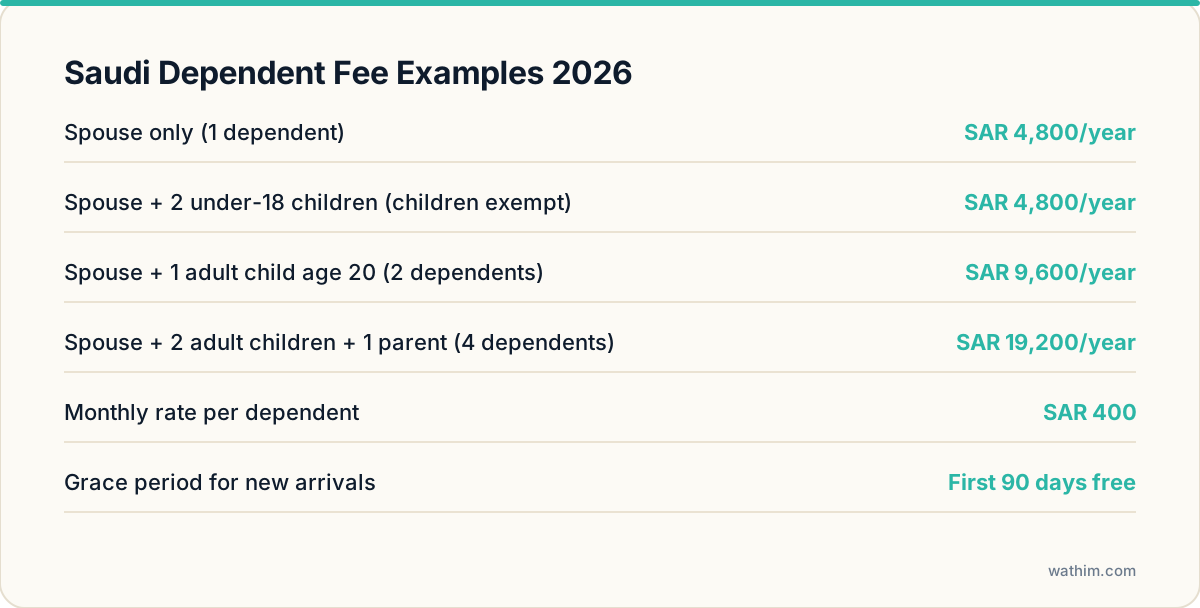
The Saudi dependent fee is SAR 400 per dependent per month, or SAR 4,800 per dependent per year, and it applies to every sponsored dependent regardless of age: spouse, children of any age, and parents. There is no under-18 exemption, despite what many forum threads and older guides claim. The fee is paid by the expatriate sponsor, the person whose Iqama lists the dependents, not by the employer.
Here is what a typical family pays per year:
| Family setup | Dependents who pay | Monthly total | Annual total |
|---|---|---|---|
| Spouse only | 1 | SAR 400 | SAR 4,800 |
| Spouse + 2 children (any age) | 3 | SAR 1,200 | SAR 14,400 |
| Spouse + 1 child | 2 | SAR 800 | SAR 9,600 |
| Spouse + 2 children + 1 parent | 4 | SAR 1,600 | SAR 19,200 |
The fee applies to each calendar month (or part-month) that the dependent is registered on your sponsorship, from the date the dependent's Iqama is issued, not from any birthday. New arrivals get a 90-day grace period, the fee starts on day 91. The rest of this guide explains the rule cleanly enough that you can plan around it: what the levy actually covers, why the under-18 exemption rumour is wrong, when to cancel sponsorships, and when the SAR 400 line on your budget is non-negotiable.
Why the fee exists and how it started
The dependent levy was introduced in July 2017 as part of Saudi Arabia's Vision 2030 fiscal reform programme. The intention was to reduce the ratio of expatriate family members to Saudi nationals and to generate revenue that would fund social programmes.
The fee started at SAR 100 per dependent per month in 2017 and increased in annual increments: SAR 200 in 2018, SAR 300 in 2019, and SAR 400 from 2020 onwards. It has remained at SAR 400 through 2026.
This history matters because many older guides and expat forum posts quote the earlier rates. Any guide that says the dependent fee is SAR 100 or SAR 200 is outdated. The current rate is SAR 400 per dependent per month, and there are no announced plans to change this. If you read a 2018 forum thread quoting SAR 200/month and assume that is still your liability, you will be undershooting by half.
Who counts as a dependent for the fee?
A dependent is anyone whose residency (Iqama) you sponsor. This typically includes:
- Your spouse (husband or wife on a family visa)
- Children of any age on a dependent visa, including infants and minors
- Parents on a family visit or dependent visa
The fee applies per dependent, per month, with no age threshold. It is not a per-household charge. If you sponsor five people, you pay for five people, whether they are 2 years old or 62.
A common misconception: the fee is charged on all dependents regardless of whether they are physically present in Saudi Arabia. If a dependent's Iqama is active and linked to your sponsorship, the fee accrues. If a dependent travels abroad for an extended period, the fee still runs unless their Iqama is formally transferred, suspended, or cancelled. This catches out many expats whose elderly parents return home for the summer or whose university-age children study abroad.
If your dependent works and has their own work Iqama (meaning they are now sponsored by an employer), they are no longer your dependent for fee purposes, their employer's levy applies instead.
Scenario: Yusuf's daughter starts university in Canada. Yusuf, an accountant in Riyadh, has a daughter now studying at the University of Toronto. She is physically in Canada for 10 months of the year. Her dependent Iqama is still active because Yusuf has not cancelled it, he wants her to be able to return on summer holidays without re-applying. The SAR 400/month has been accruing since her Iqama was first issued and keeps running while she is abroad. Over a year that is SAR 4,800, even though she is in Saudi Arabia for only two months of it. Yusuf has three options: (1) accept the SAR 4,800/year as the cost of keeping her sponsorship simple; (2) cancel her dependent Iqama now and re-issue when she visits, accepting the administrative cost; (3) explore whether his Premium Residency eligibility makes financial sense over a 5-year horizon. Most expats in his position choose option 1 until the maths becomes painful.
Myth vs fact: the under-18 exemption that does not exist
Search any expat forum for "saudi dependent fee children" and you will find confident claims that children under 18 are exempt, or that the fee only starts when a child turns 18. This is false. The MHRSD levy has applied to every sponsored dependent, of any age, since it was introduced in July 2017. We have verified this against the current MHRSD and Absher fee schedules and against multiple legal and immigration sources.
| Myth | Fact |
|---|---|
| Children under 18 are exempt from the dependent fee | Every sponsored dependent pays SAR 400/month, from infants to elderly parents |
| The fee starts the month a child turns 18 | The fee starts when the dependent's Iqama is issued (after the 90-day new-arrival grace), regardless of age |
| A family of four pays SAR 9,600 a year because the children are free | A family of four (spouse + 2 children) pays SAR 400 x 3 = SAR 1,200/month, or SAR 14,400 a year |
| The fee is still SAR 100 or 200 per month | Those were the 2017 and 2018 introductory rates; the rate has been SAR 400 since July 2020 |
Where does the myth come from? Partly from confusion with other GCC states and other Saudi fee categories that do have age thresholds, and partly from forum posts written when the levy was new and its rules were poorly understood. Whatever the origin, budgeting on the assumption that your children are free is the single most expensive mistake families make when modelling the cost of Saudi residence. A couple with three school-age children is looking at SAR 1,600/month, SAR 19,200 a year, not SAR 400/month.
How the fee is calculated (months vs partial months)
The fee is calculated per calendar month. A partial month counts as a full month. So if a dependent arrives on the 25th of a month, you owe the full SAR 400 for that month.
The 90-day grace period for new arrivals is applied before the billing starts. Day 91 is the first day the fee accrues. The grace period is counted from the date the dependent's Iqama is issued, not the date they physically arrive.
Payment in practice: although the levy is expressed as a monthly rate, it is normally collected at Iqama renewal for the year ahead, through Absher or SADAD. Renewing a dependent's Iqama for 12 months means paying 12 x SAR 400 = SAR 4,800 for that dependent upfront. Shorter renewal periods reduce the upfront amount proportionally, but the per-month rate never changes.
Arrears accrue interest and block key services. Outstanding dependent fees will block your ability to issue or extend exit re-entry visas, renew your Iqama, and in some cases issue a final exit visa.
Worked example: a family of 4 arrives mid-year. Hisham takes a job in Dammam starting 1 March 2026. His wife Layla and two children (ages 8 and 14) arrive on family visas on 15 May 2026, their Iqamas are issued 20 May 2026. The 90-day grace period runs from 20 May to 17 August. From 18 August onwards, the SAR 400/month starts for all three dependents, the children included: there is no age exemption. August counts as a full month even though the fee started mid-month, so the bill for the rest of 2026 (Aug to Dec) is 5 months x SAR 1,200 = SAR 6,000. For 2027 (full year): 3 x SAR 4,800 = SAR 14,400. The same SAR 14,400 recurs every year the family stays on Hisham's sponsorship, and in practice it is collected at Iqama renewal for the year ahead.
This is why the dependent fee is best modelled as a flat SAR 400 per head per month from day 91 onwards, not as something that ramps up as the children grow. Build it into your salary negotiation, not into your end-of-month surprise expenses.
How to pay via Absher: step by step
Payment is managed through Absher Individuals or directly via SADAD. The Absher route is the simplest for most people:
- Log into Absher Individuals at absher.sa
- Navigate to "Family Services" from the main menu
- Select "Dependent Fee" or "Family Levy"
- Your registered dependents are listed with their Iqama numbers and current balance due
- Choose the period you are paying for, typically the 12 months ahead to match the Iqama renewal
- Confirm the total amount and pay via linked payment method or SADAD
- Keep the payment receipt, you will need the reference number if there is ever a dispute
You can also pay directly through the SADAD portal at sadad.com.sa using your Iqama number as the billing reference. This is useful if Absher is having a technical issue or if you prefer to pay from your bank's SADAD integration.
What the screen actually looks like. The Family Services dependent fee page lists each sponsored dependent on a separate row with their full name, Iqama number, age (computed from date of birth), and the months currently due. If you have ignored the fee for 8 months, those 8 months appear as a list with each one's SAR 400 line. You select which months to pay (or "select all") and the total updates dynamically. SADAD payment confirmation is instantaneous, but the block-clearing in the passport services system takes 24-48 hours, plan accordingly if you have an exit visa transaction queued.
For family sponsorship and dependent management, the dedicated service page covers the full lifecycle from visa issuance to renewal.
Who is exempt from the dependent fee?
The list of genuine exemptions is short, and it is worth repeating what is not on it: children are not exempt at any age. The under-18 exemption you may have read about on forums does not exist in the MHRSD fee schedule. The exemptions that do exist as of 2026:
| Category | Exempt? | Notes |
|---|---|---|
| Children (any age) | No, not exempt | Common myth; the SAR 400/month applies from Iqama issue regardless of age |
| New arrivals (first 90 days) | Yes, grace period | Fee starts on day 91 from Iqama issue |
| Premium Residency holders | Yes, exempt from all standard resident fees | Premium Residency is a separate paid programme |
| Foreign wives of Saudi citizens with disabilities | Yes, exempt | Specific exemption per MHRSD rules |
| Dependents of industrial sector workers | Was exempt through end-2025; 2026 status unverified | Check current MHRSD announcements for 2026 status |
Note on the industrial sector exemption: this was confirmed through end-2025 but its extension into 2026 has not been verified through an official gazette announcement. If you are an industrial sector worker, confirm the current status with your employer or directly with MHRSD before assuming you qualify. Do not skip paying on the assumption it has been extended, the arrears block your services either way and recovering an overpayment is harder than avoiding underpayment.
What if you cannot pay the dependent fee?
The dependent fee accrues regardless of whether you pay on time. Arrears are recorded in the Absher and SADAD systems and block passport services. Here is what happens practically:
- You will not be able to issue or extend exit re-entry visas for yourself or your dependents
- Your Iqama renewal may be blocked (the system checks dependent fee status during renewal)
- Your dependents' Iqama renewals will be blocked
- A final exit visa may be blocked until arrears are cleared
There is no formal hardship waiver programme for the dependent fee in 2026. If you are genuinely unable to pay, the practical options are: transfer the dependent's sponsorship to a family member in Saudi Arabia who can afford the fee, have the dependent return to their home country and cancel the dependent Iqama (which stops the fee accrual), or speak with a licensed PRO service about any administrative remedies available in your specific situation.
Unpaid dependent fees do not result in criminal penalties or deportation on their own, but the service blocks cascade quickly and create a situation where you effectively cannot leave the country legally until the arrears are cleared.
Scenario: Amal between jobs. Amal, a marketing manager whose contract ended in February 2026, is searching for a new role. Her own Iqama is in the standard 90-day post-employment window. She sponsors her mother on a dependent Iqama. While Amal job-hunts, her income is zero but the SAR 400/month dependent fee keeps accruing. By month 4 of unemployment she has SAR 1,600 of arrears. When she finally secures a job and the new employer initiates a Qiwa transfer, the system shows the arrears and the transfer stalls. She clears the SAR 1,600 from her savings, the block lifts within 48 hours, and the transfer goes through. The lesson is that the dependent fee runs even when your salary does not, and the smoothest path back into work assumes you can clear arrears before the new employer initiates anything.
Impact on exit visas and final exit
Outstanding dependent fees are one of the most common reasons exit re-entry visa issuance fails in Absher. The system checks for unpaid dependent fees before allowing any passport service transaction.
For a final exit, the situation is stricter: you cannot issue a final exit visa for a dependent if their fee account has arrears, and you cannot issue your own final exit visa if you have outstanding dependent fee obligations. This creates a chicken-and-egg problem: you want to leave, but you cannot issue the exit visa until you pay, and paying requires money you may not have if you are leaving because of financial difficulty.
The practical approach is to pay off the dependent fee arrears before starting any exit processing. Calculate the exact amount owed in Absher first, then pay the minimum needed to clear the block. Full details on the exit process are in our exit re-entry visa guide.
For larger families, the Iqama and residency service can help calculate outstanding fees and coordinate payment across multiple dependents simultaneously.
How to reduce the dependent fee bill legally
You cannot negotiate the rate down: SAR 400 per dependent per month is a government levy with no room for negotiation. But you can reduce the total bill legitimately.
1. Remove adult children from your sponsorship when they get employment. When a child over 18 finds work in Saudi Arabia, their new employer becomes the sponsor. Remove them from your dependent visa immediately to stop the fee accrual. The administrative step takes a day; the savings are SAR 400 per month from that point forward.
2. Time arrivals to maximise the 90-day grace period. If you know a dependent is arriving, the 90-day grace starts from Iqama issue, not arrival. Register the Iqama as close to their actual arrival date as practicable. A 2-month early Iqama issuance burns 60 days of the 90-day grace before the dependent has even landed.
3. Do not keep the sponsorship active for dependents who have left. If your spouse or parent returned to their home country with no plans to return to Saudi Arabia soon, cancel their dependent Iqama. The fee accrues as long as the Iqama is active, whether or not the person is physically in the Kingdom. Yusuf's daughter in the earlier example is paying SAR 4,800/year to keep a sponsorship "live" for two months of summer holiday visits, that is SAR 2,400 per month of actual presence. Reissuing on each visit may be cheaper.
4. Investigate the Premium Residency programme if you plan to stay long-term. Premium Residency exempts all standard fees for you and your dependents. The upfront cost is significant (the application process and requirements are beyond the scope of this guide), but for large families on long-term assignments the maths can work in your favour over a 5-10 year horizon. As a rough benchmark: a family with 4 sponsored dependents pays SAR 19,200/year in dependent fees alone. Over 10 years that is SAR 192,000, before counting work permit levies and other fees. Run the comparison before dismissing Premium Residency as too expensive.
Edge cases and special situations
The standard rule (SAR 400/month per dependent of any age) covers most situations, but these edge cases are worth knowing in advance.
A newborn added to the family file
A baby born in the Kingdom becomes a fee-liable dependent once registered on your sponsorship and issued an Iqama. There is no age at which the fee "switches on" later: it runs from Iqama issue like any other dependent. Calendar-month rounding is consistent: partial months always round up to a full SAR 400.
Dependent whose Iqama is cancelled mid-month
If a dependent's Iqama is cancelled on the 10th of the month, you still owe the full SAR 400 for that month. There is no pro rata refund for the unused 20 days. This matters when planning departures: cancelling at the start of a month avoids paying for a near-empty month, but timing this requires the dependent to actually depart first.
Sponsor's Iqama is in a transfer or renewal state
The dependent fee accrues based on the dependent's Iqama status, not the sponsor's. Even if your own Iqama is in "under renewal" status, the dependents' fees keep running. Plan to pay both fronts during transitions.
You are sponsoring a parent who is between hospitals abroad
A parent on a dependent Iqama who is receiving extended medical treatment abroad still incurs the SAR 400/month while the Iqama remains active. Some families assume "they are not here, the fee pauses," but the fee is on the active sponsorship, not on physical presence. If treatment is expected to last 6+ months and there are no immediate plans to return, cancelling the dependent Iqama and re-issuing later may be cheaper than paying through the absence.
You are about to enter Premium Residency
Premium Residency exempts dependents from the standard fee. If your application is in process, time the dependent fee payment around the expected approval date, do not pre-pay 12 months of fees if you expect Premium Residency status within 3 months. The fee paid is non-refundable in practice for the months you paid for upfront.
Industrial sector exemption: what to do given the 2026 uncertainty
If you work in an industrial sector facility, the 2025 exemption's status in 2026 is unverified at the time of writing. The safe approach: pay the fee on the standard schedule. If MHRSD confirms a retroactive exemption (uncommon but possible), you may be able to recover or credit the payments. Underpayment based on an unconfirmed exemption is the worse mistake.
Your sponsor (you) lose your job, dependents stay
If your employment ends, your own residency status enters a 90-day grace period during which you can find new sponsorship. During that grace period, the dependent fee continues to accrue on each sponsored dependent. If you anticipate the grace running out, plan whether to cancel dependent sponsorships before exiting yourself, the alternative is paying for months you did not realise you owed when you eventually do return for a final exit.
Common problems and fixes
Absher shows a higher balance than expected
Check the registration date on each dependent's Iqama in Absher. The fee accrues from day 91, and if you have not been paying regularly, months of arrears can accumulate. The balance shown is the outstanding total across all months since the last payment. Pay the full balance before attempting any passport service transaction. If a single dependent's balance looks wrong, dig into their individual month-by-month breakdown, the system shows each accrued month as a separate line.
I paid the fee but exit visa is still blocked
Payment confirmation and the blocking flag clearing are not always instantaneous. Allow 24-48 hours after payment for the Absher passport services system to reflect the cleared balance. Keep the SADAD or Absher payment receipt reference number, if the block persists after 48 hours, contact Absher support with the reference. Do not double-pay in panic, this creates a credit that does not refund quickly.
I read that children under 18 are exempt, but Absher is charging me for my kids
Absher is right and the forum post was wrong. There has never been an under-18 exemption in the dependent levy: the SAR 400/month applies to every sponsored dependent from the date their Iqama is issued, whatever their age. If you budgeted on the exemption myth, the balance Absher shows for your children is genuine arrears, not a system error, and it must be cleared before renewals and exit visas will process.
My dependent's Iqama shows fee due but they left Saudi Arabia 6 months ago
The fee accrues on active Iqama registrations regardless of physical presence. If a dependent has left and will not return, cancel their Iqama through Absher immediately. Any arrears already accrued must be paid before you can process exit-related services. Going forward, cancelling the Iqama stops the monthly fee. There is no retroactive waiver for the months the dependent was physically absent.
My employer wants to deduct the dependent fee from my salary
This is not allowed. The dependent fee is the personal obligation of the expatriate sponsor, and Saudi labour law prohibits employers from deducting government fees from employees' salaries without specific written consent. If your employer attempts this, raise it in writing first, and escalate to MHRSD if not resolved. Some companies offer a "dependent fee reimbursement" benefit, which is different (paid as part of compensation, not deducted) and is fine.
Overwhelmed by dependent fees, Iqama renewals, and family sponsorship admin?
Managing fees, renewals, and sponsorship transfers across a family can absorb hours of your time in portals that are not always straightforward. Our team handles the end-to-end Saudi Arabia family sponsorship process: calculating exact outstanding fees, making payments, coordinating renewals, and clearing blocks quickly. Contact us and let us know how many dependents you have and what services are currently blocked, we will give you a clear action plan.
Run your numbers: our Saudi dependent fee calculator gives a clean monthly figure, and the Saudi Iqama cost calculator bundles renewal and dependent costs together. Payments and grace-period tracking sit inside Absher via Nafath; sponsors with corporate exposure should also watch Qiwa.
Related reading: Saudi family residence visa and dependent iqama.
Frequently Asked Questions
SAR 400 per dependent per month, or SAR 4,800 per dependent per year, for every sponsored dependent regardless of age. This rate has been unchanged since July 2020 and remains in effect through 2026. The fee is per sponsored dependent, not per household, so a family of four (spouse plus two children) pays SAR 1,200 per month, SAR 14,400 per year.
No. This is a persistent myth on expat forums, but there is no under-18 exemption in the MHRSD fee schedule. The SAR 400/month levy applies to every sponsored dependent, including infants and school-age children, from the date their Iqama is issued (after the 90-day new-arrival grace period). Budget SAR 4,800 per year for each child on your sponsorship.
Yes. The fee is based on active Iqama registration, not physical presence. As long as your dependent's Iqama is active and linked to your sponsorship, the SAR 400/month accrues regardless of where they are. If a dependent has effectively left for good, cancel their Iqama to stop the accrual rather than continuing to pay for an inactive sponsorship.
Arrears accumulate and block passport services: you cannot issue or extend exit re-entry visas, renew Iqamas, or process a final exit visa until the balance is cleared. There are no criminal penalties for non-payment alone, but the service blocks escalate quickly and create a situation where you cannot legally leave the country until you clear the arrears.
The 90-day grace period starts from the date the dependent's Iqama is issued, not the date they physically arrive in Saudi Arabia. Day 91 is the first day the SAR 400/month fee accrues. To maximise the grace period, time the Iqama issuance close to actual arrival rather than issuing it months in advance.
No. The dependent levy is the personal obligation of the expatriate sponsor, not the employer. Saudi labour law prohibits employers from deducting government fees from employees' salaries without specific written consent. Some employers offer a dependent fee reimbursement as part of the compensation package, that is different and legitimate, but unilateral deduction is not.
Through Absher Individuals under Family Services. You will need to cancel the dependent's Iqama, which typically requires the dependent to depart Saudi Arabia first (on a final exit visa) and all outstanding fees to be cleared before the cancellation is processed. Cancelling early in a month is preferable to late: the partial month counts as a full SAR 400 either way.
There is no discretionary waiver for the standard dependent fee, and no age-based exemption: children of any age are charged. The only fee-free options are: Premium Residency status (exempt from all standard resident fees), the foreign-wife-of-Saudi-with-disabilities exemption, or removing the dependent from your sponsorship by cancelling their Iqama. Dependents of industrial sector workers had an exemption through end-2025 whose 2026 status is unverified, do not skip payment based on an unconfirmed exemption.
Stuck on a Government Service Step?
Wathim publishes free plain-English guides to GCC visas, IDs, driving licences, attestation, and fines. If a fee table looks off or a step is missing, tell us and we will update the guide. You can also book a free guidance call with our GCC services desk.

Wathim Editorial
GCC Services Desk
The Wathim team writes plain-English guides to GCC government services. We track ICP, GDRFA, MOHRE, Absher, Muqeem, Qiwa, Metrash, LMRA, ROP Oman, and MOI Kuwait so expats can plan visa, residency, ID, and licence steps without guesswork.