In This Guide
- What you need to know right now: fees and types
- Single vs multiple entry: which one do you need?
- Who issues your exit re-entry visa: employer vs self
- Issue or extend your visa via Absher: step by step
- Screen by screen: every Absher route, and the Muqeem alternative for employers
- Extending while inside Saudi Arabia
- Extending while outside Saudi Arabia, this is the critical one
- Check your exit re-entry visa status
- Exit re-entry visas for dependents
- Decision table: single vs multiple, when, who pays
- The 3-year ban: what actually happens if your visa expires abroad
- Edge cases and special situations
- Common problems and fixes
- Troubleshooting: visa not showing in Muqeem, paid but not issued, and the return window
- Need help with a blocked exit visa or complex travel situation?
What you need to know right now: fees and types
An exit re-entry visa lets a Saudi Arabia resident leave the Kingdom and return before the visa expires, without losing their Iqama. You need one every time you travel internationally unless you hold a premium residency, diplomatic status, or fall under another specific exemption.
Last verified: July 2026 against Absher and Muqeem service pages. The fee structure reconfirmed: SAR 200 covers the first 2 months of a single-entry visa with SAR 100 per additional month, and SAR 500 covers the first 3 months of a multiple-entry visa with SAR 200 per additional month, with additional-month rates doubling if you apply from outside the Kingdom. Run your own scenario in the exit re-entry fee calculator.
There are two types: single-entry and multiple-entry. The fees below are confirmed by Royal Decree and have not changed since January 2023:
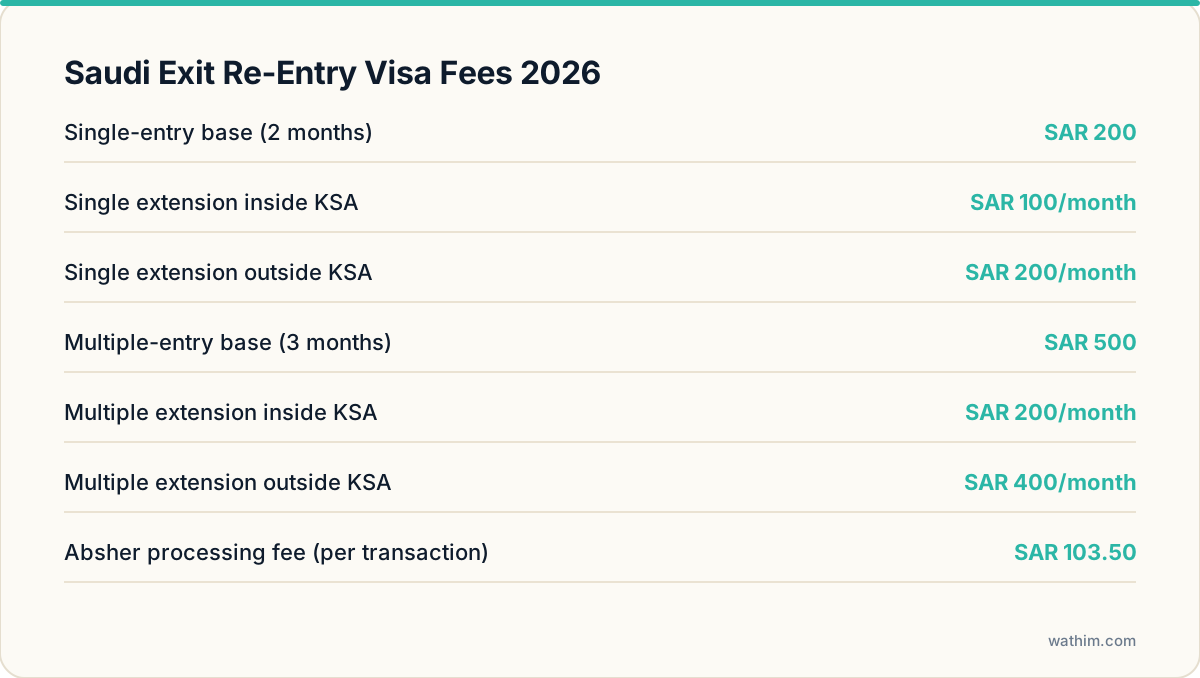
| Visa type | Base fee | Duration covered | Extension (inside KSA) | Extension (outside KSA) |
|---|---|---|---|---|
| Single-entry | SAR 200 | Up to 2 months | SAR 100/month | SAR 200/month |
| Multiple-entry | SAR 500 | Up to 3 months | SAR 200/month | SAR 400/month |
| Absher processing fee | SAR 103.50 | Per extension transaction | - | - |
All fees are non-refundable, including if the visa is cancelled before use. The visa validity is capped by your remaining Iqama expiry: you cannot issue a visa that extends beyond your Iqama end date. That single rule causes more last-minute travel chaos than any other in the Saudi system, and the rest of this guide treats it with the seriousness it deserves.
Single vs multiple entry: which one do you need?
A single-entry exit re-entry visa is used once: you exit Saudi Arabia and return once. After that re-entry, the visa is consumed. If you need to travel again, you issue a new one.
A multiple-entry visa allows unlimited exits and re-entries during its validity period. This is the better choice if you travel frequently, for example, if you take short trips every 4-6 weeks.
The cost comparison: a single-entry base costs SAR 200 for 2 months. A multiple-entry base costs SAR 500 for 3 months. If you travel more than twice in a 3-month window, the multiple-entry option works out cheaper. If you travel once every few months, single-entry is usually more economical because you only pay when you need it.
One practical note: the multiple-entry visa is also easier to manage administratively if you are unsure of your return date. With a single-entry visa, if your trip runs long and the visa expires before you return, you need to extend it from abroad at the higher rate.
Worked example 1: Saif, the occasional traveller. Saif lives in Riyadh and visits his family in Hyderabad twice a year, in March and August, for about three weeks each. He never travels otherwise. A single-entry visa at SAR 200 each time covers both trips: SAR 400 per year. A multiple-entry visa for a full year would not buy him anything useful, his trips are far apart and each fits comfortably within the 2-month base. Verdict: single-entry, both times.
Worked example 2: Reema, the regional consultant. Reema, based in Jeddah, flies to Cairo every 5-6 weeks for client work, plus a longer summer break. Over a 3-month window she usually takes two business trips plus the start of her summer leave. A multiple-entry visa at SAR 500 covers three months of unlimited entries. If she did each of those three trips as separate single-entries, that is SAR 200 × 3 = SAR 600, plus the administrative pain of issuing each one. Verdict: multiple-entry, refreshed each quarter.
The break-even is roughly three trips inside a 3-month window. Below that, single-entry wins on price. Above that, multiple-entry wins on price and on time saved.
Who issues your exit re-entry visa: employer vs self
Before the Labour Relation Initiative 2021, only the employer could issue an exit re-entry visa for the sponsored worker. This has changed significantly.
Private sector workers can now issue their own exit re-entry visas directly through Absher Individuals without employer approval. The employer is notified but cannot block departure for routine travel. This is one of the most useful but least known protections of the 2021 reforms, many workers still ask HR to "approve" their travel when no approval is required.
Employers retain the ability to issue visas for their workers and typically handle this for domestic workers and certain categories of dependent-visa holders. For company employees, self-service through Absher is now standard.
Government sector workers and some specific visa categories may still require employer initiation. If you are in a government job or your sponsor is a government entity, check with your HR department before assuming self-service applies to you.
Counter-example: when self-service does not help you. Even if you are eligible to self-issue, the system will block you if you have outstanding fines, dependent fee arrears, or active huroob status. In these cases the block is not your employer, it is the system reading the database. The fix is to clear the underlying issue, not to ask HR to "override" anything (they cannot).
Issue or extend your visa via Absher: step by step
The entire process is digital, no office visit, no paper forms. You need an active Absher account with your registered Saudi mobile number available for OTP.
- Log into Absher Individuals at absher.sa
- Select "Passport Services" from the main menu
- Choose "Issue Exit/Re-Entry Visa" for a new visa, or "Extend Exit/Re-Entry Visa" for an existing one
- Select visa type: single-entry or multiple-entry
- Choose the duration and travel date
- Review the total fee shown (base fee plus Absher service fee of SAR 103.50 for extensions)
- Pay via SADAD or linked debit/credit card
- The visa is issued digitally and active immediately, no physical stamp is required on your passport
The visa is visible in the Absher app under "My Visas." You can show this screen at the airport or immigration checkpoint; no printed document is required.
What it actually feels like at the counter. At Jeddah and Riyadh airports, the immigration officer scans your passport, the system pulls up your active exit re-entry visa automatically, and you are through within seconds. No officer has asked to see a printed visa in years, the screen they look at is the same database your Absher app is reading from. The one situation where this gets awkward is if the visa was issued in the last 1-2 hours and the border system has not synced yet; in that rare case you may be redirected to a desk and asked to wait for a manual lookup. Issue the visa the day before travel, not the morning of, and this never happens.
You can also check your exit and entry service status through the dedicated service portal.
Screen by screen: every Absher route, and the Muqeem alternative for employers
The steps above cover the happy path. This section maps the individual screens for each issuing route, because the menus differ depending on who is issuing the visa, and each route has its own spot where people get stuck. Labels below match the English interface of Absher as of July 2026; the app occasionally renames menus between versions, so treat close variants ("Passports" vs "Passport Services") as the same screen.
Route 1: issuing for yourself through Passport Services
- Log into Absher Individuals and open the dashboard
- Open "My Services," then "Passports"
- Select "Exit and Re-Entry Visa," then the issue option
- Pick yourself from the person list, choose single or multiple entry, and set the duration in months
- Review the fee summary, confirm, and settle the payment (SADAD invoice or card)
- The visa appears under "My Visas" once the payment clears
Where people get stuck: the duration list silently caps at your Iqama expiry. If the months on offer look shorter than expected, or the confirm button will not activate, it is almost always the Iqama ceiling or an unpaid fine, not an app bug. Check both before contacting support.
Route 2: the self-service "Visa Requests" route (no employer involvement)
Private sector workers using the post-2021 self-service channel go through "Services," then "Passports," then "Visa Requests," then "Create Visa Request." This is the route where the employer is only notified, never asked. Two quirks are consistently reported across 2026 guides: the self-service request covers a single-entry visa with a return period of up to 30 days, and it is not instant. The employer is notified through Muqeem, any objection goes to the Ministry of Human Resources for a decision reported to take up to 10 days, and from day 11 you then have a window of roughly 5 days to pay and issue before the request expires. We could not find that exact window spelled out on an official Absher page, so treat the day counts as indicative and never plan a flight around day 15 of a pending request.
Route 3: dependents through Family Services
Select the family member under "Family Members," open "Services," choose "Visa Services," press "Issue Visa," then set the type and period per person. Each dependent is a separate transaction with its own fee and its own eligibility check, which is why one child's visa can fail while three others go through cleanly.
The Muqeem alternative for employers
Employers and PROs issue worker visas in bulk through the Muqeem business portal rather than Absher. The reported flow: log in with the company's Muqeem credentials, confirm the OTP sent to the registered company mobile, open "Resident Management" in the sidebar, search for the worker by Iqama number, select the exit re-entry service, set the type and duration, and settle the SADAD invoice from the company account. Guides describe processing anywhere from immediate to 24-72 hours depending on the company's setup, so employers should never issue on the morning of a flight. Domestic workers are typically handled by the household employer through Absher's sponsor services instead.
| Route | Best for | Menu path | Speed |
|---|---|---|---|
| Passport Services (Absher Individuals) | Workers issuing their own visa the standard way | My Services, Passports, Exit and Re-Entry Visa | Instant after payment |
| Visa Requests (Absher Individuals) | Workers using the no-employer-approval channel | Services, Passports, Visa Requests, Create Visa Request | Up to 10 days notification, then a short payment window (reported) |
| Family Services (Absher Individuals) | Sponsors issuing for spouse and children | Family Members, Services, Visa Services, Issue Visa | Instant after payment, per dependent |
| Muqeem (business portal) | Employers and PROs issuing for staff | Resident Management, search by Iqama, exit re-entry service | Immediate to 72 hours (reported) |
Extending while inside Saudi Arabia
If your trip plans change and you want to add time to an existing exit re-entry visa before you leave, you extend it through the same Absher flow described above. Select "Extend Exit/Re-Entry Visa" and add the months you need.
Cost for extending inside KSA: SAR 100/month for single-entry, SAR 200/month for multiple-entry, plus the SAR 103.50 Absher processing fee per transaction.
The extension is processed instantly. There is no waiting period or employer approval required for private sector workers extending from within the Kingdom.
Key constraint: you cannot extend a visa to run beyond your Iqama expiry date. If your Iqama is expiring in 3 months, you can only extend the visa to that date maximum. This is why checking your Iqama expiry date before any travel planning matters, a short-validity Iqama caps everything downstream.
Worked example: extending before a delayed return. Karim, in Riyadh, issues a single-entry visa on 1 May for a 6-week trip back to Lahore, expiring 30 June (within the 2-month base). Two weeks in, his mother needs surgery and he wants to stay until 25 July, an extra 25 days, which the system rounds up to one full month. He logs into Absher from his flat in Riyadh before flying out, selects "Extend Exit/Re-Entry Visa," adds one month, and pays SAR 100 + SAR 103.50 service fee = SAR 203.50. The new expiry is 30 July, comfortably covering his planned 25 July return. Had he waited until he was in Lahore, the same one month would have cost SAR 200 + SAR 103.50 = SAR 303.50. The lesson: if you have any inkling your trip may run long, extend before you fly.
Extending while outside Saudi Arabia, this is the critical one
Many expats do not know this is possible. If you are already outside the Kingdom and your exit re-entry visa is about to expire, you can extend it remotely through Absher before the expiry date passes.
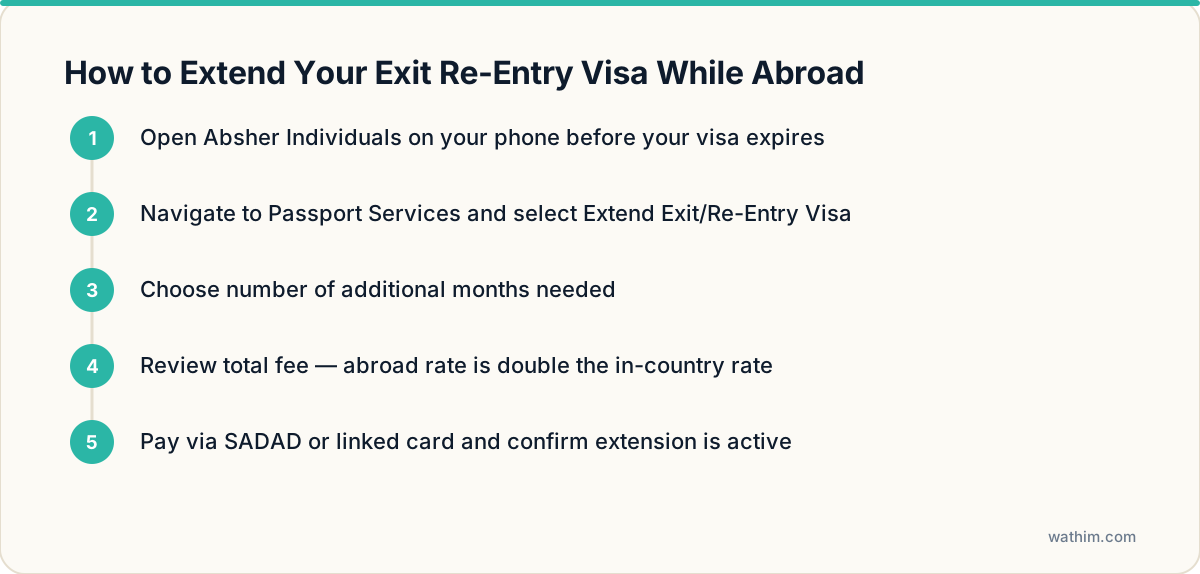
The process is identical to in-country extension: Absher Individuals, Passport Services, Extend Exit/Re-Entry Visa. The difference is the cost: extending from outside the Kingdom is double the in-country rate.
- Single-entry extension from abroad: SAR 200/month (vs SAR 100 inside)
- Multiple-entry extension from abroad: SAR 400/month (vs SAR 200 inside)
- Plus the SAR 103.50 Absher processing fee per transaction
You need your Saudi mobile number to receive the Absher OTP. If your Saudi SIM is inactive while abroad, use a SIM card forwarding service or arrange for someone in KSA to receive the OTP on your behalf.
The extension must be completed before the visa expires. Once the visa has expired while you are abroad, the situation is more complicated, see the next section on consequences.
Also note: the extension is subject to remaining Iqama validity. If your Iqama expires next month, extending the exit/re-entry visa for 3 months is not possible. The Iqama renewal needs to happen from the KSA side (employer action) while you sort out the visa extension.
The OTP problem solved three ways. The single most common reason a from-abroad extension fails is that the Absher OTP cannot be received. The three practical fixes, in order of robustness: (1) Activate international roaming on your Saudi SIM before you leave, even just for the cheapest data-only week, this is enough for SMS reception in most cases. (2) Use a SIM forwarding service that re-sends SMS messages received on a physical SIM in KSA to a number or app of your choice. (3) Trusted intermediary: leave the Saudi SIM with a flatmate or colleague and arrange a same-second handoff over a phone call when you request the OTP. The first is the cleanest if you remember; the third is what 80% of stuck workers end up doing.
Check your exit re-entry visa status
Two methods to check visa status:
Method 1, Absher: Log into Absher Individuals and navigate to Passport Services. Your active exit re-entry visa, its type, issue date, and expiry date are shown under "My Visas."
Method 2, Muqeem: The Muqeem visa validity portal at vv.muqeem.sa also shows your visa status when you enter your Iqama number and passport number combination. This method works without a Saudi mobile number once you are registered.
Always check status before booking travel. A visa that appears valid in your memory may have expired, been cancelled, or had an extension that did not process correctly. The check takes 30 seconds and saves the airport queue conversation that begins with "the system shows your visa as not valid."
Exit re-entry visas for dependents
Dependents on a family sponsorship visa (spouse, children) need their own exit re-entry visas. The primary sponsor issues these through Absher Individuals under "Family Services" or "Dependent Passport Services."
The fees are the same structure as for the primary worker. For large families, this adds up.
Worked example: family of four cost-out for summer holiday. Tariq, a senior engineer in Dammam, is taking his family (wife and two children, ages 16 and 12) home to Islamabad for 6 weeks during the summer. He needs four single-entry visas. Each base SAR 200 covers up to 2 months, which fits his 6-week trip exactly. Total base fee: 4 × SAR 200 = SAR 800. No extension needed if he returns on schedule, so no Absher processing fees added. If instead he were unsure of return date and wanted to extend each visa from abroad by one month at SAR 200 + SAR 103.50 service fee, that would add 4 × SAR 303.50 = SAR 1,214. The lesson: for a known-duration family trip, issue single-entries sized correctly the first time, and budget about SAR 800 for a four-person base.
Children under 18 on a family visa still require their own exit re-entry visa for travel, but the process is the same through Absher. The dependent fee (covered in our dependent fee guide) is a separate monthly charge: it does not grant any travel permission and is not related to exit re-entry visa fees. A common confusion: parents assume paying the SAR 400/month dependent fee covers their children's travel rights, it does not. The exit re-entry visa is a separate transaction every time.
Decision table: single vs multiple, when, who pays
This table is the quick-reference for choosing between visa types and timing extensions.
| Your situation | Recommended visa | Typical total cost |
|---|---|---|
| One holiday trip, 3-6 weeks, no plan to extend | Single-entry, base only | SAR 200 |
| Annual leave 8-10 weeks, slight uncertainty on return | Single-entry, base + 1 month extension before flying | SAR 200 + SAR 100 + SAR 103.50 = SAR 403.50 |
| 3+ business trips planned in next 3 months | Multiple-entry, base only | SAR 500 |
| Family of 4, single holiday up to 8 weeks | 4 × single-entry, base only | SAR 800 |
| Surprise extension needed, already inside KSA | Extend before leaving | SAR 100/month (single) + SAR 103.50 service |
| Surprise extension needed, already abroad | Extend via Absher with OTP from abroad | SAR 200/month (single) + SAR 103.50 service |
| Iqama expires within 60 days of planned travel | Renew Iqama first; visa is capped by Iqama validity | Renewal cost + visa cost (see Iqama expiry guide) |
In all cases, the rule "extend before you fly if there is any uncertainty" saves the doubled abroad-extension cost.
The 3-year ban: what actually happens if your visa expires abroad
For years, expats were warned that letting an exit re-entry visa expire while outside Saudi Arabia would trigger an automatic 3-year re-entry ban. This rule was real, and frequently enforced. But it was removed, effective 16 January 2024.
Since 16 January 2024, the automatic 3-year ban for workers whose exit/re-entry visa expired while abroad has been removed. Workers who previously exceeded their exit permit validity can now re-enter Saudi Arabia on new work visas without serving a ban.
Re-entry bans still apply in other situations: deportation cases, criminal violations, extended overstaying beyond the visa period, and unresolved huroob status. A clean expiry of an exit re-entry visa while abroad, however, is no longer an automatic ban trigger.
If you were previously banned under the old rule and believe you are now eligible to re-enter, contact the Saudi Jawazat (Passports Authority) or a licensed immigration services provider to confirm your specific status before purchasing a ticket. The reform took effect on 16 January 2024 via Jawazat notification to Saudi ports of entry and is corroborated by international advisories including Deloitte and immigration law firms; still, treat the case-specific outcome as worth confirming officially rather than assuming based on this post alone.
Edge cases and special situations
The standard advice covers most workers most of the time. The situations below require a small twist.
Your Iqama expires while the exit re-entry visa is still valid (you are abroad)
The exit re-entry visa is capped by Iqama validity. When the Iqama expires, the visa also becomes invalid in the system, even if the visa's printed expiry is later. You will not be able to re-enter on it. The fix has to come from the KSA side: your employer renews the Iqama through Muqeem, then either the existing visa is reactivated or you are issued a new entry visa. Coordinate with HR before the Iqama expiry date, not after.
Your sponsor refuses to cooperate with a needed extension
For routine extensions on private sector visas, your sponsor's cooperation is not required, you self-service through Absher. The only reason an extension fails after Absher gives a green light is an outstanding fine, dependent fee arrears, or a flag on your record. Sponsor refusal is not in that list. If you suspect HR is "blocking" you, it is almost always one of the system-side issues, not the sponsor pressing a button.
You are travelling with an active labour dispute
If you have an MHRSD complaint pending or a court case in progress, travel is technically allowed unless a travel ban has been issued specifically against you. A travel ban shows up in Absher as a system block on passport services. Check Absher before booking a ticket. If you see any block, do not buy tickets and consult a licensed PRO or legal advisor.
You are leaving permanently, not on a holiday
An exit re-entry visa is for round-trip travel. For permanent departure, you need a final exit visa, which is a separate document with its own rules. The final exit visa is currently free (SAR 0 in fees) plus the SAR 70 Absher processing fee, but requires all fines, dependent fees, and employment obligations to be settled first. Do not use an exit re-entry visa to "leave permanently" in the hope of avoiding the final-exit checks, you will be re-flagged on the next entry attempt.
You hold Premium Residency
Premium Residency holders are exempt from the standard exit re-entry visa requirement for routine travel, the residency itself functions as the travel document for the holder. Confirm the specific terms with your Premium Residency documentation; this is one of the meaningful benefits that distinguishes the programme from standard sponsorship.
Your passport expires within 6 months of intended travel
The exit re-entry visa is linked to your passport. If you renew your passport during a trip, the old visa may not transfer to the new passport automatically. Most destination countries require 6 months of passport validity on entry. The cleanest sequence: renew the passport first, update Absher with the new passport number, then issue the exit re-entry visa.
Common problems and fixes
Cannot issue a visa through Absher, blocked message
The most common block is an unpaid fine (traffic, municipal, or dependent fee arrears). Log into Absher and check for outstanding amounts under the dashboard "Violations" or "Fines" section. Traffic fines block most passport services. Dependent fee arrears also block exit visas, see the dependent fee guide for how to clear these. After payment, wait 2-4 hours for the block flag to clear before retrying.
Absher shows the visa as issued but the border system does not recognise it
There is occasionally a short sync delay between Absher and the border control database. Wait 2-4 hours after issuance before travelling. If the problem persists, call the Jawazat helpline (920001997) or visit the departure hall's immigration desk before reaching the exit gate. Always screenshot the Absher "My Visas" page before leaving home so you have evidence of issuance regardless of sync state.
Visa expired while I was abroad, what do I do now?
Since 16 January 2024, the automatic ban has been removed. You will need a new work or entry visa to re-enter Saudi Arabia. Contact your employer in KSA, they will need to issue a new entry visa for you through the appropriate channel. Do not attempt to enter on the expired visa, the airline will likely refuse boarding when they scan it against the destination's online system.
Extension payment went through but the visa was not extended
Screenshot the payment confirmation with the transaction reference number. Contact SADAD or Absher support with the reference. Do not attempt to travel until the extension shows as confirmed in Absher. Payments and visa issuance occasionally de-sync during system maintenance windows, the payment is recorded but the visa update fails silently. Refunds on these de-sync cases do happen but require the SADAD reference, save it.
My employer refuses to approve the exit visa
Since the LRI 2021 reforms, private sector workers can issue their own exit re-entry visas through Absher without employer approval. If you are blocked at the Absher level specifically (not at the border), the issue is likely a system flag (fine, dependent fee, or huroob) rather than employer approval. Check your Absher status for any alerts and clear those before assuming HR is the obstacle.
Family member's visa block but mine works
Each dependent is checked separately. A child reaching age 18 with unpaid dependent fee arrears in their name can block their own exit visa even when yours is fine. Pay arrears on each dependent's account individually through Absher Family Services.
Troubleshooting: visa not showing in Muqeem, paid but not issued, and the return window
Beyond the quick fixes above, four situations generate the most panicked messages to our desk. Here is what actually resolves each one, in rough order of frequency.
Visa issued in Absher but not showing in Muqeem
The Muqeem validity checker at vv.muqeem.sa requires an exact cross-match between your Iqama or visa number and a second field (passport number, name, date of birth, or an expiry date). When it returns "no record" or an information mismatch, the usual causes, ranked: (1) you renewed your passport and the visa is still linked to the old passport number, so try both numbers; (2) a stray space copied into the Iqama or passport field; (3) your Iqama has expired, so the visa fails validation even though it was issued; (4) the visa is only hours old and the systems have not synced; (5) browser cache, so retry in a private window. If Absher's "My Visas" shows the visa but Muqeem still returns nothing after 24 hours, screenshot the Absher screen and call Jawazat on 920001997. The Absher record is the authoritative one; Muqeem is a mirror.
Payment made but visa not issued
Distinguish two different failures. First, ordinary SADAD lag or de-sync: payments can take up to 24 hours to reflect, especially near midnight or during maintenance windows, so a visa that is "missing" 20 minutes after payment is usually just queued. Save the transaction reference either way. Second, the self-service Visa Requests route has a real deadline: if the short post-approval payment window lapses, the request expires, and users report that money paid against an expired request can end up sitting in the MOI "Passports Deposit" balance visible in Absher instead of issuing anything. That balance can be applied to a new request or reclaimed, but neither happens automatically; raise it with Absher support quoting the SADAD reference. In all cases, do not book or board until the visa shows in "My Visas."
Dependent visa problems
Each dependent is validated separately, so a family application is really four or five independent applications. The recurring traps: a child turning 18 with dependent fee arrears in their own name, a newborn who has not yet been added to the Iqama record and therefore cannot be issued a visa until registration completes, and families returning on different flights who only checked the primary sponsor's visa. Check each person individually in Muqeem or Absher before booking, and clear arrears person by person through Family Services.
You are outside Saudi Arabia: what you can and cannot do
- You can extend an unexpired visa from abroad through Absher, at double the in-country monthly rate (full steps in the extension section above)
- You can check your visa and Iqama status through Muqeem without a Saudi SIM
- You cannot issue a brand-new exit re-entry visa from outside the Kingdom; that has to be done from inside Saudi Arabia or by your employer through Muqeem
- You cannot convert an exit re-entry visa into a final exit visa while abroad; Jawazat has publicly confirmed conversions are not possible from outside the Kingdom
- If your Iqama expired while you were abroad, the visa lapsed with it; the recovery path is employer-led and covered in our guide to an Iqama expiring outside Saudi Arabia
If you miss the return window
The visa lapses on its expiry date and cannot be revived. Since 16 January 2024 there is no automatic 3-year ban for a clean expiry abroad; you return on a new work or entry visa arranged by your employer. There is a separate trap for people still inside the Kingdom: if a visa expires unused and is not cancelled, Jawazat applies an escalating fine, widely reported as SAR 1,000 for a first offence and SAR 2,000 then SAR 3,000 for repeats. That penalty is most clearly documented for final exit visas, and several 2026 guides report it applies to unused exit re-entry visas as well, so the safe habit is simple: cancel any visa you will not use through Absher before it expires. The fee is non-refundable either way. If you are leaving permanently, use a final exit visa instead, and if the situation has already gone sideways, our Saudi exit and entry service can coordinate the employer-side steps.
Need help with a blocked exit visa or complex travel situation?
Blocked exit visas, expired visas while abroad, and complicated family travel arrangements are the situations where getting the process right the first time matters most. Our team knows the exact channels to clear common blocks and coordinate employer-side actions quickly. Contact us with your situation and we will walk you through the fastest legitimate route.
Run your numbers: budget the exit and re-entry side-costs in our Saudi exit/re-entry fee calculator, and confirm GOSI deductions while you are away via the Saudi GOSI calculator. The exit visa application itself runs on Absher with Nafath sign-in, and Muqeem shows whether a re-entry is still valid.
Want this handled for you? Wathim runs exit and re-entry visas in Saudi Arabia end to end — brief the desk and we will take the filing, the follow-ups and the portal chasing off your plate.
Frequently Asked Questions
A single-entry visa costs SAR 200 for up to 2 months. A multiple-entry visa costs SAR 500 for up to 3 months. Extensions cost SAR 100-200/month inside KSA or SAR 200-400/month from abroad, depending on visa type. The Absher processing fee of SAR 103.50 applies per extension transaction. The base fees have been unchanged by Royal Decree since January 2023.
Yes. You can extend through Absher Individuals from anywhere in the world, as long as the visa has not already expired. The extension fee is double the in-country rate: SAR 200/month for single-entry and SAR 400/month for multiple-entry, plus the SAR 103.50 service fee. You will need access to OTPs sent to your Saudi mobile, so activate international roaming or arrange a SIM forwarding solution before you leave.
No. The automatic 3-year re-entry ban for workers whose exit/re-entry visa expired while outside Saudi Arabia was removed by Jawazat effective 16 January 2024. You will need a new work or entry visa to return, but no ban is imposed for a clean visa expiry. Bans still apply for deportation, criminal violations, and unresolved huroob status, those triggers are unchanged.
Private sector workers can issue their own exit re-entry visas through Absher Individuals without employer approval, following the 2021 Labour Relation Initiative reforms. Government sector employees and some other categories may still require sponsor coordination, check with your HR department. If Absher blocks you, the issue is almost always a fine or dependent fee arrears, not employer approval.
No. Exit re-entry visa fees are completely non-refundable, even if the visa is cancelled before use. This is confirmed by Jawazat policy. Do not issue a visa unless you plan to travel, and avoid issuing well in advance if your travel dates are still uncertain. If you absolutely need to lock in dates, single-entry at SAR 200 is the lower-risk option.
If your Iqama expires while you are outside Saudi Arabia on an exit re-entry visa, the visa also becomes invalid: both the Iqama and the visa expire together because visa validity is capped by Iqama validity. You will need your employer to renew the Iqama from the KSA side and issue you a new entry visa before you can return. Coordinate with HR before any long trip if your Iqama is anywhere close to expiry.
Log into Absher Individuals and check under Passport Services, or use the Muqeem visa validity portal at vv.muqeem.sa with your Iqama and passport number. The Muqeem method works without a Saudi mobile number once you have registered. Always check before booking tickets, a visa you assume is valid may have been cancelled, expired with the Iqama, or had an extension that did not process correctly.
Extend before the expiry date, once it has expired you cannot extend it. Allow at least 48 hours buffer for payment processing and system updates. If you are outside KSA, the urgency is higher because the higher abroad-extension rate (SAR 200 single, SAR 400 multiple per month) applies and a lapsed visa means you need a new work visa to return. If there is any chance your trip will run long, extend while still inside Saudi Arabia at the lower in-country rate.
The Muqeem checker at vv.muqeem.sa needs an exact cross-match, so the usual causes are: the visa is still linked to an old passport number after a renewal (try both numbers), a stray space in the Iqama or passport field, an expired Iqama which invalidates the visa in the system, a sync delay of a few hours for freshly issued visas, or browser cache (retry in a private window). Absher's My Visas screen is the authoritative record; if it shows the visa but Muqeem still returns no record after 24 hours, screenshot Absher and call Jawazat on 920001997.
First, wait: SADAD payments can take up to 24 hours to reflect, especially near midnight or during maintenance. Save the transaction reference number. If you used the self-service Visa Requests route, check that the request had not already expired, because its post-approval payment window is short and users report that money paid against an expired request can sit in the MOI Passports Deposit balance in Absher rather than issuing a visa. Contact Absher support with the SADAD reference to reapply or reclaim it, and do not travel until the visa appears under My Visas.
No. Extension from abroad is only possible while the visa is still valid, at double the in-country monthly rate. Once it expires, it cannot be revived, and you also cannot issue a new exit re-entry visa or convert to a final exit visa from outside the Kingdom. The way back is a new work or entry visa arranged by your employer. The good news: since 16 January 2024 a clean expiry abroad no longer triggers the automatic 3-year re-entry ban.
Letting a visa expire unused without cancelling it can attract an escalating Jawazat fine, widely reported as SAR 1,000 for a first offence and SAR 2,000 then SAR 3,000 for repeat offences. The penalty is most clearly documented for final exit visas, and several 2026 guides report it applies to unused exit re-entry visas too. The safe habit: if your travel plans change, cancel the visa through Absher before it expires. The visa fee itself remains non-refundable in every case.
Stuck on a Government Service Step?
Wathim publishes free plain-English guides to GCC visas, IDs, driving licences, attestation, and fines. If a fee table looks off or a step is missing, tell us and we will update the guide. You can also book a free guidance call with our GCC services desk.

Wathim Editorial
GCC Services Desk
The Wathim team writes plain-English guides to GCC government services. We track ICP, GDRFA, MOHRE, Absher, Muqeem, Qiwa, Metrash, LMRA, ROP Oman, and MOI Kuwait so expats can plan visa, residency, ID, and licence steps without guesswork.