In This Guide
- What is a final exit visa and what does it actually do?
- Who can apply and which pathway applies to you?
- Step-by-step: applying via Absher (self-service route)
- What blocks a final exit visa from being issued?
- End-of-service settlement: what to confirm before you leave
- Validity window and whether the visa can be cancelled
- What happens to your dependents?
- Re-entry after final exit: the 2025 reform most guides get wrong
- Three personas: how a final exit plays out differently
- Leaving Saudi Arabia without a final exit visa
- Edge cases and special situations
- Common problems and fixes
- Need help with your Saudi exit process?
What is a final exit visa and what does it actually do?
Last verified: July 2026 against MHRSD and Absher fee schedules.
A Final Exit Visa (Khurooj Nihai) permanently cancels your Saudi Iqama and authorises you to leave the Kingdom for good. The moment you depart on a final exit, your residency is cancelled automatically. There is no grace period to change your mind after you pass through the airport.
The visa is completely free: Jawazat and Absher list no government fee and no platform service charge for issuing a final exit visa. If a typing centre or PRO helps you with the application, whatever they charge is a private service fee, not a visa cost. The catch is everything that has to be cleared before the system will issue. Outstanding fines, an active labour case, a vehicle in your name, or dependents under your sponsorship will all block the visa silently. The Absher portal does not always explain which blocker is preventing issuance, which is why many expats burn days bouncing between counters trying to figure out what is wrong.
| Item | Detail |
|---|---|
| Government fee | SAR 0 (free) |
| Absher service fee | SAR 0 (no charge; typing-centre help is a private service fee) |
| Visa validity window | 60 days (or remaining Iqama validity, whichever is shorter) |
| Minimum Iqama validity required | 30 days remaining at time of application |
| Employer objection window (self-service) | 10 working days |
| Automatic re-entry ban | Removed for most workers (mid-2025 reform) |
If you are leaving Saudi Arabia permanently, this guide covers every step, every blocker, and the biggest misconception currently circulating online about re-entry bans.
Who can apply and which pathway applies to you?
There are three ways a final exit visa gets issued, depending on your situation. Understanding which pathway applies saves a lot of back-and-forth with HR.
Pathway A: Employer-initiated (standard contract end)
Your employer files through the Absher Business portal. This is the default process when your employment contract has finished. You do not need to do anything on Absher Individuals; HR handles the filing and you receive confirmation once it is processed. Most large companies use this route as the default, particularly when the employer also covers your repatriation ticket.
Pathway B: Head of household (for dependents)
If you are the primary sponsor and want to issue a final exit for a dependent family member, you do this through Absher Individuals under Passport Services. You manage your own dependents' exit permissions directly. This is the route used when, say, a spouse is travelling ahead while the main applicant winds down their own contract.
Pathway C: Worker self-service (post-2021 reform)
Private sector workers can apply for their own final exit visa without waiting for employer action, provided the employment contract has ended or expired. The employer receives a 10-working-day window to raise a legal objection. Silence from the employer is treated as approval. This pathway was introduced under the Labour Relations Initiative reforms of 2021 and applies specifically to private sector employees. It is the route that matters most when a worker and employer are in a stalemate over departure.
For all routes, you can use Absher and pay through SADAD. The Exit and Entry services page has more on processing timelines.
Step-by-step: applying via Absher (self-service route)
Here is the exact flow for Pathway C, the self-service worker route. HR-led routes follow similar logic on the business portal.
- Log into Absher Individuals at absher.sa and navigate to Passport Services.
- Select Final Exit Visa from the available options.
- Confirm your contract status. The system checks that your contract has ended or expired. If your contract is still active, you cannot proceed on this pathway.
- Review the pre-departure checklist the system presents. Any uncleared blockers will appear here.
- Submit the request. There is no fee to pay: the final exit visa is free of both government and Absher charges.
- The employer receives an automated notification and has 10 working days to object on legal grounds.
- Once the window closes without objection (or employer approves), the visa is issued digitally. No physical stamp is needed.
The visa is valid for a maximum of 60 days, but if your Iqama expires in fewer than 60 days, the visa validity matches the Iqama, not 60 days. This is a common source of confusion at the airport.
What blocks a final exit visa from being issued?
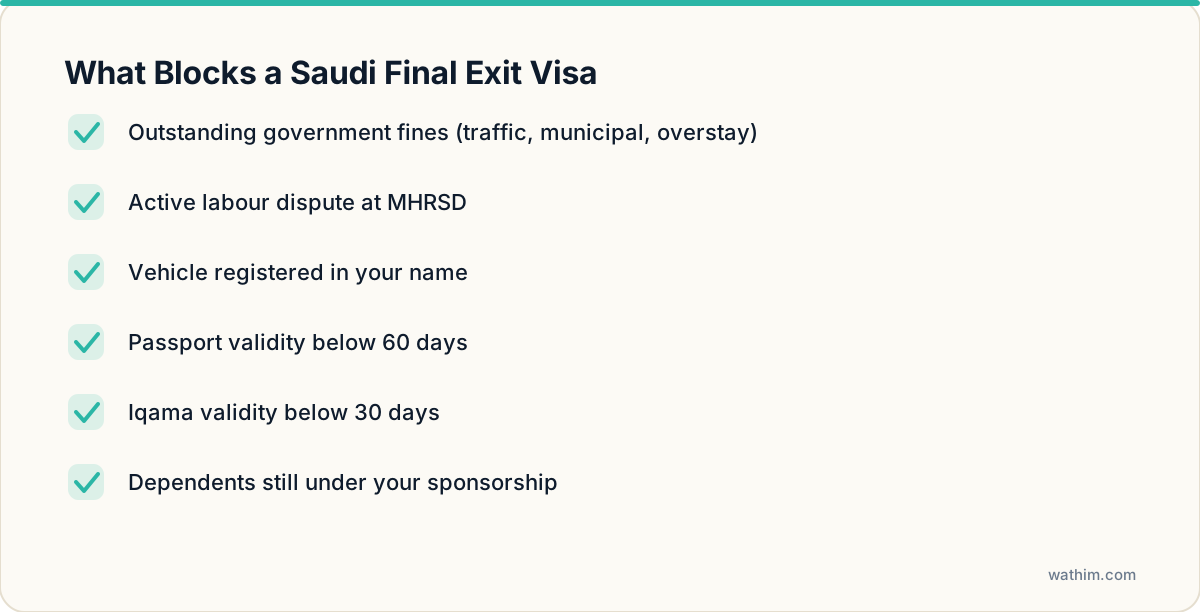
This is where most expats hit problems. The system does not always issue helpful error messages; it just rejects. Here are the six blockers you need to clear before you even open Absher.
Decision table: what to check, where
| Blocker | Where to check | Typical fix time |
|---|---|---|
| Outstanding traffic / municipal fines | Absher Fines, MOI portal, SADAD | Same day if paid; 24 to 48 hours for system to clear |
| Active labour dispute | HRSD portal, Qiwa, court system | Weeks to months depending on case |
| Vehicle registered in your name | Absher Vehicle Services | 1 to 5 days for transfer or sale |
| Passport validity below 60 days | Your passport book | Embassy timeline (often weeks) |
| Iqama validity below 30 days | Absher / Muqeem | Days, requires employer renewal |
| Unsettled dependents under your sponsorship | Absher Family Services | Days to weeks for exit or transfer |
The Fines and Overstay service page covers how to check and clear outstanding penalties. Your Saudi Arabia hub has links to all relevant portals.
Worked example: clearing the stack
You are 6 weeks from your planned departure. Quick audit reveals: SAR 350 unpaid traffic fine from 5 months ago, a car still registered to you, and your Iqama expires in 25 days.
- Day 1: Pay SAR 350 fine via SADAD. Wait 48 hours for system to clear.
- Days 1 to 3: List the car for sale or arrange transfer to a friend or buyer with power-of-attorney support.
- Day 3: Ask employer to renew Iqama for 12 months (Iqama renewal fee SAR 650 + service fee SAR 51.75) so you have well over 30 days remaining at exit application.
- Day 5: Recheck Absher. All blockers should be clear.
- Day 6: Open self-service final exit application. No fee applies, the visa is free. Wait 10 working days for employer window.
- Day 20: Visa issues. You have 60 days from issue date to depart (capped by remaining Iqama validity).
End-of-service settlement: what to confirm before you leave
Getting the final exit visa issued does not mean your financial obligations are settled. Saudi Labour Law entitles you to an end-of-service gratuity if you have worked for the same employer for at least two years. Make sure the following are confirmed in writing before you leave:
- End-of-service gratuity calculation reviewed and agreed with HR
- Final salary payment confirmed (must cover up to last working day)
- Any outstanding leave balance paid out
- Air ticket provided if your contract included repatriation
- GOSI (social insurance) contributions cleared for your record
- Employment certificate issued if you want it for future applications
Chasing these amounts after you leave the country is significantly harder. The labour courts do handle remote complaints, but the process is slow and often requires a local representative. The cleanest sequence is: settle dues first, then apply for the final exit, then book the flight, in that order. Many people reverse it and find themselves stranded mid-process.
If your employer is delaying the exit visa or withholding end-of-service payments, the self-service Pathway C lets you apply directly. You can also file a complaint via Qiwa before departure. MHRSD can issue enforceable decisions for claims up to SAR 50,000 without involving the court, which is the practical route for most end-of-service disputes.
Validity window and whether the visa can be cancelled
Your final exit visa is valid for up to 60 days from the date of issue. Within those 60 days you can depart from any Saudi port of exit. The clock starts on the issue date, not when you book your flight.
Worked example: short Iqama validity at application
Your Iqama expires on 15 June. You apply for final exit on 1 May. Iqama has 45 days remaining.
- Standard visa validity: 60 days
- Iqama-capped validity: 45 days
- Your effective exit window: 45 days (until 15 June)
- If you do not depart by 15 June, the visa expires and you have an irregular Iqama status to fix
If you change your mind and do not want to leave, the official position on whether a final exit visa can be cancelled after issuance is not clearly published by Jawazat. Based on what is publicly available, cancellation is not a standard option. You would typically need to return to employment under a new Iqama rather than reversing the exit visa itself. If this applies to your situation, contact Jawazat directly before making any plans.
One practical scenario: if you do not use the final exit visa and it expires while you are still inside the Kingdom, your Iqama status becomes irregular and overstay-style consequences kick in. Deal with this immediately through Absher or a typing centre.
What happens to your dependents?
Your dependents' sponsorship is tied to your Iqama. When you depart on a final exit, their residency must already be handled. The system checks this as part of the blocker list.
You have two options for each dependent:
- Issue them a final exit visa too: Apply through Absher Individuals under Family Services. They travel with you or separately within the valid window.
- Transfer their sponsorship: If a dependent wants to remain in the Kingdom under another sponsor (for example, a spouse continuing to work), the sponsorship transfer must complete before your final exit processes.
The Family Sponsorship service page has detail on the transfer process. Outstanding dependent fees must also be settled; any unpaid monthly levies will block the process. The dependent fee is SAR 400 per month per dependent of any age, children included. A backlog of even 6 months is SAR 2,400 per person, which has to clear before the system will progress.
Worked example: family of four leaving together
Main sponsor plus three dependents (spouse and two children). Each dependent needs a separate final exit. The visas themselves cost nothing; if a typing centre handles the paperwork, its charge is a private service fee, not a visa cost. Each dependent must also clear their own document set. If any has an unpaid traffic fine or unsettled obligation, the whole exit is blocked at that dependent's record, not the main sponsor's. Run the Absher check on every family member before applying for any.
Re-entry after final exit: the 2025 reform most guides get wrong
Here is the change that most online guides still have wrong: as of mid-2025, Saudi Arabia removed the automatic 3-year re-entry ban for workers whose exit/re-entry visa expired while they were outside the Kingdom. That ban no longer applies automatically for this specific situation.
What does this mean in practice? If you previously overstayed an exit/re-entry permit while abroad, you can now apply for a new work visa and re-enter Saudi Arabia. The automatic ban has been lifted for that category of violation.
Re-entry bans do still apply in the following cases:
- Deportation for criminal violations
- Extended overstay or unresolved Huroob status at departure
- Fraud or document violations
- Serious labour law violations as determined by the court
For deportation cases, bans range from 3 years to permanent depending on the severity of the violation. But if you are leaving cleanly on a final exit visa with all obligations settled, there is no automatic ban preventing future work visas.
If you need to return for a new job after a clean final exit, your future employer files a new work visa through their Absher Business portal. Your previous Iqama history is visible to them but does not automatically block the application. Check the Absher portal for current visa status before applying. The mid-2025 reform is corroborated by multiple sources but has not been formally restated in an official MOI gazette known to us; treat it as the current practical position rather than a published immutable rule, and check before assuming.
Three personas: how a final exit plays out differently
Three short walkthroughs to show how the same visa product reshapes around context.
Persona A: Bilal, clean departure after 4-year contract
Bilal completed a 4-year contract with a large construction firm. HR initiates Pathway A (employer-initiated) two weeks before his planned departure. End-of-service settlement (roughly 1.5 months' salary per year of service) is calculated and paid to his Saudi bank account. Final exit visa issues 5 days after submission. He flies out on day 12. Total cost to him: SAR 0, the visa is free and the employer handled the filing.
Persona B: Reza, stalemate with employer
Reza's contract ended on 31 March. His employer dragged feet on issuing the final exit, hinting at unresolved disputes over work-handover. On 15 April Reza opened Pathway C (self-service) himself, at no cost. The 10-working-day employer objection window ran out on 30 April with no objection filed. Visa issued automatically on 1 May. Reza flew out 5 days later. Cost: SAR 0. Time cost: 21 days from application to departure, mostly the objection window.
Persona C: Layla, dependent of a sponsor who already left
Layla's husband finished his contract in February and departed on his own final exit, transferring her sponsorship to her father (a long-term Saudi resident) before leaving. Three months later, Layla decided to leave too. Her father, as her current sponsor, initiated her final exit through his Absher Individuals account under Family Services. No employer objection window applies for dependents under a non-employer sponsor. Visa issued in 3 days. Total cost: SAR 0, the visa is free.
Leaving Saudi Arabia without a final exit visa
If you depart Saudi Arabia on an exit/re-entry visa but do not use the final exit process, your Iqama remains active and you retain the right to return. This is distinct from a final exit; your residency is not cancelled.
Problems arise when people leave on an exit/re-entry permit, their permit expires abroad, and they cannot return or do not intend to return. In the old rules, this triggered a 3-year ban. Under the 2025 reform, that automatic ban is gone, but you still have an expired residency situation to resolve if you want to visit or work in the Kingdom again.
The cleanest approach if you know you are leaving permanently: apply for the final exit visa before you leave. Do not rely on an exit/re-entry permit expiring as a de facto exit strategy. It saves you from the situation where, a year later, you decide you want to come back for a visit and discover that resolving the lapsed status is more expensive than the final exit would have been.
Edge cases and special situations
Your contract is on a renewable basis (no fixed end date)
Under LRI 2021, all private sector contracts became fixed-term. If your contract is rolling year-to-year, the end of the current term is your earliest self-service trigger. Discuss with HR which term-end date the system uses.
You have an active bank loan
Bank loans are not part of the standard blocker list, but Saudi banks can file a travel ban (Mana Safar) for unpaid debt. This is separate from the Absher final exit blocker. Check your travel ban status via Absher before booking flights, even after the final exit issues.
You are on Huroob status
Active Huroob (Absent from Work) blocks the standard final exit pathway. You first resolve the Huroob (employer cancellation within the 60-day grace, transfer of sponsorship, or court-ordered cancellation) and then apply for final exit.
You died in the Kingdom
For families dealing with bereavement, the deceased's Iqama is cancelled by submission of the death certificate to Jawazat. No final exit needed. Dependents under the deceased's sponsorship typically receive a grace period to either also exit or transfer sponsorship.
You are an industrial sector worker (post-Dec 2025)
The work permit levy was permanently cancelled for companies holding a valid Industrial Licence by Cabinet decision on 17 December 2025. This affects the employer's costs more than the worker's exit process directly, but it may change how willing your employer is to retain you, which in turn affects how cooperative they are with exit applications.
You hold Premium Residency
Premium Residency holders have different rules and can exit and return on their own terms. The final exit visa concept does not apply to Premium Residency in the same way as it does to standard work-tied Iqama.
Common problems and fixes
Problem: System shows a fine I already paid
Payment processing takes 24 to 48 hours to reflect. Wait and try again. If it persists after 48 hours, visit the relevant authority (traffic department, municipality) with your payment receipt and request manual clearance.
Problem: Employer is blocking the exit visa and will not respond
On the self-service route, employer silence after 10 working days results in automatic approval. You do not need active employer consent. If your employer is filing objections with no legal basis, escalate to MHRSD via Qiwa or the HRSD complaints portal.
Problem: Iqama expired before I could apply
If your Iqama has less than 30 days remaining (or is already expired), you cannot get a final exit visa through the standard Absher route. Your employer must first renew the Iqama (adding at least 30 days), and then you can apply for the final exit. This costs money but is the only path forward.
Problem: Vehicle is registered to me but I already left the Kingdom
If you departed on an exit/re-entry visa and realised afterward that a vehicle is blocking future exit processing, you need a power of attorney arrangement. A trusted contact inside the Kingdom can handle the transfer on your behalf with the right documentation. The power of attorney usually needs to be notarised at a Saudi embassy or consulate in your country.
Problem: Final exit visa expired before I could use it
You are now inside the Kingdom with an expired final exit visa and an irregular Iqama status. Visit a typing centre or Jawazat office immediately. Do not wait. The longer you wait, the more fines accumulate.
Need help with your Saudi exit process?
Clearing blockers, coordinating with HR, and navigating the Absher portal when something is flagged wrongly takes time you may not have when you are planning a departure. If you are stuck on any part of the final exit process, the Wathim team handles Saudi exit cases regularly.
Contact us with your situation and we will walk you through it. You can also browse the Exit and Entry services page for an overview of what we can handle on your behalf, or visit the Saudi Arabia country hub for all related guides. Related reading worth checking: the Huroob guide if there is an absent-from-work flag to clear, and the Exit/Re-Entry Visa guide if you are not yet sure whether you need a final exit or a return-eligible exit.
Run your numbers: final exit timing decides what you walk away with, so confirm payouts in our Saudi EOSB calculator and GOSI in the Saudi GOSI calculator. The application itself runs through Absher (or Qiwa for the employer side) with Nafath sign-in; Muqeem shows clearance status.
Frequently Asked Questions
Yes. The final exit visa is completely free: SAR 0 in government fees and no Absher service charge, per Jawazat and Absher. This is a substantive difference from exit/re-entry visas, which carry per-month government fees. If a typing centre or PRO handles the application for you, their charge is a private service fee, not a visa cost. Outstanding fines and other blockers must still be cleared before issuance, and those can run into the thousands of riyals separately.
A maximum of 60 days from the date of issue, or until your Iqama expires if that is sooner. If your Iqama has 45 days remaining when the visa is issued, your exit window is 45 days, not 60. The clock starts at issue, not at booking the flight. Plan the timing to leave at least 1 to 2 weeks buffer rather than the final day, in case of flight cancellations or unforeseen delays.
Yes, there is no automatic re-entry ban from a clean final exit. You would need a new work visa or visit visa. The mid-2025 reform also removed the automatic 3-year ban for workers whose exit/re-entry permits previously expired abroad, which was a separate category of historical penalty. Re-entry is still blocked for deportation cases, unresolved Huroob at departure, and criminal or fraud violations.
Private sector workers can apply directly through Absher Individuals (self-service route, Pathway C) provided the employment contract has ended or expired. The employer has 10 working days to raise a legal objection. Silence equals approval. If your employer files baseless objections, escalate to MHRSD via Qiwa or the HRSD complaints portal. The reformed labour framework treats unjustified employer objections as labour violations, not as automatic blockers.
Yes. Each dependent must either receive their own final exit visa or have their sponsorship transferred to another sponsor before your final exit will process. You cannot depart on a final exit while dependents remain under your sponsorship. Each dependent's exit application is a separate transaction in Absher Family Services, but the visa itself is free for every family member. Any outstanding dependent fees (SAR 400 per dependent per month, any age) must be cleared first.
Your Iqama must have at least 30 days of remaining validity when you apply. If it has less than 30 days, you need to renew the Iqama first (which costs the SAR 650 annual renewal fee plus SAR 51.75 Absher service fee) before applying for the final exit visa. This catches expats who leave departure planning to the last week before their Iqama expires.
Jawazat has not published a clear cancellation process for final exit visas after issuance. In practice, cancellation is not a standard option. If you change your mind, speak directly to Jawazat before taking any action. The practical workaround for someone who decides to stay would typically involve seeking a fresh Iqama under a new sponsor before the visa expires, but this is case-by-case and not a normal pathway.
Yes. All outstanding government fines, including traffic violations, municipal fines, and any penalties, must be cleared before the system will issue a final exit visa. Check via Absher, the MOI traffic portal, and SADAD. Pay any outstanding amounts at least 48 hours before applying for the visa to allow the system to update. Unpaid fines are the single most common reason exit applications stall.
Stuck on a Government Service Step?
Wathim publishes free plain-English guides to GCC visas, IDs, driving licences, attestation, and fines. If a fee table looks off or a step is missing, tell us and we will update the guide. You can also book a free guidance call with our GCC services desk.

Wathim Editorial
GCC Services Desk
The Wathim team writes plain-English guides to GCC government services. We track ICP, GDRFA, MOHRE, Absher, Muqeem, Qiwa, Metrash, LMRA, ROP Oman, and MOI Kuwait so expats can plan visa, residency, ID, and licence steps without guesswork.