In This Guide
- The new AED 50 per day rate: what changed in February 2026
- Tourist visa overstay vs residence visa overstay: the structural difference
- How fines accumulate: five worked examples with real arithmetic
- Three personas: how the same rule plays out differently
- How to check your overstay fine: ICP and GDRFA methods
- Payment channels for overstay fines
- Amnesty and waiver programs: what has existed and what is active now
- Status change: how to avoid the fine without leaving
- Overstay and the ban: when does a ban actually happen?
- Airport scenarios: what actually happens at the immigration counter
- ICP vs GDRFA: which system covers you
- Edge cases and special situations
- Common problems and fixes
- Need help sorting an overstay situation?
The new AED 50 per day rate: what changed in February 2026
Last verified: July 2026 against ICP announcements.
As of 11 February 2026, the UAE unified its overstay fine at AED 50 per day across every emirate and every visa category. Before that date, daily rates varied: Dubai applied a first-day surcharge on top of its daily rate, the Northern Emirates ran their own tariff schedules through ICP, and tourist overstays were charged differently from residence overstays. All of that complexity is now gone. Whatever your visa type and whichever emirate issued it, the meter runs at a flat AED 50 per day. You can get an exact figure for your dates in the UAE overstay fine calculator.
The fine applies to anyone who remains in the UAE beyond their permitted stay: tourist visa holders, visit visa holders, residents on cancelled permits, holders of expired residence visas, and the family members and dependents whose status was linked to a cancelled sponsor. The ICP (Federal Authority for Identity, Citizenship, Customs and Port Security) announced and enforces the unified rate. GDRFA Dubai follows the same federal schedule.
What changed in February 2026
The February 2026 announcement made two structural changes, not just a rate change:
- One rate everywhere. AED 50 per day now applies across all seven emirates and all visa types. Dubai's separate first-day surcharge and the distinct Northern Emirates tariffs are superseded. If you see a table quoting different daily rates for Dubai versus Sharjah or Ajman, it predates 11 February 2026.
- No more tourist grace period. The 10-day grace period that previously applied to tourist and visit visas was removed. Fines now accrue from day one after expiry.
| Rule | Before 11 Feb 2026 (superseded) | From 11 Feb 2026 |
|---|---|---|
| Daily rate | Varied by emirate and visa type; Dubai added a first-day surcharge | AED 50/day, all emirates, all visa types |
| Tourist/visit visa grace | 10 days after expiry before fines started | None; fines from day 1 after expiry |
| Northern Emirates tariffs | Separate ICP schedules | Folded into the unified AED 50/day rate |
The change was announced by ICP in February 2026. The exact number of the implementing legal instrument has not been consistently published across official channels, so we cite the announcement rather than a decree number; verify your own case against icp.gov.ae. Fines accrued before 11 February 2026 were calculated under the old schedules, so a long-running case can show two segments at different rates.
The headline rate is simple, but the grace period that applies before that rate starts ticking is where most people get caught out. Grace varies dramatically by visa class, and the difference between a "tourist" mindset and a "residence" mindset is the difference between AED 1,500 a month in fines and nothing at all.
| Visa Type | Grace Period | Fine Starts | Daily Rate |
|---|---|---|---|
| Tourist visa | None | Day 1 after expiry | AED 50 |
| Visit visa | None | Day 1 after expiry | AED 50 |
| Employment / residency visa (cancelled) | 30 days | Day 31 | AED 50 |
| Family / dependent visa | 30 to 60 days | Day 31 to 61 | AED 50 |
| Investor visa (2-year) | 60 days | Day 61 | AED 50 |
| Golden Visa (10-year) | Up to 180 days | Day 181 | AED 50 |
| Green Visa (5-year) | Up to 180 days | Day 181 | AED 50 |
| Student visa | Up to 180 days | Day 181 | AED 50 |
Some sources still mention a 10-day grace period for tourist and visit visas. That buffer existed under the old rules but was removed with the 11 February 2026 change. As of July 2026, the ICP position is that tourist and visit visa fines start immediately after expiry. Treat any claim of a tourist visa grace period with caution and verify directly on icp.gov.ae for your case. The grace periods shown for long-term visas (Golden, Green, student) come from single sources and are best confirmed when checking your individual file. If your residence visa was cancelled rather than expired, the UAE grace period after visa cancellation guide covers exactly how the 30-day clock is counted.
Tourist visa overstay vs residence visa overstay: the structural difference
The distinction between overstaying a tourist or visit visa and overstaying a cancelled or expired residence visa is not just a difference in grace period. It is a difference in how the immigration system frames you. A tourist who overstays is treated as a short-term visitor who failed to leave on time. A resident who overstays is treated as someone who failed to transition status. The procedural consequences and the practical exit experience are different.
Tourist and visit visa overstay
If you arrived on a tourist or visit visa and did not leave or change status before it expired, fines start accumulating from day one after expiry. There is no buffer since the February 2026 rule change removed the old 10-day grace period. At AED 50 per day, a two-week overstay generates AED 700 in fines. A month costs AED 1,500. A 90-day overstay reaches AED 4,500. The fine must be paid before you can exit the country, and the payment counter at the airport may not accept every card. If your visa has not expired yet, an in-country extension is usually the cheaper move: typing-centre market rates for extension filings run roughly AED 750 to 1,200, which beats a month of fines. The visit visa extension without exit guide covers that route in detail.
Tourist overstays are also the category most likely to attract additional scrutiny on re-entry. While a short paid overstay rarely triggers a ban, repeated tourist overstays across separate trips do build a record. If you visit the UAE often, even a clean paid overstay can complicate future visa-on-arrival eligibility for some nationalities.
Cancelled or expired residence visa overstay
When your employer cancels your residence visa, you receive a 30-day grace period to either leave the UAE or change your status to a new visa. No fines during those 30 days. From day 31 onward, AED 50 per day applies. This is the most common overstay scenario for workers whose employment ends, and it is the one most often misunderstood.
The grace period starts on the cancellation date recorded in the ICP or GDRFA system, not on your last working day, not on the date you found out, and not on the date you got your final settlement. Employers sometimes file the cancellation weeks before your physical departure from the office. You can be partway through your 30 days before you even check your status. The grace period after visa cancellation guide breaks down how to confirm your exact cancellation date.
If you are in this situation, your options include: leaving the UAE before day 30, finding a new employer who sponsors a new visa before day 30, applying for a self-sponsored visa such as the Freelance Visa or Green Visa, or moving onto a family member's sponsorship. The UAE Residency Visa service page walks through the transition options.
Golden Visa, Green Visa and student visa holders
Holders of long-term visas like the Golden Visa, Green Visa, or student visas have up to 180 days after expiry before fines start. This extended buffer reflects the higher investment, qualification, or institutional commitment behind these categories. It is not, however, a licence to forget about renewal. If you exceed 180 days without renewing, fines start accumulating retroactively from day 181, not from when you eventually act.
Family and dependent visas
Family visas inherit grace from the sponsor. If your sponsor's visa is cancelled, your dependent visa is also cancelled, and your 30 to 60 day window starts from the same date. This catches families by surprise when a single earner's job ends: the spouse and children are suddenly on the same clock as the main applicant. Plan family transitions as a single event, not as separate cases.
How fines accumulate: five worked examples with real arithmetic
Understanding the maths helps you make a quick decision about whether to pay and leave now, change status, or wait for a possible amnesty. The numbers are simple but the framing matters. If you want your own dates run automatically, the UAE overstay fine calculator does this arithmetic for you.
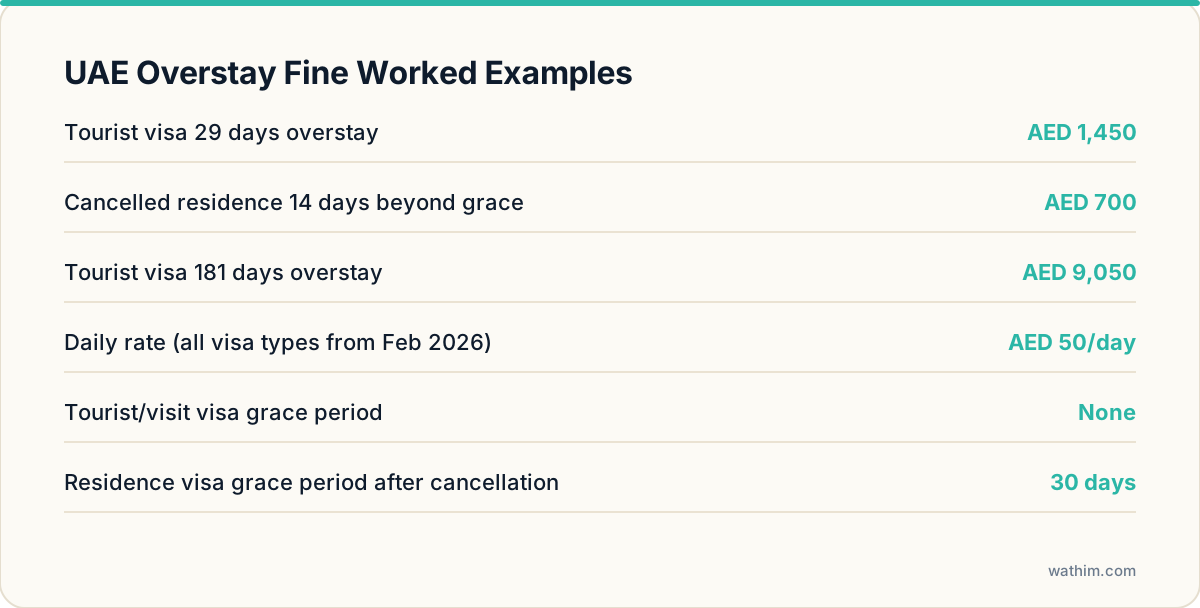
Example 1: Tourist visa expired, no grace period
Visa expired on 1 April. You depart on 30 April (29 days later).
- Days overstayed: 29
- Fine: 29 x AED 50 = AED 1,450
- Payment must clear before boarding. Online payment 24 to 48 hours before flight is the safe option.
Example 2: Residence visa cancelled, partial grace period used
Visa cancelled on 1 April. You depart on 15 May (44 days after cancellation).
- Grace period: 30 days (1 April to 30 April, no fine)
- Overstay days: 14 (1 May to 14 May)
- Fine: 14 x AED 50 = AED 700
Example 3: Residence visa cancelled 47 days ago
Visa cancelled on 1 April. You realise on 17 May (47 days later) and book a flight for 20 May.
- Grace period: 30 days (no fine)
- Overstay days at exit: 20 (1 May to 20 May)
- Fine: 20 x AED 50 = AED 1,000
- Every additional day on the ticket adds AED 50. A 4-day delay between realising and departing costs AED 200.
Example 4: Long overstay on tourist visa
Visa expired on 1 January. You depart on 1 July (181 days later).
- Days overstayed: 181
- Fine: 181 x AED 50 = AED 9,050
- At this duration the immigration desk will likely refer to a supervisor. Budget extra time and consider clearing the case at an ICP centre before the airport.
Example 5: Family of three on a cancelled sponsor
Main applicant's residence visa cancelled on 1 April, dependents on the same date. The family leaves on 10 May (40 days later).
- Grace period: 30 days for each person
- Overstay days each: 10
- Fine per person: 10 x AED 50 = AED 500
- Total family fine: 3 x AED 500 = AED 1,500
Each person on a cancelled sponsor accrues fines independently. A four-person family on day 40 is paying AED 200 a day combined. Booking a one-week-earlier flight saves AED 1,400 in fines, which often exceeds the cost difference on tickets.
There is no maximum cap on overstay fines in the UAE. Unlike the Emirates ID late fine (capped at AED 1,000), overstay fines continue to accumulate indefinitely until you pay and leave or change status. The longer you wait, the more you owe, full stop.
Three personas: how the same rule plays out differently
The headline rate of AED 50 a day is identical for everyone. The lived experience is not. Three short walkthroughs show how the same rule reshapes around context.
Persona A: Priya, an IT contractor whose project ended in Sharjah
Priya finished her 12-month contract on 31 March. HR filed her visa cancellation on the same day. She did not check the portal until 22 April, by which time 22 of her 30 grace days were already used. She had two practical paths: rush to find a new sponsor within 8 days (unrealistic), or book a flight for 28 April and exit before grace runs out. She booked the flight. No fine, no overstay, but a week of frantic packing. The lesson: always check the cancellation date on ICP within 48 hours of your last day, not weeks later.
Persona B: David, a tourist who extended once and then waited too long
David arrived on a 60-day tourist visa, extended for another 30 days through a typing centre (market rates for extension filings run roughly AED 750 to 1,200), and then decided he wanted "just a bit more time" to close a real estate deal. He overstayed by 22 days before booking his exit. Fine: 22 x AED 50 = AED 1,100. He paid online through GDRFA the morning of his flight, kept the receipt screenshot, and exited with no issues. The lesson: tourists pay from day one under the 2026 rules, but a clean paid overstay under a month rarely creates a ban. A second extension via the in-country extension route, filed before expiry, would have cost about the same as his fine and kept his record clean.
Persona C: Aysha, a dependent caught between her husband's job loss and a new role
Aysha's husband lost his Abu Dhabi job on 15 March; his visa was cancelled the same week, and her dependent visa with it. Her husband secured a new offer in Dubai that took five weeks to process. They were on day 38 by the time the new visa was issued. Fine for each of them: 8 days x AED 50 = AED 400 each, AED 800 combined. The status change began before grace expired but did not complete in time. The lesson: "in process" does not pause the clock. Only an issued new visa stops fines, and the gap between application and issuance can be longer than people expect.
How to check your overstay fine: ICP and GDRFA methods
Which portal you use depends on which emirate issued your visa. Using the wrong portal returns a "no record found" error that can be misleading: it does not mean you have no fine, it means you asked the wrong system.
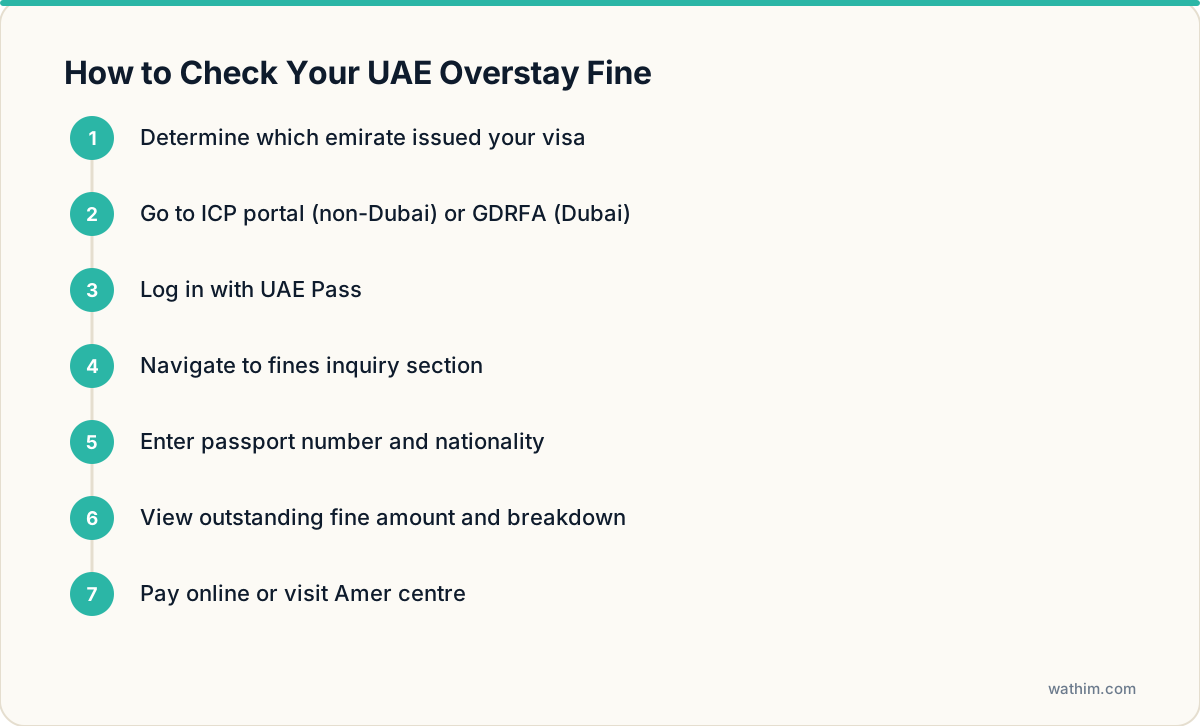
If your visa was issued by Abu Dhabi, Sharjah, Ajman, UAQ, RAK, or Fujairah: use ICP
- Visit ICP Smart Services at smartservices.icp.gov.ae
- Navigate to the fines inquiry or application tracking section
- Log in using UAE Pass (required for authenticated results)
- Your outstanding fines and their breakdown will be displayed
- ICP hotline: 600 522 222
If your visa was issued by Dubai: use GDRFA
- Visit GDRFA Dubai at gdrfad.gov.ae or use the GDRFA mobile app
- Access the status inquiry section
- UAE Pass authentication is required
- Alternatively, visit an authorised Amer centre for in-person assistance
- GDRFA hotline: 800 5111 (within UAE) or +971-4-313-9999 (outside UAE)
The determining factor is which emirate originally issued your visa, not where you currently live or work. If you genuinely do not know, check both portals. A small Sharjah-based free zone employer can route your visa through ICP even if your office is in Dubai. The UAE visa status check guide walks through how to identify which authority issued your visa from the documents you already have.
What the portal actually shows
The fine breakdown usually displays: the underlying visa or permit, the expiry or cancellation date, the days counted as overstay, the daily rate applied, and the cumulative total. Some screens also show a "valid until" date for payment, which is essentially the date the portal expects the fine to be cleared before the next system update. If the figure on screen does not match your own calculation, do the maths yourself before trusting either number. Portals occasionally lag by 24 to 48 hours after a cancellation.
Payment channels for overstay fines
You cannot exit the UAE with an unpaid overstay fine. The immigration system at the airport will flag the outstanding amount and you will be directed to pay before being allowed to depart. Paying in advance saves time at the airport and avoids the failure mode where a foreign card is declined at a counter that does not accept cash for amounts over a certain threshold.
Available payment channels:
- ICP Smart Services portal (smartservices.icp.gov.ae): Online payment for non-Dubai fines. Accepts most UAE-issued debit and credit cards.
- GDRFA Dubai portal (gdrfad.gov.ae): Online payment for Dubai-issued visa fines.
- UAE Pass app: Both ICP and GDRFA fines can be surfaced and paid through the unified app, useful if you have lost track of which authority you are on.
- Amer centres: Authorised GDRFA intermediaries for in-person payment and processing. Useful if your card is being declined online.
- Immigration counters at airports and land borders: Pay at time of departure (expect queues and possible card failures).
- ICP-authorised typing centres: For non-Dubai overstay cases, often co-located with passport service desks.
Online payment 24 to 48 hours before flight is the recommended sequence. Pay, screenshot the receipt, then check the portal again a few hours later to confirm the fine shows as cleared. If you wait until the airport, allow at least 90 extra minutes; smaller airports such as Ras Al Khaimah and Fujairah have limited counter hours and may not have an immigration cashier on duty late at night.
Amnesty and waiver programs: what has existed and what is active now
The UAE has historically offered amnesty windows allowing overstayers to regularise their status or leave without paying full fines. Here is an honest account of the recent history and the current situation as of July 2026. Separately from amnesties, individual fine reductions are possible in narrow circumstances; the overstay fine reduction guide covers which reasons authorities actually accept.
What has happened recently
- October to December 2025 amnesty: A standard amnesty window ran during this period. The exact closing date is not fully confirmed across sources; treat the late-2025 window as historical context rather than a precedent for an automatic next round.
- Emergency waiver (4 March to 31 March 2026): The ICP issued a specific waiver for overstayers stranded by a regional airspace closure in February to March 2026. This waiver expired on 31 March 2026 at 23:59.
- Temporary grace period for tourist and visit visas: A temporary period of leniency for expired tourist and visit visas ended on 21 April 2026. Since 22 April 2026, standard fines have been fully reinstated.
Current status (July 2026)
There is no active general amnesty program as of July 2026. All overstay fines are accruing at AED 50 per day. If a new amnesty is announced, it will be published on the ICP website (icp.gov.ae) and the official UAE government portal (u.ae).
The "wait for amnesty" calculation
People in heavy overstay sometimes ask whether to wait for the next amnesty rather than pay now. The straightforward calculation: every additional day costs AED 50. Sixty days of waiting costs AED 3,000. Past amnesty windows have arrived roughly once every 18 to 36 months and have not been guaranteed to wipe fines entirely; many have offered structured discounts or fine-free exit, not retroactive refunds. The expected value of waiting is rarely positive unless you are within weeks of a credibly announced window. Checking the ICP portal regularly is the best way to stay informed, but check icp.gov.ae directly, not unofficial social media forwards.
Status change: how to avoid the fine without leaving
If your visa has expired or is about to expire but you have a legitimate reason to stay in the UAE, a status change (in-country visa change) may allow you to move from one visa category to another without accruing overstay fines. This needs to happen before the grace period ends, and "happen" means an issued new visa, not a submitted application.
Common status change scenarios:
- New employer: Your new employer sponsors a new work permit and residence visa before your cancelled permit's 30-day grace period expires. This is the standard employment transition path. Typical timeline: 7 to 21 days from offer signed to visa stamped, depending on the employer's free zone or mainland setup and any medical or Emirates ID delays.
- Freelance Visa or Green Visa: If you qualify, you can self-sponsor on a freelance or Green Visa. Applications go through ICP Smart Services or GDRFA Dubai depending on your emirate. Green Visa eligibility requires a salary or qualification threshold; freelance permits require a recognised activity and supporting documents.
- Family sponsorship: A spouse or parent already resident in the UAE with sufficient salary can sponsor you as a dependent during the grace period. Family sponsorship has a salary minimum (commonly AED 4,000 to 10,000 depending on relationship and emirate) and proof of accommodation requirements.
- Student visa: Enrolling in an accredited UAE institution converts your status. The institution typically handles the visa process and can sponsor outside of the standard employment route.
- Golden Visa: If you qualify under the AED 30,000 salary threshold or AED 2M property route, applying within grace can give you the rare combination of avoiding overstay and securing 10-year residency in one step. See the UAE Golden Visa requirements guide.
The key constraint is timing. A status change must be initiated and, in most cases, the new visa must be issued before your grace period ends. "In-process" does not guarantee a pause in fine accumulation. Speak to Amer centre (for Dubai) or an ICP-authorised typing centre (for other emirates) to understand your exact timeline. For a detailed look at residency visa options, see the UAE Residency Visa service page.
Overstay and the ban: when does a ban actually happen?
Many people fear an automatic ban from any overstay. The reality is more nuanced. A short overstay that you pay and exit cleanly does not automatically result in a ban. Ban decisions are discretionary and typically reserved for longer overstays or aggravating circumstances.
The factors that increase ban risk:
- Overstay of 6 months or more
- Repeated overstay history across separate visa cycles
- Outstanding criminal matters or active police cases
- Attempting to exit without paying the fine, or being intercepted in a workplace inspection
- False documentation or identity issues
- Active labour or rent disputes filed against you
Ban duration in practice
When bans are imposed for overstay-related reasons, they typically range from one year (mid-range overstay, paid on exit) to permanent (deportation cases involving criminal charges or repeat offences). Most clean short overstays carry no ban at all. A 6 to 12 month overstay paid on exit may carry no ban for someone with no other issues, while the same overstay alongside an unresolved rent cheque case could attract a multi-year ban.
If you have a substantial overstay (several months or more), consider getting professional advice before presenting yourself at the airport. An Amer centre or the ICP service centre may be able to clarify your ban risk before you attempt to exit. The UAE Fines and Overstay service page covers the full picture of what Wathim can assist with if your case is complex.
Airport scenarios: what actually happens at the immigration counter
Here is what to realistically expect at UAE immigration if you have an overstay situation. These are the four most common scripts the desk plays out.
Scenario A: Small fine, paid in advance
You checked your fine online, paid it through ICP or GDRFA portal, and you have your payment receipt. At immigration, the system should show the fine as cleared. This is the smoothest exit. Keep the receipt on your phone or printed just in case the system has not yet updated. The desk takes 30 to 60 seconds, you board normally.
Scenario B: Fine not paid in advance
Immigration flags the outstanding fine. You are directed to a payment counter before being processed for exit. Queues at these counters vary by airport and time of day; Dubai Terminal 3 at peak departure hours has been observed to add 45 to 90 minutes. Smaller airports such as Sharjah, Ras Al Khaimah, and Fujairah may have limited payment counter hours and you may have to wait for a supervisor with cashier authority. Budget at least 2 extra hours and do not arrive at the last minute.
Scenario C: Large overstay, unclear ban status
If your overstay is several months or more, immigration may refer you to a supervisor. In some cases this can involve additional processing time or a detention hold while your case is reviewed. The supervisor may pull additional records (court cases, labour complaints, traffic violations) before deciding. If you are in this situation, the safest approach is to resolve your status proactively through the ICP or GDRFA service centres before attempting to exit, rather than discovering the outcome at the airport departure gate.
Scenario D: Employer is holding your passport
Passport confiscation by employers is illegal in the UAE. If your employer is holding your passport and you are overstaying as a result, contact MOHRE on 600 590 000 or approach the Amer centre directly. There are documented processes for handling this situation, including emergency travel document assistance through your home country's embassy. MOHRE typically takes the labour side of this seriously and can intervene; the passport return order is then enforceable through the police if the employer continues to refuse.
ICP vs GDRFA: which system covers you
The UAE has two separate immigration authorities managing residency and overstay fines. Knowing which one handles your visa is essential. Using the wrong portal gives you incomplete information and creates the false impression that you have no fine at all.
| Authority | Covers | Website |
|---|---|---|
| ICP (Federal) | Abu Dhabi, Sharjah, Ajman, UAQ, RAK, Fujairah | smartservices.icp.gov.ae |
| GDRFA (Dubai) | Dubai only | gdrfad.gov.ae |
Jurisdiction is determined by which emirate originally issued your visa, not where you currently live or work. If you work in Dubai but your visa was issued through a Sharjah-based free zone, your fines are with ICP, not GDRFA. For more detail on how the two systems split responsibilities, see the UAE Visa Status Check guide and the UAE country hub.
Edge cases and special situations
Some overstay situations sit outside the standard table. The system handles them, but the playbook differs.
You were inside the UAE on the day the rate changed (11 February 2026)
Fines accrued before 11 February remain at the old rate that applied; fines from 11 February onward use the new AED 50/day rate. The portal calculates this automatically. If your fine breakdown looks like two segments with different daily rates, that is why.
Your employer cancelled your visa without telling you
The 30-day clock starts on the cancellation date in the ICP/GDRFA system, regardless of whether you were notified. Check your status within days of any employment change, even if HR has not formally communicated.
You are pregnant or recovering from surgery and cannot fly
Medical exceptions exist but are not automatic. You need supporting documentation from a UAE-licensed physician and to engage with ICP or GDRFA before grace ends. A short status conversion (often to a tourist or visit visa via family sponsor) is usually the practical path. Do not assume the system will be lenient at the airport if you arrive with an unmanaged medical case.
You are outside the UAE when your residence visa is cancelled
If you are abroad when your sponsor cancels you, you typically lose the right to re-enter on the cancelled visa. The grace period in this scenario is academic; the practical issue is securing a new entry permit. Your sponsor or a new employer must initiate a fresh entry permit, or you need to apply for a tourist visa to re-enter and resolve outstanding matters.
You hold dual residency (UAE plus another GCC country)
UAE residency is independent of other GCC residency. A valid Saudi or Qatari Iqama does not protect you from UAE overstay fines. The systems do not cross-reference at this level.
You died abroad with a valid UAE residence visa
For families dealing with bereavement, the deceased's residence visa is cancelled by submission of the death certificate to ICP or GDRFA. No overstay fine applies. Family members on dependent visas linked to the deceased typically receive the standard grace period from the cancellation date.
Visa was extended but the extension does not appear in the portal
Some short-term tourist visa extensions can take 24 to 72 hours to propagate. If you have a paid extension reference but the portal still shows the original expiry, do not panic. Keep the extension receipt, recheck after 48 hours, and call the relevant hotline if it still does not show.
Common problems and fixes
Problem: Portal shows no fine but I know I have overstayed
Check that you are using the right portal (ICP vs GDRFA). If you are on the correct portal and still see no result, it is possible the fine has not yet been calculated in the system. Try again the following day. If it persists, call the relevant hotline: ICP on 600 522 222 or GDRFA on 800 5111.
Problem: I cannot pay online because the portal does not accept my card
Try a different payment method (UAE debit card rather than international credit card). If that fails, visit an Amer centre (Dubai) or an ICP-authorised typing centre (other emirates) for cash or alternative payment options.
Problem: I paid the fine but the system still shows it as outstanding
Payment processing can take 24 to 48 hours. Keep your payment receipt or screenshot. If you need to travel urgently and the system has not updated, go to an immigration counter at the airport early and show the receipt. They can manually verify and clear you in most cases.
Problem: My visa was cancelled by my employer without my knowledge
Your 30-day grace period started from the cancellation date, not from when you found out. Check your visa status immediately via ICP or GDRFA. If your grace period has already partially elapsed, calculate your options quickly. The Fines and Overstay service can help if you need to move fast.
Problem: I am stuck outside the UAE with a cancelled visa and cannot re-enter
If your residency was cancelled while you were abroad, you need a new entry permit before you can return. Contact your employer or a visa services provider. The UAE Residency Visa page has the options available to you.
Need help sorting an overstay situation?
Overstay cases have a way of escalating quickly once fines start adding up. If you are unsure how much you owe, how to pay it, or whether your situation carries a ban risk, the Wathim team deals with these cases regularly across all emirates.
Contact us with your situation including emirate, visa type, and rough timeline, and we will give you a straight answer on your options. You can also use the UAE Fines and Overstay service page to see exactly what we handle, or check the Emirates ID Renewal guide if your ID has also expired alongside your visa.
Run your numbers: get an exact figure in our UAE overstay fine calculator, and if your ID lapsed alongside the visa, add the Emirates ID fine calculator on top. Payment and amnesty status update on ICP or GDRFA Dubai; signing in through UAE Pass is now the fastest route.
Frequently Asked Questions
AED 50 per day, unified across all emirates and all visa types effective 11 February 2026. Before that date, rates varied by emirate and visa class, with some categories charged a higher daily figure plus a first-day flat penalty. The new flat AED 50 rate now applies uniformly whether you are on a tourist, visit, residence, family, or long-term visa.
No, not since 11 February 2026. Tourist and visit visa fines start from day one after expiry with no grace period. The 10-day buffer that some older sources mention existed under the pre-February 2026 rules and was removed as part of the unified AED 50/day change. The safest assumption is that AED 50 starts accruing the day after your visa expires. Check directly with ICP on 600 522 222 if you need certainty for your specific case before booking a flight.
Use ICP Smart Services (smartservices.icp.gov.ae) if your visa was issued by Abu Dhabi, Sharjah, Ajman, UAQ, RAK, or Fujairah. Use GDRFA Dubai (gdrfad.gov.ae) if your visa was issued by Dubai. Both require UAE Pass login for full visibility. The portal shows the underlying visa, the overstay start date, the days counted, and the cumulative total. If you use the wrong portal you will see no record at all, which is not the same as no fine.
No. The immigration system at airports and land borders flags outstanding fines. You will be directed to pay before being allowed to exit. Pay in advance online to save time at the airport, ideally 24 to 48 hours before your flight so the portal has time to update. If you arrive at the airport with an unpaid fine, expect at least 60 to 90 minutes of additional processing and possible card payment issues at the counter.
No active general amnesty as of July 2026. The most recent amnesty periods (an emergency waiver for airspace-closure stranded travellers and a tourist visa grace period) both ended by April 2026. Monitor icp.gov.ae for any future announcements rather than relying on social media forwards. Waiting for an unannounced amnesty rarely makes financial sense because each day costs AED 50 with no cap.
30 days grace period from the cancellation date recorded by ICP or GDRFA, not from your last working day. Fines start at AED 50 per day from day 31. You must either leave, transfer to a new issued visa, or be inside a new visa that has actually been issued before the grace period ends. An application that is merely in process does not pause fines once day 31 arrives.
Not automatically for short overstays that are paid on exit. Ban decisions are discretionary and typically apply to overstays of 6 months or more, repeat overstayers, or those with criminal matters or unresolved labour disputes. Pay the fine and exit cleanly to minimise ban risk. If your overstay is long or your situation includes other complications, resolving status through an ICP or GDRFA service centre before the airport is safer than testing the desk's discretion on the day.
ICP (Federal Authority for Identity, Citizenship, Customs and Port Security) handles Abu Dhabi, Sharjah, Ajman, UAQ, RAK, and Fujairah. GDRFA (General Directorate of Residency and Foreigners Affairs Dubai) handles Dubai only. The key is which emirate originally issued your visa, not where you live or work today. Using the wrong portal will show no record even if substantial fines exist on the other system.
Before 11 February 2026, Dubai-issued visas followed a GDRFA schedule that included a first-day surcharge on top of the daily rate, and the Northern Emirates ran separate ICP tariffs that differed by visa type. Exact historical figures varied by category and are best treated as superseded rather than quoted. Any table you find online that shows different daily rates for Dubai versus other emirates predates the unified rule. From 11 February 2026 onward, every emirate charges the same flat AED 50 per day. Fines that started accruing before that date are calculated in two segments: the old schedule up to 10 February, then AED 50/day from 11 February.
Because the 10-day grace period on tourist and visit visas was removed as part of the February 2026 unification announced by ICP. Under the old rules you had roughly 10 fine-free days after expiry to exit. Under the current rules, AED 50 per day accrues from the first day after expiry. Guides written before February 2026 are describing a rule that no longer exists. If your visa is still valid and you need more time, extending in-country before expiry (typing-centre filings typically run AED 750 to 1,200) is far cheaper than letting fines accrue.
Sometimes, but only in narrow circumstances and never automatically. The unified AED 50/day rate did not remove the discretion authorities have to reduce fines for documented reasons such as hospitalisation, death of the sponsor, or other humanitarian grounds, and periodic amnesty windows have historically offered structured relief. Reductions require an application with evidence, not a request at the airport counter. The overstay fine reduction guide lists the reasons that are actually accepted and how to present them.
Stuck on a Government Service Step?
Wathim publishes free plain-English guides to GCC visas, IDs, driving licences, attestation, and fines. If a fee table looks off or a step is missing, tell us and we will update the guide. You can also book a free guidance call with our GCC services desk.

Wathim Editorial
GCC Services Desk
The Wathim team writes plain-English guides to GCC government services. We track ICP, GDRFA, MOHRE, Absher, Muqeem, Qiwa, Metrash, LMRA, ROP Oman, and MOI Kuwait so expats can plan visa, residency, ID, and licence steps without guesswork.