

What the drum and slope test is
The drum and slope test is the yard part of the Oman driving test. It sits in stage one, alongside the sign test, and the three are reported to be taken on the same day with a single fee for the stage. You pass all three to move on to the on-road test with a Royal Oman Police (ROP) examiner.
The drum test is a low-speed control exercise: you steer forward and in reverse through a narrow passage lined with drums, which is mainly a parking test. The slope test is a hill start: you drive up an incline, stop at a line, hold the car on the handbrake, then move off smoothly without rolling back. Neither needs speed. Both need patience and clutch and brake control, and both are where many first-time applicants lose their place in the queue.
There is a lot of conflicting information online, and the ROP does not publish a step-by-step description of the yard layout. We tell you what guides and candidates report, and say where it varies. Your driving school will show you the exact layout used at your centre, and that is the one to practise on. The sign test is covered below, because it is the part you can prepare for at a desk, and a failure there ends the day before you reach the drums. For the full licence picture, see the Oman driving test hub.
Stage one at a glance
Here is how the three yard-stage tests fit together, as described by an expat guide and by the figures in our country data. Details can differ between centres and over time.
| Part | What you do | Main way to fail |
|---|---|---|
| Sign test | Identify road signs and show you know the rules. Electronic since January 2021 | Not recognising signs |
| Drum test | Drive forward and in reverse through a narrow lane lined with drums | Touching or knocking a drum |
| Slope test | Stop on an incline at a line and move off | Rolling back, stalling, jerking |
| Fee | A single fee for the stage is reported | Failing any part means paying again |
| What follows | The on-road test with an ROP examiner | Separate fee and waiting period |
The key point is that the parts are linked. You do not get to bank the sign test and retake only the drums, as far as guides report. Ask your school how a partial pass is handled at your centre before you sit.
The drum test: layout, steps and what fails you
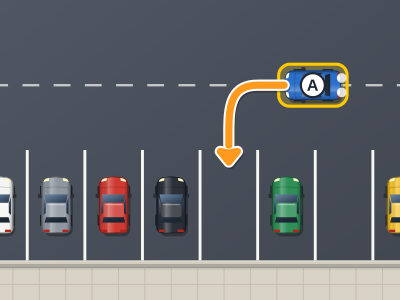
Guides describe the drum test in two slightly different ways: a forward and reverse run through a narrow lane with drums on both sides, or a reverse into a gap between drums. The layout can differ by centre, which is why your instructor's advice beats anything online. In every version the aim is the same: complete the manoeuvre without touching a drum.
A reliable routine
- Before you start, set your mirrors and seat so you can see both sides of the lane.
- Move off at walking pace. Speed is your enemy here, not time.
- Look at the drum, not at the gap. The car follows your eyes.
- Use small, steady steering corrections and stop if you are unsure.
- In reverse, check over your shoulder and in both mirrors, and keep checking.
- Finish by stopping square and waiting for the examiner's instruction.
What fails you
Touching a drum is the usual way to fail. Others commonly reported are stalling, going over a line, a very slow or hesitant run that stops repeatedly, and ignoring an instruction. Your instructor can tell you the exact penalty rules in force.
The slope test: hill start without rolling back
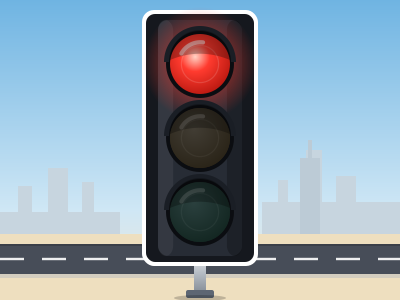
The slope test checks that you can control the car on an incline. Guides describe the sequence as: drive up the slope, stop at a stop line when told, apply the handbrake, then move off again without noise, jerking or rolling backward.
Manual car routine
- Approach slowly in first gear and stop with the front of the car at the line.
- Apply the handbrake firmly, keep the foot on the brake and select first gear.
- When told to go, raise the clutch to the bite point. You will feel the nose lift slightly.
- Add a little power, then release the handbrake smoothly.
- Keep the clutch moving up and the speed gentle until the car is clearly over the line.
Automatic car routine
In an automatic, hold the brake at the line with the handbrake on, select drive, release the handbrake gently as you ease off the brake, and apply light power at once. Do not let the car roll back even a little, since that counts against you. Practise until this feels boring, because you do it under pressure on the day.
The sign test comes first
Stage one starts with the sign test. Before 2021 it was a short oral test where an ROP officer pointed to signs and you named them. Since 6 January 2021, ROP theory tests have been electronic: applicants book online and take the tests on a system rather than orally. If you fail the signs, the drums and the slope do not save you.
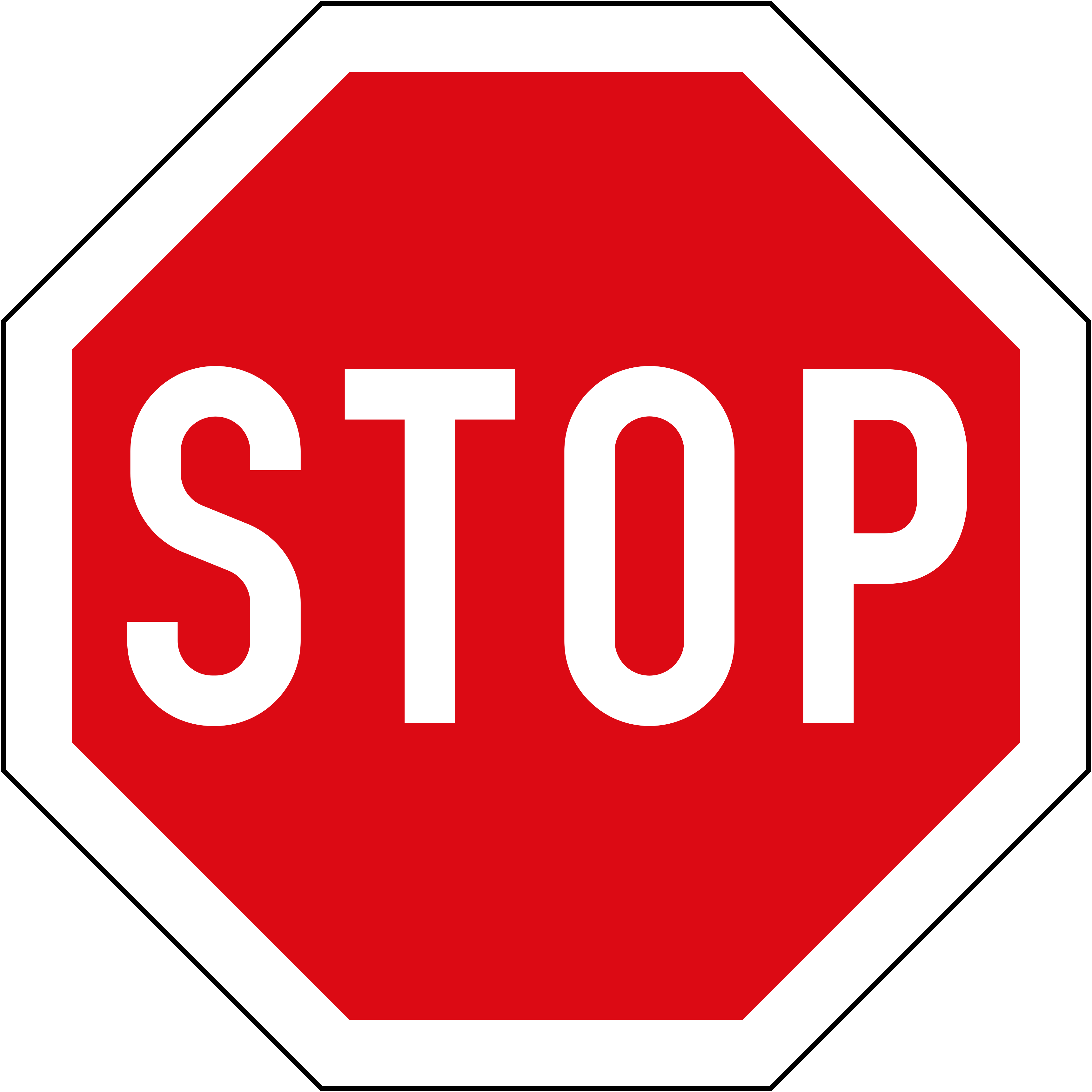
The Oman signs are the standard Gulf set. Stop, give way, no entry, speed limits, no overtaking, no parking and no turns will all be familiar if you have studied elsewhere in the region. Learn them as a group by shape and colour: red circles are prohibitions, red-bordered triangles are warnings, and blue circles are mandatory instructions.
Do our free road signs test 1 and test 2 before your yard day. They show the sign and explain the meaning, so you can see what you missed. The reason this page offers sign and rule questions free is simple: this is the stage-one part you can practise at a desk.
Oman printable theory pack
485 questions with the answer and the rule, 3 full papers at the real length. One payment, no account.
Fail on the day
~OMR 25
Pass first time
OMR 1.5
- 3
- Full papers
- 485
- Questions
- printable
That's 3.1 baisa a question, every answer explained.
Fees and retakes: what guides report
Fees are the most contradictory part of the Oman licence process, so treat every number as a guide and confirm with your school or the ROP.
| Source | What it says | Caveat |
|---|---|---|
| Gulf News guide | OMR 25 per test, paid again for each failed attempt | Undated, may be out of date |
| Expat guide (2019) | A single fee applies to the three stage-one tests together | Older, from before the 2021 change |
| Reader letter to a newspaper | The ROP booking fee is far lower, with instructors charging more | Opinion piece, not an official schedule |
| ROP | No current public fee schedule found by us | Ask the ROP or your school |
What does not change is the logic. Each attempt costs money, and between practical attempts, candidates report waits of several weeks. A failed yard test therefore costs a fee, a delay and often extra lessons. That makes the free practice you can do now, on signs and on technique with an instructor, the cheapest part of the process.
The mistakes that fail people
These are the failure points most often reported by candidates and instructors. Use the table as a checklist before your yard day.
| Mistake | Where | Fix |
|---|---|---|
| Touching a drum | Drum test | Slow down, look ahead, use mirrors, small steering |
| Rolling back | Slope test | Handbrake on, find the bite, release smoothly |
| Stalling | Slope test | Practise the bite point until it is automatic |
| Jerky start | Slope test | Smooth clutch, light power, no revving |
| Hesitating and stopping repeatedly | Drum test | Commit once you have checked, then keep moving |
| Failing a sign | Sign test | Drill the signs tests |
Most of these are technique, not knowledge, which means more practice with an instructor fixes them. It also means that a candidate who is nervous on the day will do worse than they did in lessons, so practise past the point where you get it right once. Get it right five times in a row.
Why instructors push repetition
A single clean run proves very little, because the drums punish small errors that creep in when you are tired or watched. Ask your instructor to mark you strictly in the final lessons, as an examiner would, and to change the order of the exercises so that you do not rely on a rhythm. If you are paying for lessons by the hour, spend them on the exercise you find hardest, not the one you enjoy. Candidates who rehearse the slope in a car and the drums in the same car as the test report far fewer surprises on the day.
A one-week plan before stage one
This plan assumes you are already taking lessons with a school. The drum and slope need driving time, so book extra sessions if you can.
Days 1 to 3: signs and theory
- Day 1: road signs test 1. Learn every sign you missed.
- Day 2: road signs test 2 and road rules test 1.
- Day 3: mock test 1. Note any weak topics.
Days 4 to 6: yard skills
- Day 4: drum routine with your instructor, ten runs, no touches.
- Day 5: slope routine, ten starts, no roll back.
- Day 6: run the whole stage in order, with the sign test fresh in your mind.
Day 7: rest and check
Take mock test 2 for confidence, confirm your booking on the ROP app or portal, and check your documents. Stop practising early and sleep.
Test-day checklist
Run this list on the morning of stage one.
- Confirm your slot and centre. Book through your school, the ROP app or the portal rather than walking in.
- Bring your licence file, eye-test certificate and ID. The eye-test certificate is reported to be valid for only a short window, around 30 days.
- Wear shoes you can feel the pedals through. Flip-flops are a bad idea.
- Arrive early and watch the other candidates if you can. Note the layout.
- Adjust your seat and mirrors before you start, not after.
- Do the sign test calmly. Read the question and look at the sign before answering.
- On the drums and slope, go slowly. Nobody fails for being too careful.
If you feel your hands shake, breathe out slowly before you release the handbrake. Many candidates report that nerves, not skill, caused their failures.
After stage one: the road test
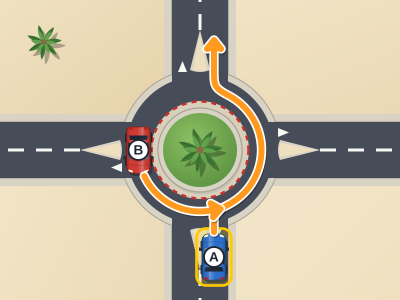
Once you pass stage one you move on to the on-road test with an ROP examiner. It is a different skill: mirrors, lane discipline, stops, following distance and, above all, roundabouts. Oman has a very large number of them and candidates report that entering a roundabout when the lanes to the left are not clear is a frequent failure.
Prepare the rules side with the right of way test and the safe driving test. Candidates also report that there is typically a waiting period of several weeks between practical attempts, and that many take more than one go, so do not book until you are ready. The reasons and fixes are the same as on the yard: slow down, check, commit.
How to practise: free first, then the full bank
You cannot practise the drums on a website, but you can practise everything else. The free test on this page gives you 10 sign and rule questions with the answer and reason after each one. Use it as a baseline, then work through the mock tests, fines and black points and the other topic tests. Each has 20 or more questions with explanations. Our mocks have 30 questions, and the topic tests are shorter.
If you want more, the printable Oman papers are a zip of separate PDFs: a start-here guide, each paper with its own answer key and score bands, and the revision bank. Our questions are written to the published rules and to what candidates report from the real test. They are not the official exam.
Which governorate you test in does not change the plan, whether you are in Muscat, Dhofar, Al Batinah North or Al Dakhiliyah. The ROP sets the tests, and your school knows your centre. Pair this page with the Oman theory test pass mark guide to plan the rest of your route, and remember that each retake is a fee and a wait, so practise until the whole stage is boring.
Free Muscat mock tests and topic tests
Every test opens on ten free questions. Pick a full mock at the real length, or drill one topic.
- Oman Theory Mock Test 1Mock · 30 questions
- Oman Theory Mock Test 2Mock · 30 questions
- Oman Theory Mock Test 3Mock · 30 questions
- Oman Theory Mock Test 4Mock · 30 questions
- Oman Road Signs Practice Test 1Topic · 22 questions
- Oman Road Signs Practice Test 2Topic · 22 questions
- Oman Road Rules Test 1Topic · 20 questions
- Oman Road Rules Test 2Topic · 20 questions
- Oman Right of Way Practice TestTopic · 22 questions
- Oman Safe Driving Practice TestTopic · 22 questions
- Oman Fines & Black Points Test 1Topic · 20 questions
- Oman Fines & Black Points Test 2Topic · 20 questions
Practise for your governorate
The rules are national, but the test centre, booking and fees can differ by area.
Frequently asked questions
It is the yard stage of the Oman driving test. You drive between drums at low speed, forward and in reverse, and do a hill start on a slope, on the same day as the sign test. You must pass all of stage one before the road test.
Touching or knocking a drum is the most common failure reported. Stalling, crossing a line and repeated hesitation can also count against you. Go slowly, use your mirrors and ask your instructor how your centre marks it.
Rolling backwards, stalling or a jerky start after stopping on the incline. The aim is to move off smoothly without noise or uncontrolled movement. Practise finding the clutch bite point and releasing the handbrake smoothly.
Gulf News reports OMR 25 per test, paid again for each failed attempt, while an expat guide describes a single fee for stage one. Sources conflict and are undated, so confirm the current fee with the ROP or your driving school.
Yes, stage one is reported to be the sign test, the drum test and the slope test taken together on one day. Since January 2021 the Royal Oman Police has run theory tests electronically rather than orally.
It depends on whether your licence can be converted. Eligible foreign licences may convert without these tests, but the list of countries is set by the ROP and changes. Ask the ROP before you assume an exemption.
Guides do not say you cannot, and many people sit tests in automatics, but rules on test vehicles can differ by school and centre. Ask your driving school which vehicle is used and practise in that same car.
The ROP does not publish a wait for stage one in the sources we found. Candidates report waits of several weeks between practical test attempts, so each failure can delay your licence noticeably.
The on-road test with a Royal Oman Police examiner. It covers mirrors, lane discipline, stops and, importantly, roundabouts, which candidates report as a frequent reason for failing. Book it only when you feel ready.
Book extra lessons with your instructor on the same layout, and rehearse the routines until you get it right five times in a row. Practise the sign test with free questions, since you can do that at home.
Oman printable theory pack
485 questions with the answer and the rule, 3 full papers at the real length. One payment, no account.
Fail on the day
~OMR 25
Pass first time
OMR 1.5
- 3
- Full papers
- 485
- Questions
- printable
That's 3.1 baisa a question, every answer explained.