

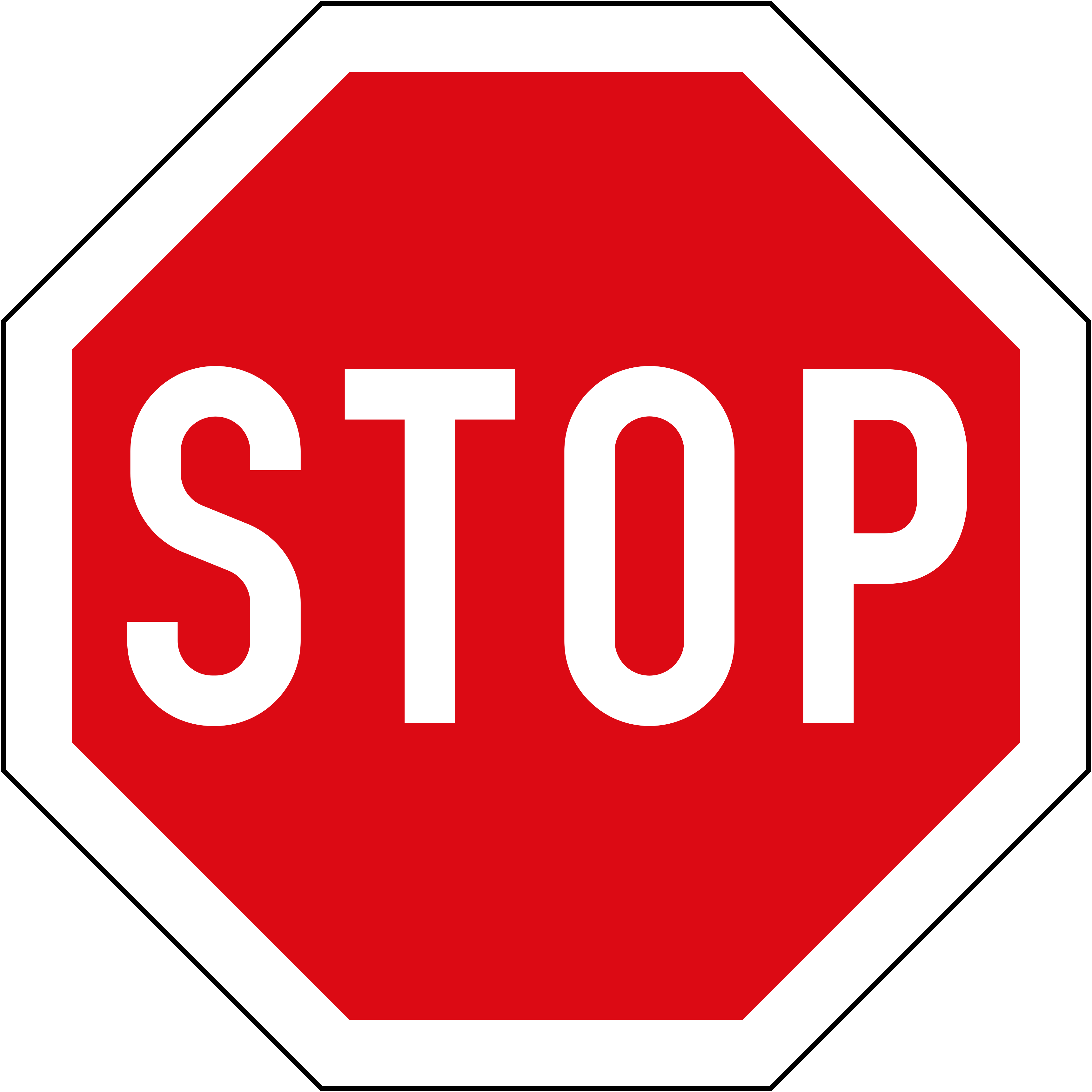
Oman driving test questions and answers: what you are getting
This page gives you 15 worked questions with the correct answer and the reason for it, across the topics the Oman theory test covers. They are written to the published Oman traffic rules and to what candidates report from the real test, so you can see how a question is built, where the trap sits, and how to think your way to the answer instead of memorising a list.
They are practice questions. They are not the official exam, and the Royal Oman Police (ROP) sets the real question bank, format and pass mark. If you only want the road sign chart, go to Oman traffic signs and meanings. If you want the score you need, see the pass mark guide.
How to use this page
Cover the answer, pick your option, then read the reason. Do not just check whether you were right. If you were right for the wrong reason, you will drop that question on a slightly different version of it. Keep a note of every topic where you missed one, and use the table of topics below to send yourself to the right free test.
Questions with pictures
Most of our questions come with a picture of the sign or the road scene, because the real test is reported to rely heavily on signs and situations. Where we show a picture below, it is the same artwork used in our free tests, such as the first full Oman mock.
What the real Oman theory test looks like
Start with what is and is not known, because many pages online state figures as fact when they are not. The ROP does not publish the question count, the pass mark or the question bank for the theory, or signal, test. What is documented is the history and the format direction.
| Item | What is reported | Our position |
|---|---|---|
| Format before 2021 | A short oral sign check by an ROP officer | Reported in a 2019 expat guide |
| Format since January 2021 | Theory tests moved to an electronic system | Reported by Oman Observer and other outlets |
| Questions and pass mark | Prep sites quote 20 to 30 questions and about 24 to pass, and they disagree | Not confirmed by the ROP |
| Languages | Arabic and English commonly reported | Confirm when you book |
| Our mock tests | 30 questions, 30 minutes, 23 correct to pass (75%) | Our own practice standard |
| Our topic tests | 20 to 22 questions each, 15 or 17 correct to pass | Our own practice standard |
What this means for how you answer
Prepare for both a sign recognition style and a rules style. The first needs the shapes and colours. The second needs the rule and its exceptions, which is where most of the 15 questions on this page sit. The questions are multiple choice with four options in our tests, and one is correct.
Candidates in every governorate sit the same national test. If you are in Dhofar, Al Batinah South or Muscat, the rules are the same. For the whole licence route, see our Oman driving licence guide for expats.
The topics, and where to practise each one
Our Oman light vehicle bank has five topics. The table shows how many questions we hold for each and which free test to take. Heavy vehicle and motorcycle candidates have their own topics, linked below the table.
| Topic | Questions in our bank | What it covers | Free test |
|---|---|---|---|
| Road signs | 65 | Signs, markings, traffic lights, police signals | Road signs test 1 |
| Traffic rules | 70 | Lanes, overtaking, U-turns, parking, tunnels, weather | Road rules test 1 |
| Right of way | 70 | Junctions, roundabouts, emergency vehicles, pedestrians | Right of way test |
| Safety | 70 | Seat belts, child seats, speed, following distance, fog and floods | Safe driving test |
| Penalties | 70 | Alcohol, phones, black points, fines | Fines and black points test 1 |
Other vehicle types
Motorcycle candidates should use the motorcycle mock test 1, and truck and bus candidates the heavy vehicle mock test 1. The worked questions on this page are for light vehicles.
Which topic first
Start with signs, because they take a week and every other topic refers to them. Then do right of way, which is where the longest and trickiest questions are. Leave penalties for last, since the numbers are the easiest to learn and the easiest to forget. The full mocks mix all five.
Worked questions on signs and markings
Five questions from the road signs topic. Each one tests a rule that candidates regularly get wrong.
Speed signs
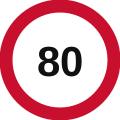
Question 1. You passed an 80 km/h sign 1.5 km ago and no new sign has appeared. Does the limit still apply?
- A. No, limits only apply for 1 km from the sign
- B. No, the limit expires at the next junction
- C. Yes, it stays in force until a new speed sign or an end of restriction sign
- D. No, it applies only while the sign is in view
Answer: C. A speed limit has no automatic expiry distance. It runs until a new sign replaces it or the same number with a diagonal line cancels it.
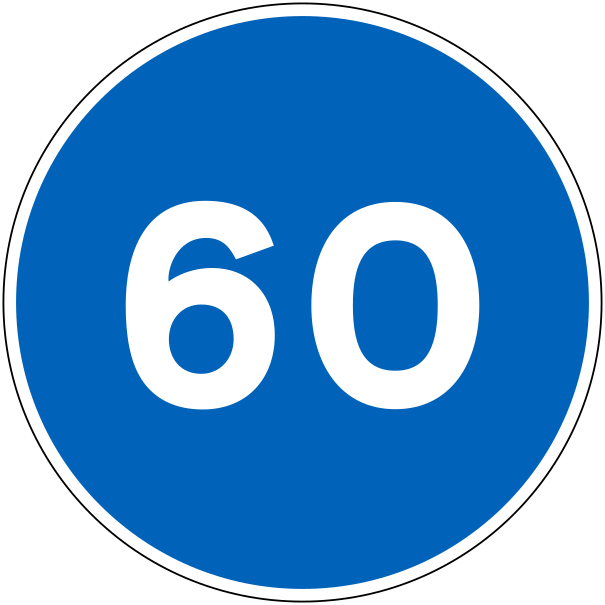
Question 2. A blue circular sign displays the number 60. What does it mean?
- A. The maximum speed is 60 km/h
- B. The speed limit resumes at 60 km/h
- C. The minimum speed is 60 km/h
- D. The recommended speed in bad weather is 60 km/h
Answer: C. A blue circle is a command. With a number it is a minimum speed, which you must keep unless conditions make it unsafe. Do not confuse it with the red circle, which is a maximum.
Markings and lights
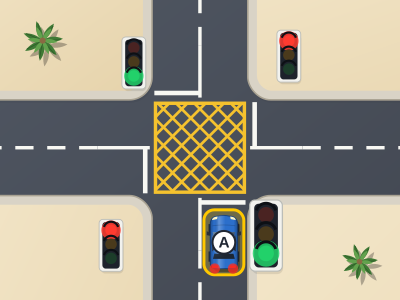
Question 3. You approach a yellow box junction painted on the road. When may you enter the box?
- A. Whenever the signal is green
- B. Whenever the box itself is empty
- C. At any time if you move through it quickly
- D. Only when your exit road is clear and you can drive through without stopping inside
Answer: D. You must not enter the box unless your exit is clear, even on green. If traffic is queued beyond the box, you wait. The rule prevents gridlock at busy junctions.
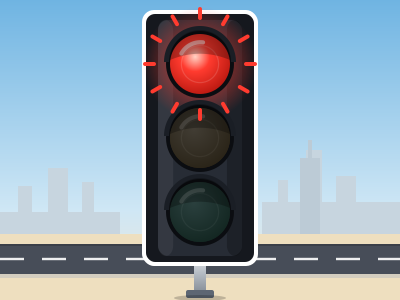
Question 4. A traffic light is showing a flashing red signal. What should you do?
- A. Stop, give way to all traffic, then proceed when it is safe
- B. Stop and wait for a steady green
- C. Proceed with caution at any speed
- D. Sound the horn and continue slowly
Answer: A. A flashing red is treated like a stop sign. You make a complete stop, check all directions and go when it is clear. You do not have to wait for green.
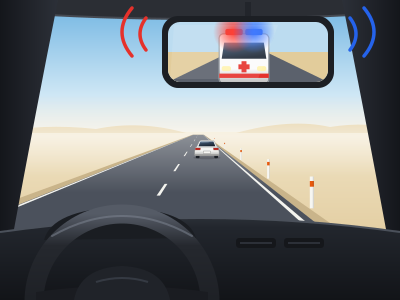
Question 5. You hear a siren from an emergency vehicle approaching from behind on a two lane road. What should you do?
- A. Move towards the right side to let it pass on the left
- B. Stop in the middle of the road at once
- C. Speed up and turn off at the nearest side road
- D. Move to the left so it can pass on the right
Answer: A. Emergency vehicles use the left lane or the centre to pass. Move right to open a clear path, and do not brake harshly or stop in a dangerous place. Obstructing an emergency vehicle is an offence.
For the full picture of every sign family, use the Oman traffic signs and meanings chart.
Worked questions on right of way and junctions
Right of way is where the longest questions live, and the answers depend on one detail: a sign, a signal or a position. Read every word.
Give way, priority and dead signals
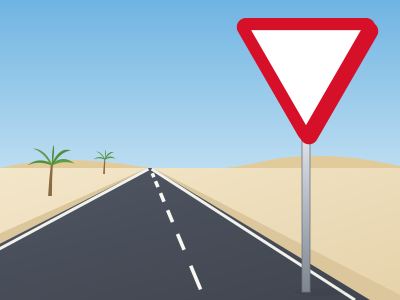
Question 6. You are at a junction controlled by a GIVE WAY sign. No traffic is visible. Must you stop?
- A. Yes, you must always stop at a give way sign
- B. No, you may proceed without stopping if it is clearly safe
- C. Yes, stop and count to three
- D. No, a give way sign gives you priority over all traffic
Answer: B. Give way means yield to traffic on the major road. You are not required to make a full stop if the road is clearly safe to enter. That is the difference from a stop sign.

Question 7. You are travelling on a priority road marked by the yellow diamond. You approach a side junction. Who has right of way?
- A. The vehicle on your right always has priority
- B. You, as the driver on the priority road
- C. The vehicle on the left
- D. Nobody, priority ends at every junction
Answer: B. The yellow diamond gives drivers on that road right of way over vehicles joining from side roads. It overrides the normal give way to the right rule at unmarked junctions.
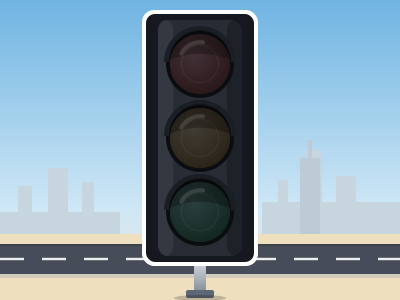
Question 8. Traffic signals at a junction fail completely and show no lights. How should you treat the junction?
- A. As an unmarked junction, giving way to traffic from the right
- B. All traffic stops until the signals are repaired
- C. The road with more lanes has priority
- D. Proceed at full speed because the signal no longer applies
Answer: A. A failed signal makes the junction effectively uncontrolled. Treat it as unmarked, give way to traffic on your right and proceed with caution.
Police and the officer rule
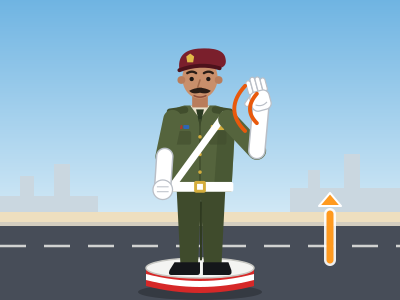
Question 9. The lights at a crossroads show steady red for your direction, but a police officer waves you through. What do you do?
- A. Stay stopped because the red light overrides the officer
- B. Obey the officer and proceed through the red light
- C. Wait for the light to turn green
- D. Sound the horn and proceed cautiously
Answer: B. An officer directing traffic has authority over signs and signals. Failing to follow a lawful instruction from an officer is an offence.
More like these are in the free Oman right of way test, which has 22 questions and a pass line of 17.
Worked questions on rules and safe driving
These questions come from the traffic rules and safety topics. They test exceptions, which is why a candidate who learned only the headline rule drops marks.
Overtaking, U-turns and mountain roads
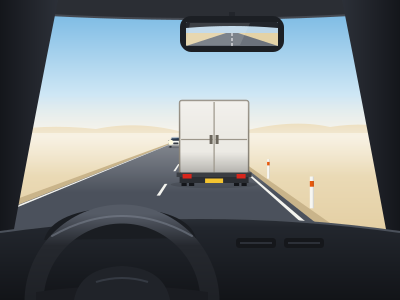
Question 10. Is it ever legal to overtake on the right in Oman?
- A. No, never
- B. Only if you sound the horn first
- C. Only on roads with three or more lanes
- D. Yes, when the vehicle ahead has clearly signalled and is turning left
Answer: D. Overtaking is normally on the left. One recognised exception is when the vehicle ahead is clearly signalling a left turn. You may pass on the right only when it is safe and without inconveniencing others.
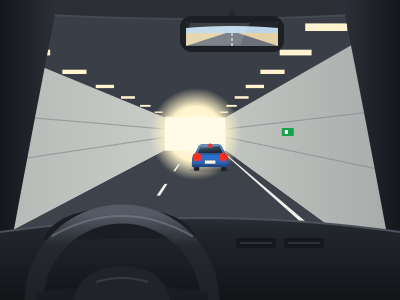
Question 11. At which of these places is a U-turn always forbidden?
- A. Only on highways above 100 km/h
- B. Only in school zones during school hours
- C. At no specific type of place
- D. On a bridge, inside a tunnel, at a pedestrian crossing, or where a bend restricts vision
Answer: D. U-turns are banned where visibility is limited or the move creates serious danger, including bridges, tunnels, crossings, sharp bends and hill crests. Use a designated U-turn gap instead.
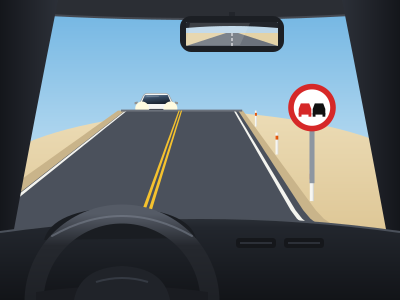
Question 12. On a narrow mountain road you meet an oncoming vehicle and there is no room to pass. Who gives way?
- A. The vehicle going downhill gives way to the one going uphill
- B. The vehicle going uphill gives way
- C. The smaller vehicle always gives way
- D. The first driver to sound the horn
Answer: A. Downhill traffic gives way because stopping and reversing is easier when facing downhill, where an uphill vehicle risks rolling back. Use any passing place available.
Weather and children
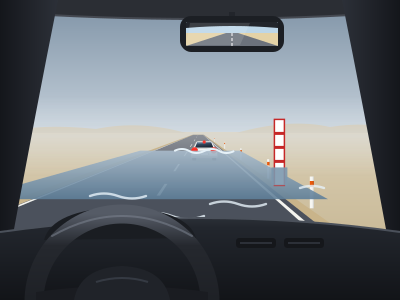
Question 13. You are driving through a wadi after heavy rain and see fast-flowing water across the road. What do you do?
- A. Stop before the water and wait for it to subside, never try to cross
- B. Cross quickly at speed to limit time in the water
- C. Cross slowly in first gear if it looks shallow
- D. Follow the vehicle ahead
Answer: A. Wadi flash floods are extremely dangerous. Water that looks shallow can be deep and fast enough to sweep a vehicle away. The ROP and civil defence advise never crossing a flooded wadi. Turn back and find another route.
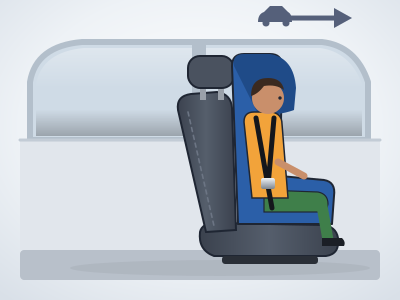
Question 14. Where must a young child too small for an adult seat belt travel in a car?
- A. On an adult's lap in the front seat
- B. In the boot if there is no seat
- C. In an approved child seat suited to the child's age and weight, fitted in the rear seat
- D. In the front seat held by an adult
Answer: C. A child seat is required for young children, and the rear seat is the safest place for it. Our bank also teaches that children under 10 should not sit in the front. Confirm current age limits with the ROP.
One question on penalties
Question 15. Under Oman's traffic law, what is the legal blood alcohol limit for drivers?
- A. A low limit similar to Europe
- B. Zero, any detectable alcohol is illegal
- C. A limit that applies only to expatriates
- D. A limit that depends on how long you have held a licence
Answer: B. Oman applies a zero tolerance rule. The likely result of any detected alcohol is prosecution, a heavy fine, vehicle impoundment and, for an expatriate, possible deportation. The fines and black points test covers the rest.
Oman printable theory pack
485 questions with the answer and the rule, 3 full papers at the real length. One payment, no account.
Fail on the day
~OMR 25
Pass first time
OMR 1.5
- 3
- Full papers
- 485
- Questions
- printable
That's 3.1 baisa a question, every answer explained.
How to read a question so the trap does not work
Having seen 15 questions, you can see the patterns. The test does not usually ask you for obscure facts. It asks for the plain rule and then offers three tempting variations. A habit of reading in a fixed order cuts the number of marks you give away.
Read the last line first
The scenario may be long, but the question is in the final sentence. Question 1 above sounds like it is about an 80 sign, and it is really about how long a limit lasts. Find the ask, then read the scenario with it in mind.
Distrust the absolutes
Options with "always", "never", "only" or "any" are often wrong, but not always. Question 10 has a "never" that is wrong because of an exception, and question 15 has a "zero" that is right because the law has no exception. Test each absolute against the rule, do not reject it on sight.
Look for the one that keeps people safe
When two options seem possible, pick the one that gives way, slows down or stops. The questions are written to the safety rules, and the dangerous option is almost never right. Wadi, fog, children and emergency vehicles are the clearest cases.
Check the picture, not only the words
If a question has an image, the image carries part of the answer. Note the colour, the shape and the number before you read the options. That is the same habit as in the signs chart, and it applies to the scenes as well.
How to use the free mocks to get above the line
A single read-through of 15 questions does not prepare you for 30 mixed ones in a timer. Use the free tests in a fixed order, and use the score from each to decide what to do next. The table gives the order we suggest.
| Step | Test | Target | If you miss it |
|---|---|---|---|
| 1 | Road signs test 1 | 17 of 22 or more | Read the signs chart again, repeat with test 2 |
| 2 | Road rules test 1 and test 2 | 15 of 20 or more | Redo the questions you missed the next day |
| 3 | Right of way test and safe driving test | 17 of 22 or more | Draw the junction on paper before answering |
| 4 | Mock test 1 | 23 of 30 in 30 minutes | Find the topic of each miss and go back to step 1 to 3 for it |
| 5 | Mock 2, mock 3, mock 4 | 26 of 30 or more twice | Do not book the real test until you can do this |
Why aim for 26 and not 23
Our mocks pass at 23 of 30, which is 75%. The ROP has not published its own line, and some prep sites report a stricter 24. A score of 26 gives you room on any reported format and on a bad day. We explain the margin in the pass mark guide.
Why repeat tests do not count
If you take the same mock three times you will start recognising the answers, not the rules. When your scores stop moving, you have used up the free questions that are new to you, and it is time to move to the full bank.
Oman driving test questions and answers PDF
A lot of people search for these questions as a PDF, so that they can print them or read them without a connection. There are three things to know.
The official material
The ROP published Highway Code booklets for light and heavy vehicles in March 2024, free in Arabic and English. They are the reference for the rules and the signs. They are a rulebook, not a question bank, so they do not give you questions to practise on. We could not confirm the exact download link, so look on rop.gov.om.
Question papers
Our Oman printable papers are question sheets you can print, with the pictures, in English and an Arabic edition. Each one is marked against an answer key with the reason for every answer, so you can do it in a car, in a waiting room or at home, then mark it and see what went wrong.
A word of caution on free PDFs
Be careful with PDFs that claim to be "official ROP questions". The ROP does not publish its question bank, so any such file is a prep site's recall or guess, and prep sites contradict each other on the number of questions and the pass mark. A file with no explanations teaches you answers, not rules, and that fails you on the first reworded question. Our papers say plainly what they are: practice written to the published rules and to what candidates report.
If you want to keep practising on screen as well, the free tests on the Muscat light vehicle page work in any governorate.
Mistakes that cost marks on the theory test
These are the patterns that our own wrong answers and candidate reports point to. They are habits, and habits can be fixed.
Memorising answers instead of rules
A candidate who remembers that the answer to one question is "C" will fail on the same question reworded. Learn the rule behind it, as in the reasons above.
Skipping the exceptions
Overtaking on the right when the car ahead is turning left, a give way sign where you need not stop, and a priority road that beats the right hand rule are all exceptions, and all are asked because they are exceptions.
Guessing the penalty numbers
Fines and black points are exact. If you are not sure of a figure, do not guess in practice, check it in the bank. Do not rely on any number from a forum, because penalties change. The ROP is the authority.
Running out of time
Thirty questions in 30 minutes is a minute a question. Do not sit on one scene question for five minutes. Mark it, move on and come back. Practise this in a timed mock, not on an untimed topic test.
Booking too early
The test is usually charged per attempt, and a retest means another slot to wait for. The later stages, drum and slope and then the road test, slide back with it. Read about the next stage in our drum and slope guide and the reasons people fail the road test in the ROP road test guide.
A ten day study plan
This plan fits around work and driving lessons. It takes about 40 minutes a day. If you have less time, double up the first four days and keep the last three as they are.
| Day | Focus | Do |
|---|---|---|
| 1 to 2 | Signs and markings | Read the signs chart, then take signs test 1 |
| 3 | Traffic lights and police | Signs test 2, and the questions 3, 4 and 9 above |
| 4 to 5 | Traffic rules | Road rules test 1 and 2 |
| 6 | Right of way | Right of way test, drawing each junction |
| 7 | Safety | Safe driving test |
| 8 | Penalties | Fines and black points test 1, then test 2 |
| 9 | Full mock | Mock 1, timed, then review every miss |
| 10 | Second mock | Mock 2, aim for 26 of 30 |
The night before the test
Do not take a new test. Read your list of misses, sleep and arrive early. Bring what your driving institute has asked for, and remember that eye test certificates are time limited, reportedly around 30 days.
After the theory test
The next step is the stage one practical, with drums and a slope. Prepare for it using the drum and slope guide. The ROP and your institute set the final dates and fees.
What a fail costs, and the full bank
The Oman licence process has several separate fees, and the theory test is typically charged per attempt. Reported government fee amounts are a few Omani rials per stage, but the current figures are not confirmed, so we do not quote them. Lessons with a driving institute are usually the largest cost. A failed theory test adds a fee, a wait for a slot, and a delay to each later stage. The eye test certificate may expire in the wait.
The test is the stage that you can prepare for at home, with no car, no instructor and no fuel. That is why we suggest taking the free tests until you score 26 of 30 twice, and then deciding whether you want more.
When the free tests are not enough
The free tests are a sample. If you keep meeting questions you have already seen, or you want a deeper question set per topic, the full bank and the printable papers give you more variety and the same reasons for every answer. See the Oman theory test hub for everything in one place.
Where to start today
- Take the free Oman mock test 1 cold, to find your starting score.
- Write down the topics of your wrong answers.
- Use the table of topics above to pick the free test for each one.
- Come back to a mock in a few days and compare.
Whether you are in Al Dakhiliyah, Al Sharqiyah North or the capital, the questions and the rules you need are the same.
Free Muscat mock tests and topic tests
Every test opens on ten free questions. Pick a full mock at the real length, or drill one topic.
- Oman Theory Mock Test 1Mock · 30 questions
- Oman Theory Mock Test 2Mock · 30 questions
- Oman Theory Mock Test 3Mock · 30 questions
- Oman Theory Mock Test 4Mock · 30 questions
- Oman Road Signs Practice Test 1Topic · 22 questions
- Oman Road Signs Practice Test 2Topic · 22 questions
- Oman Road Rules Test 1Topic · 20 questions
- Oman Road Rules Test 2Topic · 20 questions
- Oman Right of Way Practice TestTopic · 22 questions
- Oman Safe Driving Practice TestTopic · 22 questions
- Oman Fines & Black Points Test 1Topic · 20 questions
- Oman Fines & Black Points Test 2Topic · 20 questions
Practise for your governorate
The rules are national, but the test centre, booking and fees can differ by area.
Frequently asked questions
The ROP does not publish its question bank. Candidates report questions on road signs, traffic rules, right of way, safety and penalties. Our questions are written to the published Oman rules and to what candidates report, so you can practise every topic, but they are not the official exam.
The ROP has not published a figure. Prep sites quote between 20 and 30 and disagree. Our full mocks have 30 questions with 23 correct to pass in 30 minutes, and we suggest aiming for 26 or more so you are safe on any reported format.
English and Arabic are commonly reported for the theory test, and our practice tests are in English with an Arabic edition of the printable papers. Availability can vary by centre and change over time, so ask your driving institute which language the test is in when you book.
Our practice questions are multiple choice with four options and one correct answer. Before 2021 the signs part was reported as an oral check by an officer, and since January 2021 theory tests have been electronic. Confirm the format at your centre, and practise both pictures and wording.
Our printable papers for Oman give you question sheets with pictures and an answer key with reasons. The ROP Highway Code booklets, published in March 2024, are free on rop.gov.om but are a rulebook and not a question bank. Be wary of PDFs claiming to be official questions.
Candidates report road signs and markings, traffic rules, right of way at junctions and roundabouts, safe driving in conditions such as fog, floods and sandstorms, and penalties such as fines and black points. Our bank has a free test for each topic so you can find and fix weak areas.
The ROP does not publish one. Our mocks pass at 23 of 30, which is 75%, and some prep sites report a stricter 24. Aim for 26 or more on two timed papers before you book, so you have a margin on any format. Ask your institute for its current figure.
No. They are practice questions written to the published Oman traffic rules and to what candidates report from the real test. They are not official, and the ROP sets the real question bank, format and pass mark. Use them to learn the rules and your weak areas, not to memorise answers.
Most people need about ten days at 40 minutes a day if they use timed tests and review every miss. Signs take about a week alone. If you score 26 of 30 on two mocks in a row, you are ready. If not, find the topic of your misses and repeat that test.
Oman printable theory pack
485 questions with the answer and the rule, 3 full papers at the real length. One payment, no account.
Fail on the day
~OMR 25
Pass first time
OMR 1.5
- 3
- Full papers
- 485
- Questions
- printable
That's 3.1 baisa a question, every answer explained.
Official sources
- Royal Oman Police (ROP) official website
- Oman Observer - ROP launches new online traffic services (6 Jan 2021)
- Muscat Daily - ROP publishes Highway Code handbooks (25 Mar 2024)
- Times of Oman - ROP launches 2 booklets on Highway Code for vehicles (Mar 2024)
- expat.com - Obtaining a driving license in Oman (2019)