

Al Ahmadi General Traffic Department Light vehicle
Practice mode· Right of way & safetyAl Ahmadi General Traffic Department - Kuwait Right of Way Practice Test
Tests your understanding of priority rules: unmarked junctions, roundabouts, emergency vehicles, merging lanes and more. Getting right of way right can prevent serious accidents.
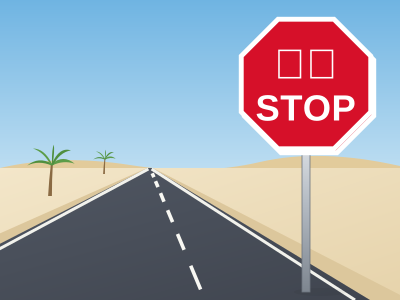
You approach a STOP sign at a junction. What must you do?
The other 12 questions in this test
Read them all. The answer and the reason for each, and the timed 22-question run, are in the Kuwait Driving Theory Online Practice Bank.
- Q11Right of way
You are leaving a private driveway or car park onto a public road. Who has priority?
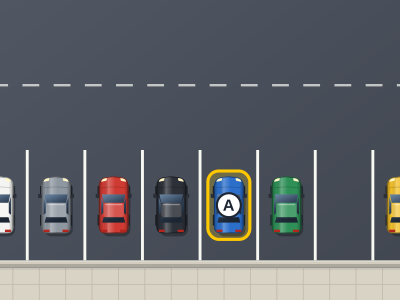
- AYou have priority because you were there first
- BAll traffic on the public road has priority over you
- CTraffic from your left has priority but not traffic from your right
- DPriority depends on whether there is a kerb or a dropped kerb at the exit
Answer and explanation in the bank
- Q12Right of way
Traffic lights are showing a flashing amber signal. What does this mean?
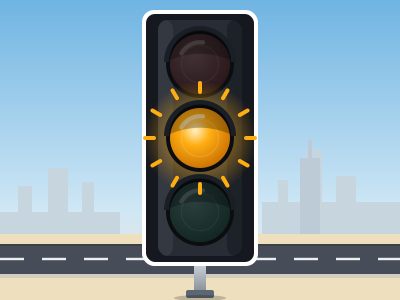
- AStop and wait for the lights to change to green
- BYou have priority; other traffic must stop for you
- CTreat it as a green light and proceed at normal speed
- DProceed with caution, giving way to any traffic or pedestrians in the junction
Answer and explanation in the bank
- Q13Right of way
You are in the right lane of a dual carriageway approaching a filter slip lane that exits to the right. A vehicle in the filter lane wants to re-enter the carriageway. Who has priority?
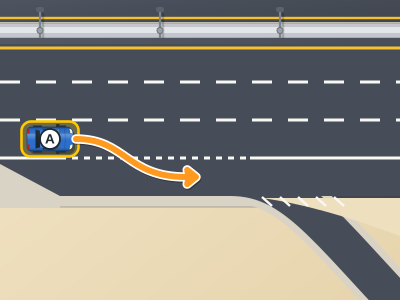
- AThe filter lane vehicle has priority because it is on your right
- BYou on the main carriageway have priority; the vehicle in the filter lane must give way
- CPriority is shared; both vehicles must slow down equally
- DThe larger of the two vehicles has priority in this situation
Answer and explanation in the bank
- Q14Right of way
On a motorway two lanes merge into one (zip-merge zone). How should drivers handle this?
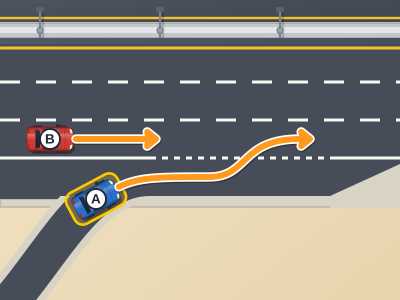
- AEach lane takes turns alternately, one vehicle at a time, like a zip fastener
- BThe lane that is ending must stop and wait for all traffic in the continuing lane to clear
- CThe vehicle travelling faster has priority in the merge zone
- DDrivers should merge as early as possible, well before the merge point
Answer and explanation in the bank
- Q15Right of way
You are in the inside (left) lane of a roundabout and wish to take the third exit. What should you do?
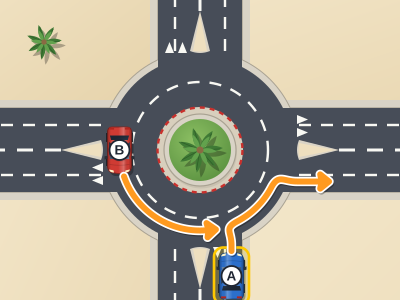
- AMove to the outer (right) lane before your exit, check mirrors and signal right, then exit
- BExit directly from the inside lane without changing lanes
- CSignal left and exit from the inside lane, cutting across the outer lane
- DStay in the inside lane and continue around the roundabout again to approach from the left
Answer and explanation in the bank
- Q16Right of way
An ambulance with its siren sounding and lights flashing approaches from the opposite direction on an undivided road. What must you do?
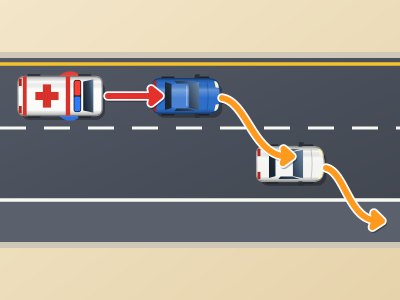
- AContinue at normal speed; the ambulance will drive on its side of the road
- BMove to the left to give the ambulance more space on your side
- CMove as far to the right as safely possible and slow down or stop
- DOnly react if the ambulance flashes its lights directly at you
Answer and explanation in the bank
- Q17Right of way
You are approaching a pedestrian crossing where pedestrians have a green man signal and are crossing. Can you proceed through the crossing?
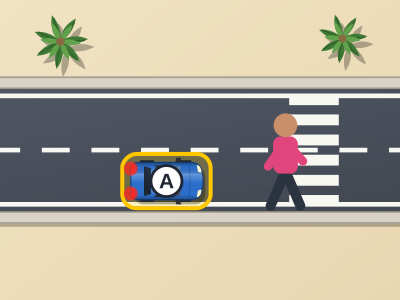
- ANo, you must stop and wait until all pedestrians have cleared the crossing
- BYes, if you can pass behind the last pedestrian without them changing direction
- CYes, if the pedestrians are on the far half of the crossing
- DYes, provided you sound your horn to warn them
Answer and explanation in the bank
- Q18Right of way
A military or official convoy with an escort vehicle displaying flashing lights is passing through a junction you are waiting at. What should you do?
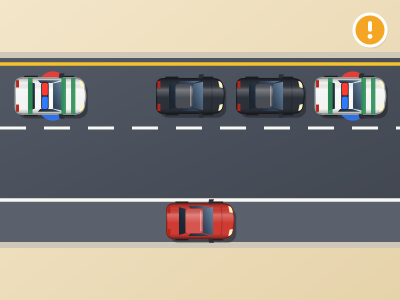
- AProceed through a gap in the convoy if it is safe to do so
- BFollow the last vehicle of the convoy through the junction
- COnly wait for the escort vehicle; you may enter the convoy gap after it passes
- DRemain stopped until the entire convoy and its escort have passed
Answer and explanation in the bank
- Q19Right of way
You are on the main road and a vehicle on a side road to your left is waiting to join. Does that vehicle have priority over you?
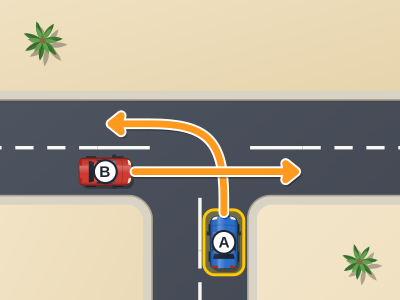
- ANo, you on the main road have priority
- BYes, because the side road vehicle is on your left
- CYes, because the side road vehicle arrived at the junction first
- DPriority depends on the speed of each vehicle
Answer and explanation in the bank
- Q20Right of way
You are turning left at a junction and a cyclist is coming straight ahead from the opposite direction on the road you are turning into. Who has priority?
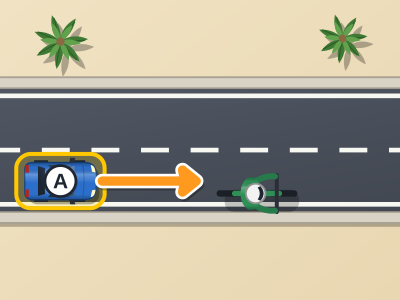
- AThe cyclist has priority; you must wait for them to pass before completing your turn
- BYou have priority because you are turning into the road the cyclist is on
- CBoth have equal priority; flash your lights to indicate you will wait
- DThe cyclist must stop because you are on the main road
Answer and explanation in the bank
- Q21Right of way
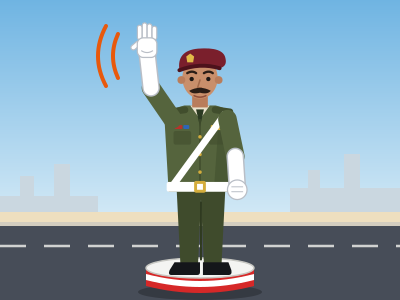
At a junction controlled by a police officer directing traffic, whose instructions must you follow?
- AThe traffic signals take priority over the police officer
- BYou may choose to follow either the signal or the officer's instruction
- CThe police officer's instructions override all traffic signals and signs
- DRoad markings take priority when a police officer is present
Answer and explanation in the bank
- Q22Right of way
You are driving on a highway and wish to leave via an exit ramp. When should you begin slowing down?
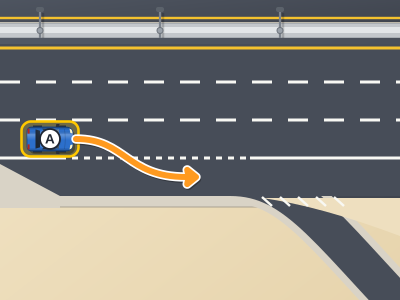
- AAfter moving into the exit lane, use the deceleration lane to slow to an appropriate speed
- BBrake sharply on the main highway just before the exit
- CBegin braking on the main highway so you are at exit speed before the deceleration lane starts
- DThere is no need to slow down; match speed with the traffic at the bottom of the ramp
Answer and explanation in the bank
Every answer above, with the rule it comes from, plus the full 22-question timed test.
Get the Kuwait Driving Theory Online Practice Bank - KWD 3.5What this test covers
Topics include road signs, traffic signals, right of way, roundabouts, speed limits, seat belts, fines and penalties, and the safe-driving rules specific to your vehicle category. Full question-by-question feedback with explanations is shown immediately after you finish the test above.
Frequently asked questions
How many questions is the Al Ahmadi General Traffic Department light vehicle theory test?
The official General Traffic Department light vehicle theory test in Al Ahmadi has 20 questions and you need 18 correct (90%) to pass. This practice test has 22 questions.
Is this the real exam?
These are practice questions to help you revise, written to the published rules and to what candidates report from the real test. They are not the official Kuwait exam and the real question bank, format, fees and pass mark are set by the General Traffic Department (Ministry of Interior), and can change. Always confirm the current requirements with your driving school or the traffic department.
Is this practice test free?
The first 10 questions are free, with no signup, and each shows the answer and the reason. The full 22-question test, timed, is in the Kuwait Driving Theory Online Practice Bank (KWD 3.5, one payment), with every question in the bank.
What does the Al Ahmadi light vehicle theory test cover?
Road signs, traffic signals, right of way, roundabouts, speed limits, seat belts, penalties and safe-driving rules, plus the handling and safety topics specific to your vehicle.