

Al Asimah (Capital) General Traffic Department Truck & Bus
Practice mode· Heavy vehicle skillsAl Asimah (Capital) General Traffic Department - Kuwait Heavy Vehicle Skills Test 1
First set of questions on truck and bus operation: braking distances, load stability, blind spots, turning space and vehicle checks. Master the skills unique to heavy vehicles.
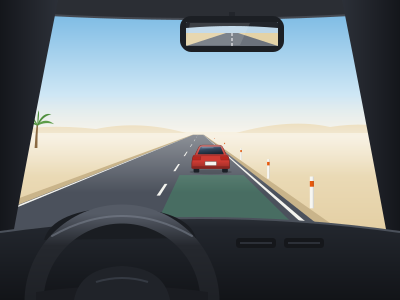
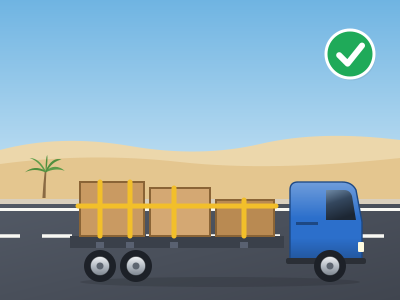
Compared with an unloaded truck of the same type, a fully loaded truck travelling at the same speed will need a stopping distance that is:
The other 12 questions in this test
Read them all. The answer and the reason for each, and the timed 22-question run, are in the Kuwait Driving Theory Online Practice Bank.
- Q11Heavy vehicle
You are driving a left-hand-drive truck in Kuwait (right-hand traffic). On which side is your largest blind spot?
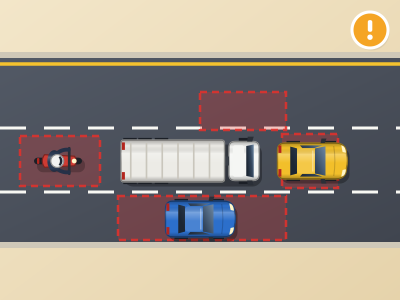
- AThe right (passenger) side, because you sit on the left and the cab structure and distance reduce visibility to that side
- BThe left (driver) side, because the engine housing blocks the view
- CDirectly behind, because the load always blocks the rear camera
- DThere are no significant blind spots on modern trucks with wide-angle mirrors
Answer and explanation in the bank
- Q12Heavy vehicle
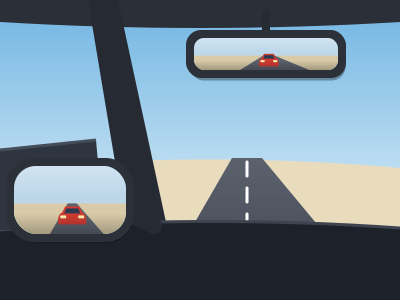
How should the right-side (passenger-side) mirror on a left-hand-drive truck be adjusted?
- ATo show only the road directly behind the truck
- BTo show the driver's own face to confirm correct seating position
- CPointed downward to see the right front tyre only
- DTo show the full length of the trailer, the right-side wheels, and a wide-angle view of the lane to the right
Answer and explanation in the bank
- Q13Heavy vehicle
When a long articulated truck turns right at an intersection, what danger is created by tail swing?
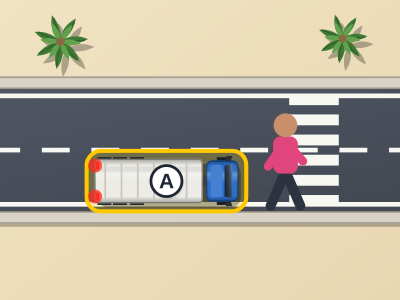
- AThe rear of the trailer swings outward to the left, potentially striking pedestrians or vehicles on the left side
- BThe cab swings outward to the right, striking vehicles waiting on the right
- CThe trailer pushes forward and hits the cab
- DThe rear wheels lift off the ground during the turn
Answer and explanation in the bank
- Q14Heavy vehicle
To safely complete a tight right turn in a long articulated truck, you should:

- ABegin the turn sharply to the right from the rightmost position immediately
- BBegin the turn from further left in the lane to allow the trailer to track through the corner without mounting the kerb
- CStop in the middle of the intersection and turn on full lock
- DReverse slightly then turn sharply to the right
Answer and explanation in the bank
- Q15Heavy vehicle
Which combination of factors most significantly increases rollover risk for a heavy vehicle?
- ALow tyre pressure combined with a very low load
- BDriving on a straight road with a heavy load concentrated at the bottom
- CUsing engine braking on a flat road at low speed
- DHigh centre of gravity combined with cornering at speed, especially with a liquid or shifting load
Answer and explanation in the bank
- Q16Heavy vehicle
You approach a roundabout in a loaded tanker truck. Which action best reduces rollover risk?
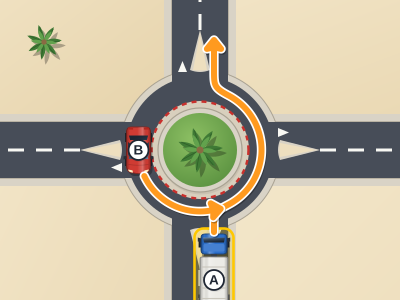
- AAccelerate through the roundabout to finish the turn quickly
- BSlow down significantly before entering the roundabout and maintain a low constant speed through it
- CBrake firmly in the middle of the roundabout if you feel the vehicle lean
- DKeep the steering wheel straight and let the vehicle naturally track through
Answer and explanation in the bank
- Q17Heavy vehicle
When coupling a semi-trailer to a tractor unit, after the kingpin has engaged with the fifth wheel, what is the next essential check?
- ATug test: drive forward slightly against the trailer brakes to confirm the kingpin is fully locked in the fifth wheel
- BRelease the trailer handbrake and drive away immediately
- CCheck that the trailer number matches the delivery paperwork
- DInflate all trailer tyres to maximum pressure before moving
Answer and explanation in the bank
- Q18Heavy vehicle
What is the function of the fifth wheel on an articulated truck?
- AIt is an extra road wheel fitted to the rear of the trailer for added stability
- BIt is a spare wheel mounted under the tractor cab
- CIt is a wheel fitted to the front axle for tight turning
- DIt is the coupling plate on the tractor unit that accepts and locks the trailer kingpin, supporting the trailer's front weight
Answer and explanation in the bank
- Q19Heavy vehicle
Before uncoupling a semi-trailer from the tractor, which action must be completed first?
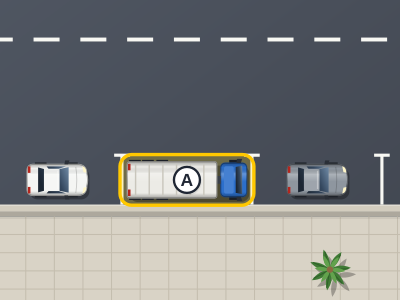
- ADisconnect all air and electrical lines first, then open the fifth wheel latch
- BApply the trailer parking brake and place wheel chocks to prevent the trailer moving when the tractor is removed
- CReverse the tractor sharply to release the kingpin
- DJack up the trailer landing legs fully before applying any brakes
Answer and explanation in the bank
- Q20Heavy vehicle
When reversing a large truck in a confined area such as a loading bay, a banksman (guide) is standing behind the vehicle. What is the driver's responsibility?
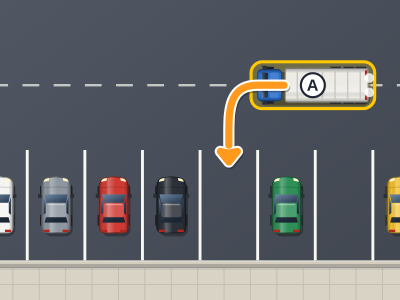
- AContinue reversing as long as the banksman was visible moments earlier
- BStop immediately if the banksman's signals stop or become unclear, and do not move until communication is re-established
- CIgnore the banksman and rely entirely on the reversing camera
- DIncrease reversing speed to reduce the time the banksman must stand behind the vehicle
Answer and explanation in the bank
- Q21Heavy vehicle
What is the agreed hand signal a banksman should use to instruct the driver to stop immediately?
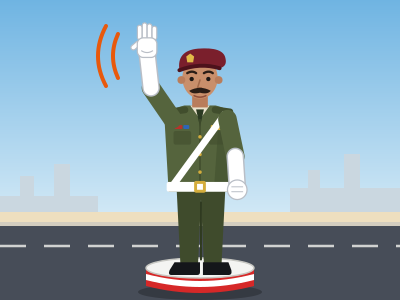
- ABoth arms raised with palms facing the driver
- BOne arm pointing to the left
- CWaving the arms rapidly from side to side at waist level
- DPointing both thumbs downward
Answer and explanation in the bank
- Q22Heavy vehicle
How does the speed limit for heavy trucks on Kuwaiti motorways (expressways) compare with the limit for passenger cars?
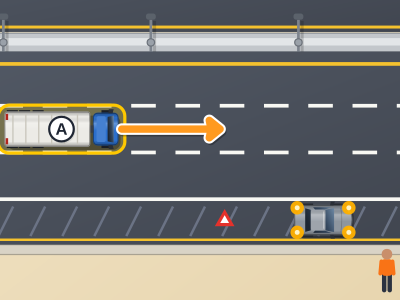
- AIt is always the same as the limit for passenger cars
- BThere is no limit on expressways provided the road is clear
- C50 km/h on all roads regardless of type
- DIt is generally lower than the car limit; follow the limit signed for heavy vehicles
Answer and explanation in the bank
Every answer above, with the rule it comes from, plus the full 22-question timed test.
Get the Kuwait Driving Theory Online Practice Bank - KWD 3.5What this test covers
Topics include road signs, traffic signals, right of way, roundabouts, speed limits, seat belts, fines and penalties, and the safe-driving rules specific to your vehicle category. Full question-by-question feedback with explanations is shown immediately after you finish the test above.
Frequently asked questions
How many questions is the Al Asimah (Capital) General Traffic Department truck & bus theory test?
The official General Traffic Department truck & bus theory test in Al Asimah (Capital) has 20 questions and you need 18 correct (90%) to pass. This practice test has 22 questions.
Is this the real exam?
These are practice questions to help you revise, written to the published rules and to what candidates report from the real test. They are not the official Kuwait exam and the real question bank, format, fees and pass mark are set by the General Traffic Department (Ministry of Interior), and can change. Always confirm the current requirements with your driving school or the traffic department.
Is this practice test free?
The first 10 questions are free, with no signup, and each shows the answer and the reason. The full 22-question test, timed, is in the Kuwait Driving Theory Online Practice Bank (KWD 3.5, one payment), with every question in the bank.
What does the Al Asimah (Capital) truck & bus theory test cover?
Road signs, traffic signals, right of way, roundabouts, speed limits, seat belts, penalties and safe-driving rules, plus the handling and safety topics specific to your vehicle.