

Al Farwaniyah General Traffic Department Light vehicle
Practice mode· Right of way & safetyAl Farwaniyah General Traffic Department - Kuwait Right of Way Practice Test
Tests your understanding of priority rules: unmarked junctions, roundabouts, emergency vehicles, merging lanes and more. Getting right of way right can prevent serious accidents.
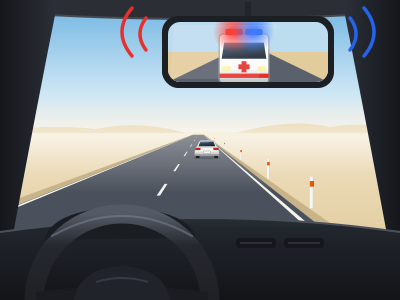
You are driving on a road when you hear the siren of an emergency vehicle approaching from behind. What should you do?
The other 12 questions in this test
Read them all. The answer and the reason for each, and the timed 22-question run, are in the Kuwait Driving Theory Online Practice Bank.
- Q11Right of way
You are driving in a lane that is about to end due to roadworks. The lane markings show you must merge left. When should you merge?
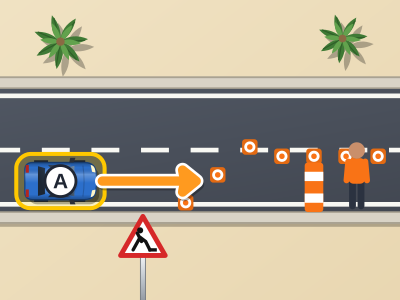
- AMerge immediately when you see the lane-end warning to avoid being last
- BYou have priority to merge because your lane is ending
- CUse the lane to its end and then merge when safe, giving way to vehicles in the continuing lane
- DStop in your lane and wait for a vehicle in the continuing lane to wave you in
Answer and explanation in the bank
- Q12Right of way
A horse and rider are approaching you on a rural road. How should you proceed?
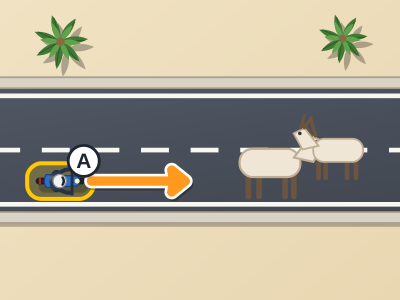
- ASound your horn to warn the horse of your approach and proceed at normal speed
- BFlash your headlights to alert the rider and overtake quickly
- CSlow down significantly, pass wide and slowly, and avoid sudden noises
- DMaintain your speed; the rider is responsible for controlling the animal
Answer and explanation in the bank
- Q13Right of way
You are in the left (inner) lane of a two-lane roundabout and want to take the next exit. A vehicle is alongside you in the right (outer) lane. What must you do?
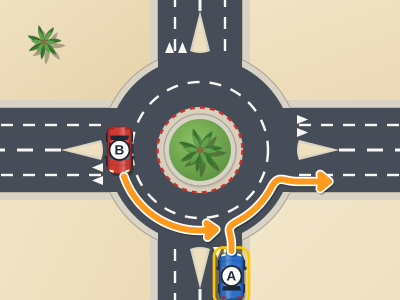
- AExit straight away, because the inner lane has priority at exits
- BGive way to the vehicle in the right (outer) lane and cross behind it to exit, or go round again if there is no safe gap
- CExit side by side with the other vehicle, because the roundabout is wide enough
- DWhichever driver signals first has priority to exit
Answer and explanation in the bank
- Q14Right of way
You see a broken white centre line on the road ahead. What does this indicate about priority?
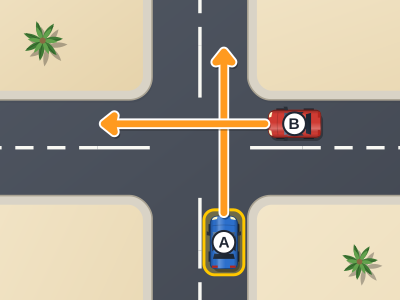
- AVehicles on the side with a wider lane have priority
- BIt indicates a normal two-way road; priority at junctions is determined by signs or the give-way rule
- CThe vehicle crossing the broken line always gives way to the other
- DA broken centre line means the road is one-way
Answer and explanation in the bank
- Q15Right of way
You are waiting at a STOP line. There is no traffic visible in either direction. Are you still required to stop completely?
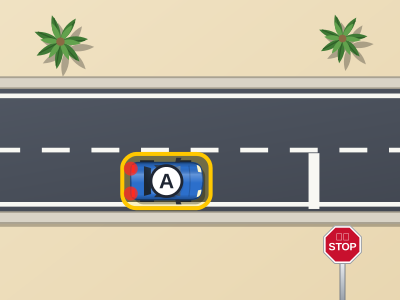
- ANo, you may proceed slowly if no traffic is visible
- BOnly stop if there is a red traffic light as well
- CStop only if other vehicles are waiting at the junction
- DYes, you must come to a complete stop at a STOP sign regardless of traffic conditions
Answer and explanation in the bank
- Q16Right of way
You are about to enter a roundabout and traffic from your left (already on the roundabout) is heavy. What must you do?
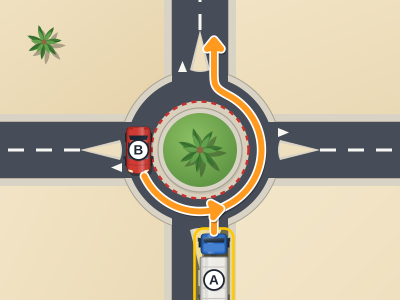
- AEnter slowly and let circulating traffic adjust to you
- BWait at the entry line until there is a safe gap in the circulating traffic
- CSound your horn and merge quickly to avoid blocking entry traffic behind you
- DEnter immediately; vehicles on the roundabout must give way to entering vehicles
Answer and explanation in the bank
- Q17Right of way
You are driving in the right lane of a dual carriageway when a vehicle from a slip road on the right wants to merge into your lane. What should you do?
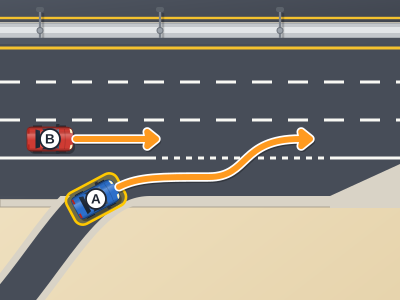
- AWhere safe, move to the left lane to make room, or maintain speed and let the merging vehicle find a gap
- BStop in the right lane to let the vehicle merge
- CThe merging vehicle has priority since it is to your right
- DAccelerate so the merging vehicle cannot fit in front of you
Answer and explanation in the bank
- Q18Right of way
You are making a U-turn on a wide road. Oncoming traffic and traffic behind you are both present. Who has priority?
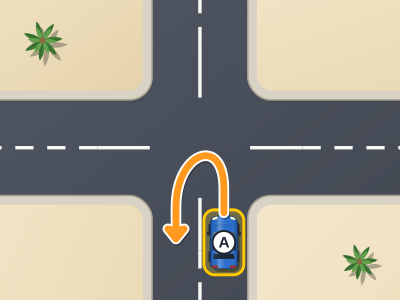
- AYou have priority once you have started the U-turn
- BAll other traffic has priority; you must wait until both directions are clear before completing the U-turn
- CTraffic behind you has priority but oncoming traffic must wait for you
- DOncoming traffic has priority but traffic behind you must wait
Answer and explanation in the bank
- Q19Right of way
You approach a junction where yellow box markings are painted on the road surface. When may you enter the box?
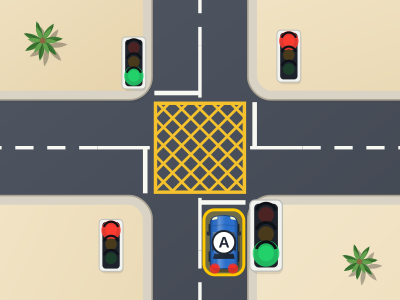
- AWhenever the traffic light is green, regardless of what is ahead
- BOnly when your exit from the box is clear; do not enter if you will be trapped inside
- CWhen the vehicle in front of you has started to move
- DYou must never enter a yellow box junction
Answer and explanation in the bank
- Q20Right of way
A pedestrian is crossing a road at a place where there is no pedestrian crossing. Who has priority?
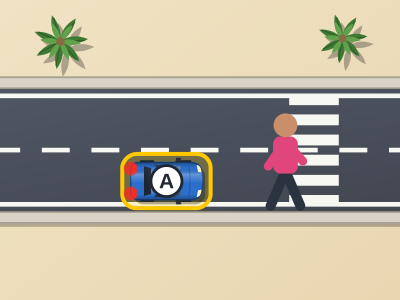
- AVehicles on the road have priority, but you should be prepared to slow down if the pedestrian is in danger
- BThe pedestrian has priority regardless of where they are crossing
- CYou must stop for any pedestrian at any location on the road
- DSound your horn to warn the pedestrian and maintain your speed
Answer and explanation in the bank
- Q21Right of way
You are approaching a junction and see a solid white line across your lane with a Give Way triangle. The road you are joining carries fast-moving traffic. What is the correct action?
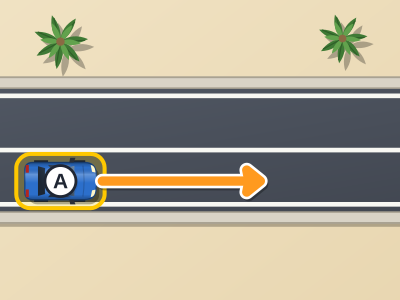
- ASlow down to 30 km/h and merge without stopping
- BStop at the line for five seconds, then proceed
- CFlash your indicator and merge immediately; traffic on the fast road must slow for you
- DSlow down well before the line, stop if necessary, and only join when there is a safe gap
Answer and explanation in the bank
- Q22Right of way
You are on a highway in the middle lane. An emergency vehicle behind you is approaching fast. The left lane is also occupied. What should you do?
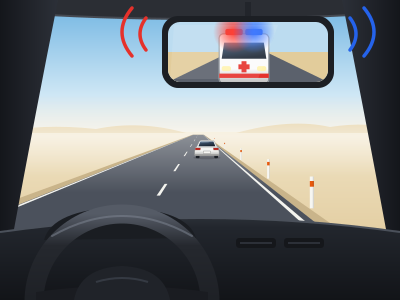
- AStay in the middle lane; the emergency vehicle will use the hard shoulder
- BSignal and move to the right lane to create a passage in the left or middle lane for the emergency vehicle
- CBrake sharply to force the vehicle behind you to change lanes
- DAccelerate to match the emergency vehicle's speed
Answer and explanation in the bank
Every answer above, with the rule it comes from, plus the full 22-question timed test.
Get the Kuwait Driving Theory Online Practice Bank - KWD 3.5What this test covers
Topics include road signs, traffic signals, right of way, roundabouts, speed limits, seat belts, fines and penalties, and the safe-driving rules specific to your vehicle category. Full question-by-question feedback with explanations is shown immediately after you finish the test above.
Frequently asked questions
How many questions is the Al Farwaniyah General Traffic Department light vehicle theory test?
The official General Traffic Department light vehicle theory test in Al Farwaniyah has 20 questions and you need 18 correct (90%) to pass. This practice test has 22 questions.
Is this the real exam?
These are practice questions to help you revise, written to the published rules and to what candidates report from the real test. They are not the official Kuwait exam and the real question bank, format, fees and pass mark are set by the General Traffic Department (Ministry of Interior), and can change. Always confirm the current requirements with your driving school or the traffic department.
Is this practice test free?
The first 10 questions are free, with no signup, and each shows the answer and the reason. The full 22-question test, timed, is in the Kuwait Driving Theory Online Practice Bank (KWD 3.5, one payment), with every question in the bank.
What does the Al Farwaniyah light vehicle theory test cover?
Road signs, traffic signals, right of way, roundabouts, speed limits, seat belts, penalties and safe-driving rules, plus the handling and safety topics specific to your vehicle.