

Hawalli General Traffic Department Truck & Bus
Practice mode· Heavy vehicle skillsHawalli General Traffic Department - Kuwait Heavy Vehicle Skills Test 2
Second set of heavy-vehicle questions covering coupling, tunnels and bridges, passenger safety, hill starts and managing long or wide loads. Complete both tests for full coverage.
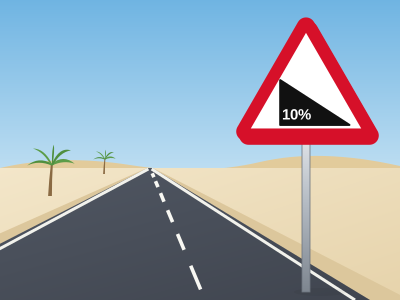
When driving a heavy truck down a long steep gradient, which technique best protects your brakes from fade?
The other 12 questions in this test
Read them all. The answer and the reason for each, and the timed 22-question run, are in the Kuwait Driving Theory Online Practice Bank.
- Q11Heavy vehicle
What does the width of a heavy vehicle include for the purposes of compliance with width limits?
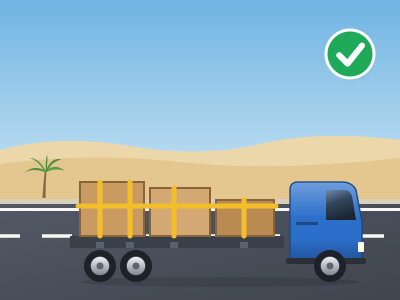
- AThe widest point of the vehicle or load, including mirrors, any projecting equipment, and the load itself
- BThe body of the vehicle only, not mirrors or protruding equipment
- COnly the cab width, as the trailer is measured separately
- DWidth limits do not apply to vehicles over 20 tonnes
Answer and explanation in the bank
- Q12Heavy vehicle
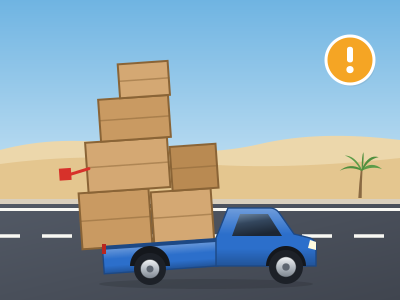
A load projects more than 1 metre beyond the rear of the truck. What must the driver do? (Confirm the exact requirements with the General Traffic Department.)
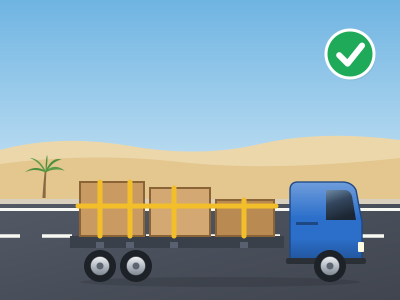
- AFit a warning marker such as a red flag or marker board at the rear of the projecting load, and may require a special permit depending on the projection length
- BDrive only at night when other vehicles can see the projection with headlights
- CNo action is needed as long as the projection is less than 2 metres
- DTravel in the right lane only to keep the projection away from other traffic
Answer and explanation in the bank
- Q13Heavy vehicle
Which is the correct technique for braking on a wet road in a loaded truck equipped with ABS?
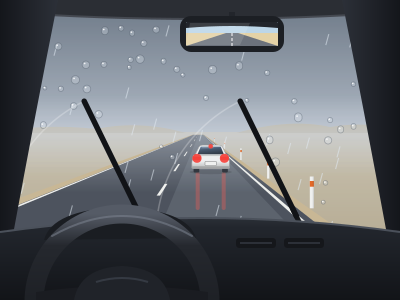
- AApply firm, steady pressure to the brake pedal and allow the ABS to modulate the brakes; do not pump the pedal
- BPump the brake pedal rapidly to prevent wheel lock
- CUse only the engine brake and avoid the service brakes completely
- DApply the trailer hand valve first, then the service brake
Answer and explanation in the bank
- Q14Heavy vehicle
What is the risk of a fully loaded truck taking a motorway exit ramp at the speed recommended for a car?
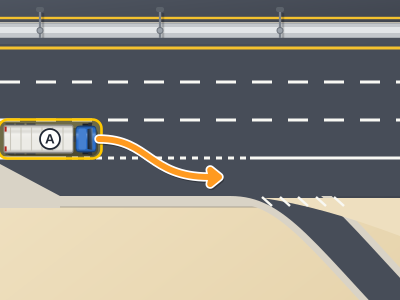
- AA truck is heavier so it corners more safely at that speed
- BThere is no additional risk as long as the tyres are correctly inflated
- CThe posted ramp speed is designed for cars; a loaded truck has a much higher centre of gravity and could roll over at the same speed
- DThe risk only exists for articulated trucks, not rigid trucks
Answer and explanation in the bank
- Q15Heavy vehicle
The fifth wheel on the tractor has not been lubricated. What is the most likely consequence during operation?
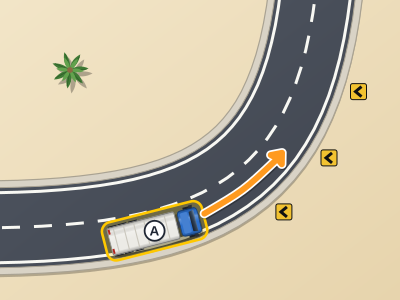
- AThe trailer will automatically disconnect at the first corner
- BExcessive wear on the fifth wheel plate and kingpin, difficult steering around tight turns, and possible cracking of the mounting
- CFuel consumption will improve because friction is reduced
- DThe air supply lines will be damaged by the dry friction
Answer and explanation in the bank
- Q16Heavy vehicle
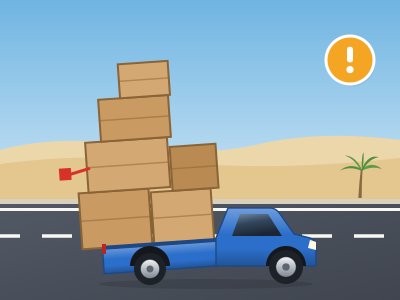
Before a long trip, a driver finds one side of the truck is noticeably lower than the other due to an asymmetric load. What is the correct action?
- ARe-distribute the load evenly before departure to balance the vehicle and bring all axle weights within legal limits
- BInflate the tyres on the lower side to compensate for the extra weight
- CDrive carefully and lean to the opposite side to compensate
- DThe truck will self-correct once it reaches speed on the motorway
Answer and explanation in the bank
- Q17Heavy vehicle
A truck has a maximum gross vehicle weight of 40 tonnes. The tare (unladen) weight is 15 tonnes. What is the maximum payload the driver may legally carry?
- A25 tonnes, calculated as GVW minus tare weight
- B40 tonnes, because GVW is the total weight of the load only
- C15 tonnes, which is the same as the tare weight by regulation
- DThere is no payload limit as long as the driver drives carefully
Answer and explanation in the bank
- Q18Heavy vehicle
A tipper truck is unloading on uneven ground. The rear body is raised. What rollover risk must the driver consider?
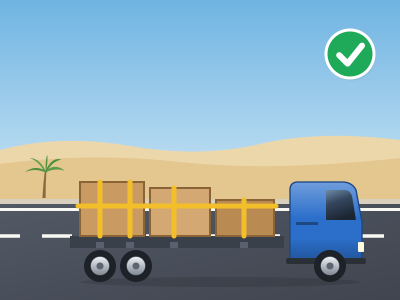
- AThe raised body acts as a sail and is only dangerous in high winds
- BThe risk is limited to fully loaded tippers; a partially loaded raised body is safe on any ground
- CThe raised body shifts the centre of gravity upward and backward; even a small sideways lean of the chassis can cause the vehicle to tip over
- DThe rear outriggers automatically deploy to prevent rollover during tipping
Answer and explanation in the bank
- Q19Heavy vehicle
Which of the following correctly describes the purpose of a speed limiter fitted to a commercial heavy vehicle?
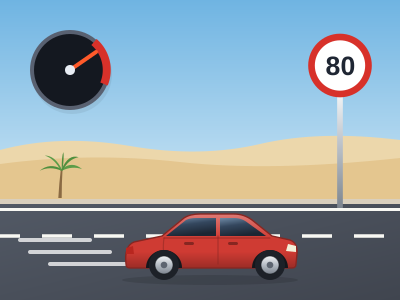
- AIt is a device that prevents the engine from propelling the vehicle above a set maximum speed regardless of accelerator position
- BIt is a device that automatically applies the brakes if the speed limit is exceeded
- CIt alerts the driver with a warning light when exceeding the speed limit
- DIt limits engine revolutions to save fuel only, with no effect on top speed
Answer and explanation in the bank
- Q20Heavy vehicle
On a long descent, the driver uses the exhaust brake to maintain speed. The exhaust brake is most effective in which gear?
- AThe highest gear, to keep engine speed low and reduce wear
- BNeutral, to allow the exhaust brake to work independently of the drivetrain
- CA lower gear, because lower gears produce higher engine revolutions, generating more braking force through the exhaust system
- DExhaust brake effectiveness does not vary with gear selection
Answer and explanation in the bank
- Q21Heavy vehicle
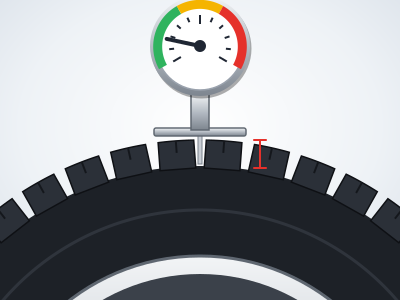
What does 'axle overloading' mean and why is it dangerous?
- AIt means the vehicle is travelling over an axle count restriction on a bridge
- BIt means the axle grease has overheated and needs replacing
- CIt means one or more axles carry weight beyond their rated capacity, stressing tyres, wheel bearings, suspension, and the road surface, and increasing the risk of component failure
- DIt means all axles are equally loaded, which reduces tyre wear
Answer and explanation in the bank
- Q22Heavy vehicle
A driver is reversing a long articulated truck into a loading bay. The trailer begins to 'jackknife' (fold at the coupling). What is the correct corrective action?
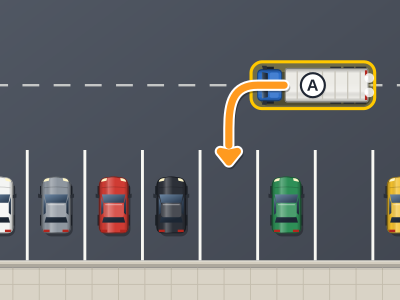
- AStop, then pull forward to straighten the combination before attempting the reverse again with smaller steering corrections
- BTurn the steering wheel further in the same direction to accelerate the swing
- CApply maximum lock in the opposite direction to the jackknife while continuing to reverse at speed
- DApply only the trailer brakes to stop the trailer swinging
Answer and explanation in the bank
Every answer above, with the rule it comes from, plus the full 22-question timed test.
Get the Kuwait Driving Theory Online Practice Bank - KWD 3.5What this test covers
Topics include road signs, traffic signals, right of way, roundabouts, speed limits, seat belts, fines and penalties, and the safe-driving rules specific to your vehicle category. Full question-by-question feedback with explanations is shown immediately after you finish the test above.
Frequently asked questions
How many questions is the Hawalli General Traffic Department truck & bus theory test?
The official General Traffic Department truck & bus theory test in Hawalli has 20 questions and you need 18 correct (90%) to pass. This practice test has 22 questions.
Is this the real exam?
These are practice questions to help you revise, written to the published rules and to what candidates report from the real test. They are not the official Kuwait exam and the real question bank, format, fees and pass mark are set by the General Traffic Department (Ministry of Interior), and can change. Always confirm the current requirements with your driving school or the traffic department.
Is this practice test free?
The first 10 questions are free, with no signup, and each shows the answer and the reason. The full 22-question test, timed, is in the Kuwait Driving Theory Online Practice Bank (KWD 3.5, one payment), with every question in the bank.
What does the Hawalli truck & bus theory test cover?
Road signs, traffic signals, right of way, roundabouts, speed limits, seat belts, penalties and safe-driving rules, plus the handling and safety topics specific to your vehicle.