

Mubarak Al-Kabeer General Traffic Department Light vehicle
Practice mode· Right of way & safetyMubarak Al-Kabeer General Traffic Department - Kuwait Safe Driving Practice Test
Covers defensive driving, following distances, fatigue, visibility, adverse weather and hazard awareness. Safe driving habits save lives and keep your licence clean.
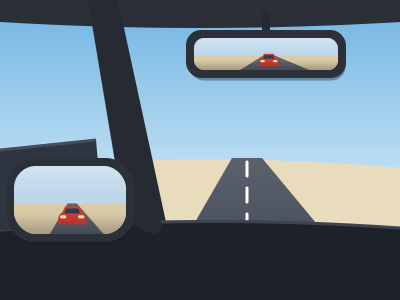
How often should you check your mirrors while driving on a Kuwaiti urban road?
The other 12 questions in this test
Read them all. The answer and the reason for each, and the timed 22-question run, are in the Kuwait Driving Theory Online Practice Bank.
- Q11Safe driving
You approach a pedestrian crossing where a pedestrian has stepped onto the crossing. What must you do?
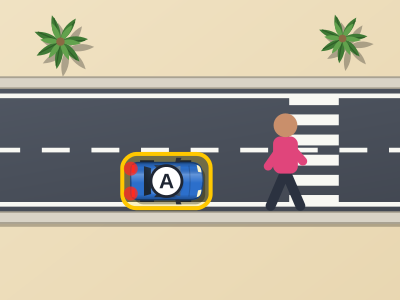
- ASound the horn to alert the pedestrian and continue at reduced speed
- BStop and give way to the pedestrian until they have fully cleared the crossing
- CGive way only if the pedestrian is directly in your path; edge past if they are on the far side
- DFlash your lights to indicate you are giving way but continue moving slowly
Answer and explanation in the bank
- Q12Safe driving
A driver is travelling at 80 km/h. Approximately how far does the car travel in the time it takes to glance at a mobile phone for just 2 seconds?
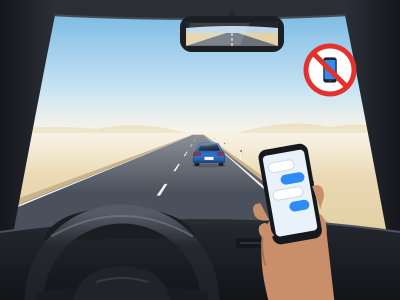
- AAbout 10 metres
- BAbout 5 metres, which is within safe stopping distance
- CAbout 44 metres, almost the length of three buses end to end
- DAbout 100 metres
Answer and explanation in the bank
- Q13Safe driving
How should you position your hands on the steering wheel for optimum control, according to standard driving guidance?
- ABoth hands on the wheel in the 9 o'clock and 3 o'clock positions (or 8 and 4), keeping hands below the airbag module
- BOne hand at the 12 o'clock position for relaxed city driving
- CBoth hands at 12 o'clock for the best leverage when turning
- DOne hand on the wheel and one resting on the gear lever at all times
Answer and explanation in the bank
- Q14Safe driving
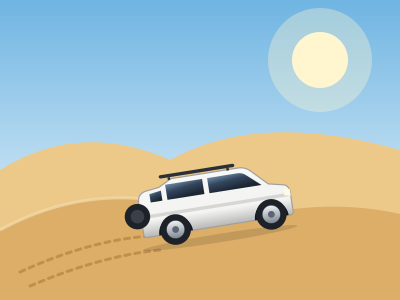
You plan a long drive from Kuwait City to Basra or across a desert route. What basic safety kit should be in your vehicle?
- AJust a spare tyre; roadside assistance apps cover everything else
- BSpare tyre in good condition, jack and wheel brace, reflective warning triangles, first aid kit, water, phone charger and a torch
- CNo kit is needed if your vehicle is new and under manufacturer warranty
- DA spare tyre and a fire extinguisher are the only legal requirements
Answer and explanation in the bank
- Q15Safe driving
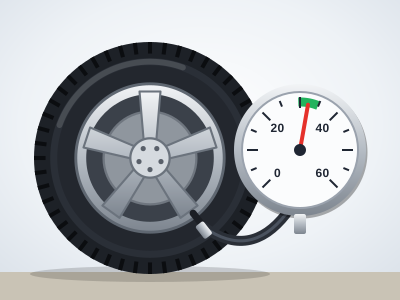
Kuwait's summer temperatures regularly exceed 45 degrees Celsius. What is the recommended practice regarding tyre pressure in extreme heat?
- AReduce tyre pressure by 5-10 PSI before driving in hot weather to prevent blowouts
- BInflate tyres above the maximum sidewall rating to compensate for heat expansion
- CCheck and set tyre pressure when the tyres are cold; heat will naturally increase pressure as you drive
- DTyre pressure does not change significantly with temperature
Answer and explanation in the bank
- Q16Safe driving
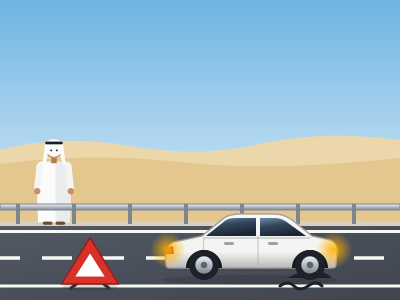
You are driving at highway speed when you experience a sudden tyre blowout on the front right. What is the correct initial response?
- ABrake immediately and as hard as possible
- BTurn the wheel sharply toward the blown tyre side to counteract the pull
- CSwitch off the engine immediately to reduce speed
- DGrip the steering wheel firmly, ease off the accelerator gradually, and steer straight without braking hard
Answer and explanation in the bank
- Q17Safe driving
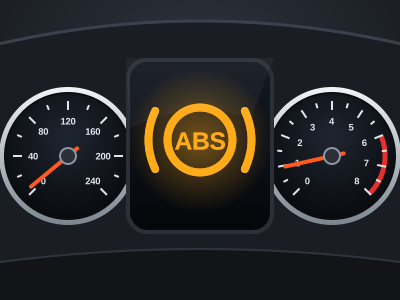
What does an Anti-lock Braking System (ABS) do when you brake sharply?
- AIt automatically increases engine braking to stop the car faster
- BIt applies the handbrake on the rear wheels only
- CIt reduces brake pressure to protect the brake pads from overheating
- DIt rapidly pulses brake pressure to prevent the wheels from locking, allowing you to steer while braking
Answer and explanation in the bank
- Q18Safe driving
A driver with ABS brakes hard on sand. Compared to a vehicle without ABS, what happens?
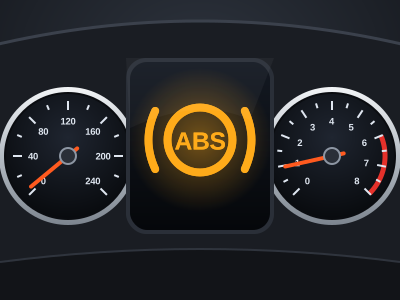
- AABS guarantees a shorter stopping distance on all surfaces
- BABS has no effect on sand surfaces
- CABS switches off automatically on sand
- DABS still prevents wheel lock-up, but stopping distances on loose sand or gravel may be longer than with locked wheels in a non-ABS vehicle
Answer and explanation in the bank
- Q19Safe driving
How should a 6-year-old child travel in a private car in Kuwait?
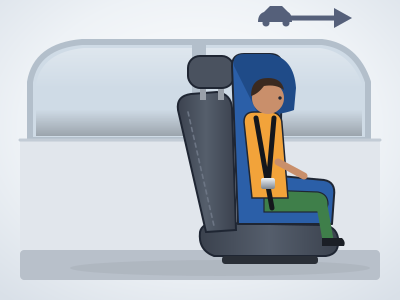
- AIn the front passenger seat, with the adult belt held away from the neck
- BUnrestrained in the back, as long as an adult sits next to the child
- COn an adult's lap in the back seat
- DIn the back, in a child seat suited to the child's size, because children under 10 must not sit in the front
Answer and explanation in the bank
- Q20Safe driving
Where is the safest seating position for a young child who still requires a child seat?
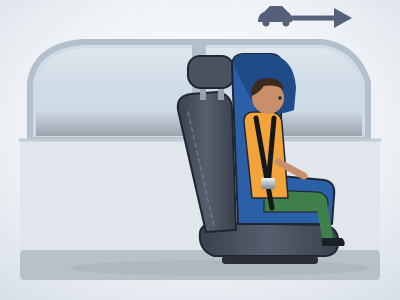
- AIn the front passenger seat facing forward
- BIn the front passenger seat facing rearward with the airbag enabled
- COn an adult's lap in the rear seat
- DIn the rear seat with the child seat correctly installed according to the seat manufacturer's instructions
Answer and explanation in the bank
- Q21Safe driving
In a crash, at what speed does the driver-side front airbag typically begin to deploy?
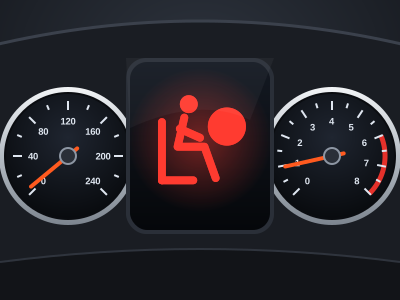
- AAny impact above 5 km/h
- BOnly in rollovers, not frontal impacts
- CAbove 80 km/h only
- DUsually in a severe frontal impact equivalent to hitting a solid wall at approximately 20-30 km/h
Answer and explanation in the bank
- Q22Safe driving
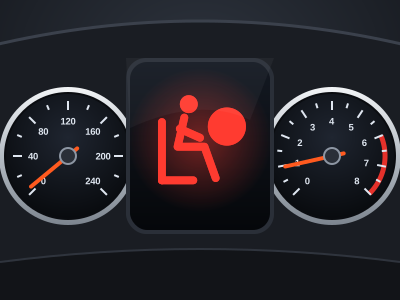
What is the recommended minimum distance between the driver's chest and the centre of the steering wheel in a vehicle equipped with a front airbag?
- AAt least 5 centimetres
- BNo minimum distance; airbags are safe at any distance
- CAt least 60 centimetres
- DAt least 25 centimetres (about 10 inches)
Answer and explanation in the bank
Every answer above, with the rule it comes from, plus the full 22-question timed test.
Get the Kuwait Driving Theory Online Practice Bank - KWD 3.5What this test covers
Topics include road signs, traffic signals, right of way, roundabouts, speed limits, seat belts, fines and penalties, and the safe-driving rules specific to your vehicle category. Full question-by-question feedback with explanations is shown immediately after you finish the test above.
Frequently asked questions
How many questions is the Mubarak Al-Kabeer General Traffic Department light vehicle theory test?
The official General Traffic Department light vehicle theory test in Mubarak Al-Kabeer has 20 questions and you need 18 correct (90%) to pass. This practice test has 22 questions.
Is this the real exam?
These are practice questions to help you revise, written to the published rules and to what candidates report from the real test. They are not the official Kuwait exam and the real question bank, format, fees and pass mark are set by the General Traffic Department (Ministry of Interior), and can change. Always confirm the current requirements with your driving school or the traffic department.
Is this practice test free?
The first 10 questions are free, with no signup, and each shows the answer and the reason. The full 22-question test, timed, is in the Kuwait Driving Theory Online Practice Bank (KWD 3.5, one payment), with every question in the bank.
What does the Mubarak Al-Kabeer light vehicle theory test cover?
Road signs, traffic signals, right of way, roundabouts, speed limits, seat belts, penalties and safe-driving rules, plus the handling and safety topics specific to your vehicle.