

Al Rayyan General Directorate of Traffic Light vehicle
Practice mode· Right of way & safetyAl Rayyan General Directorate of Traffic - Qatar Right of Way Practice Test
Tests your understanding of priority rules: unmarked junctions, roundabouts, emergency vehicles, merging lanes and more. Getting right of way right can prevent serious accidents.
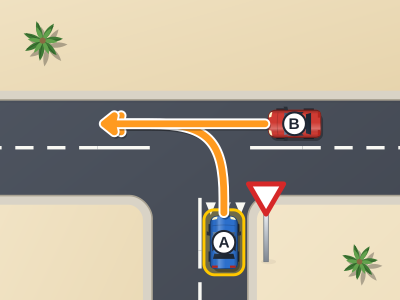
You are approaching a T-junction and intend to turn left onto the main road. Who has right of way?
The other 12 questions in this test
Read them all. The answer and the reason for each, and the timed 22-question run, are in the Qatar Driving Theory Online Practice Bank.
- Q11Right of way
An ambulance is approaching on the opposite carriageway with sirens active on a divided road. What must you do?
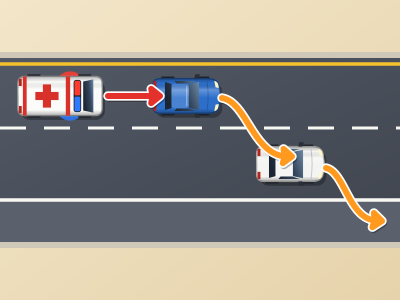
- AContinue normally; the emergency vehicle is on the other side of the central reservation
- BPull over and stop even though the ambulance is on the other carriageway
- CCross the central reservation to make way
- DStop and wait for the ambulance to pass before continuing
Answer and explanation in the bank
- Q12Right of way
You want to turn left at a junction where a cycle lane continues straight ahead on your left. What must you do?
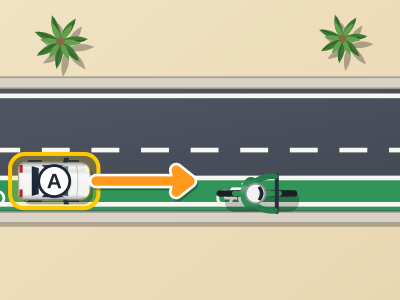
- AProceed; the cycle lane traffic must stop for turning vehicles
- BGive way to any cyclist in the cycle lane before completing your left turn
- CSound your horn to warn cyclists and then turn
- DMove into the cycle lane to block cyclists before turning
Answer and explanation in the bank
- Q13Right of way
You are on a minor road and approaching a Give Way line at a major road. The major road is clear. Must you stop?
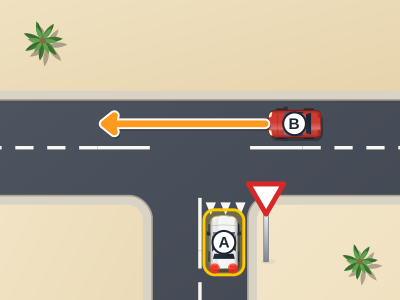
- AYes, you must always come to a complete stop at a Give Way line
- BYes, you must stop and wait for 10 seconds
- CNo, you may proceed slowly without stopping if the road is clearly safe
- DNo, Give Way lines only apply to heavy vehicles
Answer and explanation in the bank
- Q14Right of way
You are leaving a highway via an off-ramp (exit slip road) and a vehicle on the highway signals to exit behind you. Who has priority on the slip road?
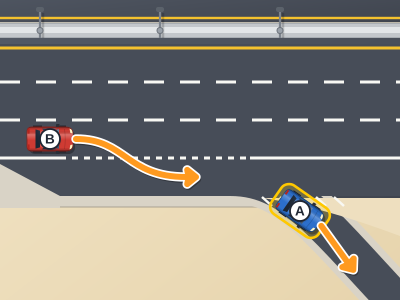
- AThe vehicle ahead on the slip road (you), as you are already committed to the exit
- BThe vehicle on the highway, because it is on the main carriageway
- CBoth vehicles must stop and negotiate
- DThe faster vehicle
Answer and explanation in the bank
- Q15Right of way
You are at a Y-junction where your road splits into two. You want to take the right fork. Is there a right-of-way issue?
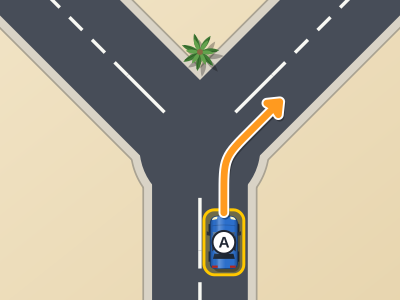
- AUsually no, because a Y-junction fork is a diverge, not a merge; however, follow any signs present
- BYou must always stop before taking either fork at a Y-junction
- CVehicles going left always have priority at a Y-junction
- DY-junctions are not covered by Qatar traffic rules
Answer and explanation in the bank
- Q16Right of way
On a one-way street, an emergency vehicle comes from behind with lights and sirens. What should you do?
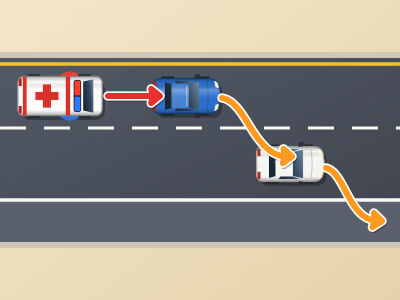
- ASpeed up and turn off the one-way street at the next junction
- BDrive in reverse to create space
- CContinue at the same speed; emergency vehicles must follow traffic rules on one-way streets
- DMove as far to one side as possible and stop to allow the emergency vehicle to pass
Answer and explanation in the bank
- Q17Right of way
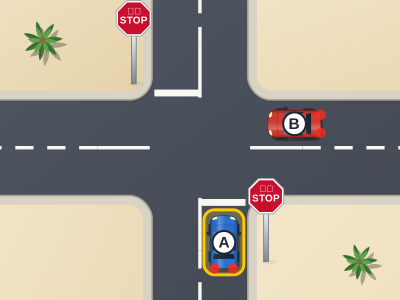
Two vehicles reach a STOP-controlled intersection at exactly the same time from different roads. Both have come to a full stop. What happens next?
- AThe vehicle with more passengers goes first
- BThe vehicle turning right goes first
- CThe vehicle that stopped first has priority
- DThe vehicle on the right has priority to proceed first
Answer and explanation in the bank
- Q18Right of way
You are travelling uphill on a narrow mountain road and meet a vehicle coming downhill. Who should reverse or give way?
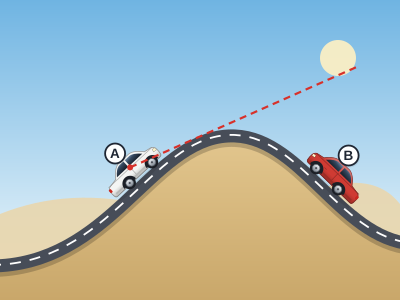
- AThe vehicle travelling downhill should give way, as it is easier to reverse downhill and the uphill vehicle has momentum
- BThe vehicle travelling uphill should give way because it can stop more easily
- CThe smaller vehicle must always give way
- DBoth vehicles stop and wait for a third party to direct them
Answer and explanation in the bank
- Q19Right of way
A pedestrian has already stepped onto an unmarked crossing at an ordinary road junction. What should you do?
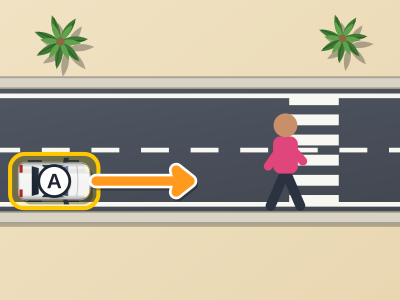
- ASound your horn and proceed slowly
- BContinue; pedestrians at unmarked crossings have no right of way
- CFlash your headlights and continue
- DStop and allow the pedestrian to finish crossing
Answer and explanation in the bank
- Q20Right of way
You are in a queue to enter a roundabout and the traffic signals at the roundabout entry show green. Who has priority?
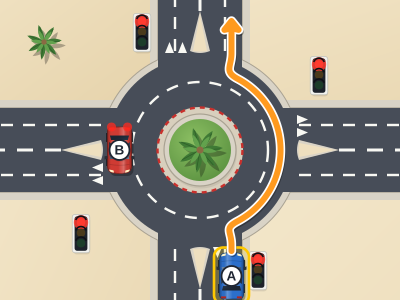
- ACirculating traffic still has priority even on a green signal
- BPedestrians on the crossing always have priority over the signal
- CYou must still stop and yield regardless of the signal
- DYou may enter because the traffic signal overrides the normal yield-to-circulating-traffic rule
Answer and explanation in the bank
- Q21Right of way
You are the third vehicle in a convoy of private cars following a hearse at a funeral. An oncoming driver wants to turn left across the convoy. What should happen?
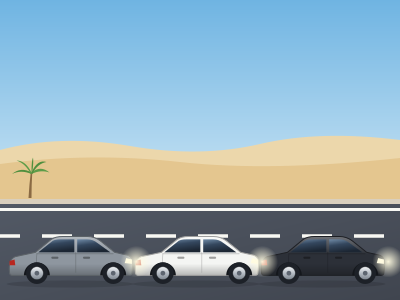
- AThe oncoming driver may turn between convoy vehicles if a large gap appears
- BThe oncoming driver must wait for the entire convoy to pass before turning
- CThe last vehicle in the convoy must stop to allow the turn
- DFuneral convoys have no special right-of-way status
Answer and explanation in the bank
- Q22Right of way
Children are crossing the road near a school, supervised by a crossing guard holding a stop paddle. What must you do?
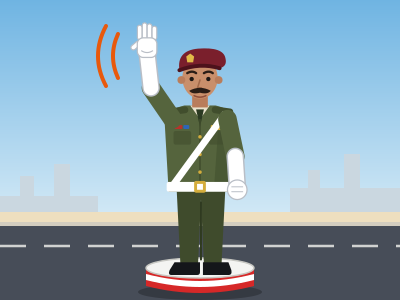
- ASlow to 20 km/h and proceed carefully
- BStop and wait until the crossing guard signals that it is safe to continue
- CSound your horn to alert the children and proceed
- DStop only if a child is actually in your lane
Answer and explanation in the bank
Every answer above, with the rule it comes from, plus the full 22-question timed test.
Get the Qatar Driving Theory Online Practice Bank - QAR 39What this test covers
Topics include road signs, traffic signals, right of way, roundabouts, speed limits, seat belts, fines and penalties, and the safe-driving rules specific to your vehicle category. Full question-by-question feedback with explanations is shown immediately after you finish the test above.
Frequently asked questions
How many questions is the Al Rayyan General Directorate of Traffic light vehicle theory test?
The official General Directorate of Traffic light vehicle theory test in Al Rayyan has 40 questions and you need 37 correct (92.5%) to pass. This practice test has 22 questions.
Is this the real exam?
These are practice questions to help you revise, written to the published rules and to what candidates report from the real test. They are not the official Qatar exam and the real question bank, format, fees and pass mark are set by the General Directorate of Traffic (Ministry of Interior) and the driving schools, and can change. Always confirm the current requirements with your driving school or the traffic department (for example via the Metrash service).
Is this practice test free?
The first 10 questions are free, with no signup, and each shows the answer and the reason. The full 22-question test, timed, is in the Qatar Driving Theory Online Practice Bank (QAR 39, one payment), with every question in the bank.
What does the Al Rayyan light vehicle theory test cover?
Road signs, traffic signals, right of way, roundabouts, speed limits, seat belts, penalties and safe-driving rules, plus the handling and safety topics specific to your vehicle.