

Al Shahaniya General Directorate of Traffic Truck & Bus
Practice mode· Heavy vehicle skillsAl Shahaniya General Directorate of Traffic - Qatar Heavy Vehicle Skills Test 2
Second set of heavy-vehicle questions covering coupling, tunnels and bridges, passenger safety, hill starts and managing long or wide loads. Complete both tests for full coverage.
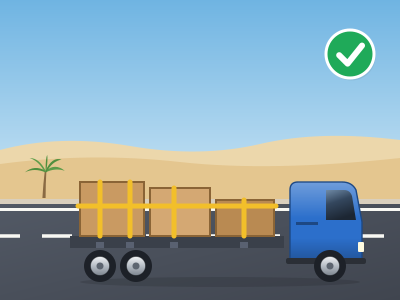
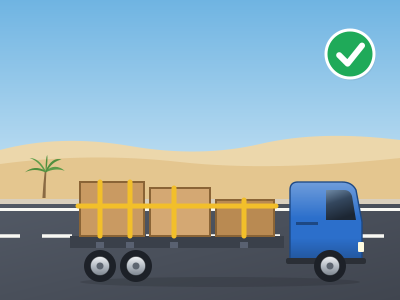
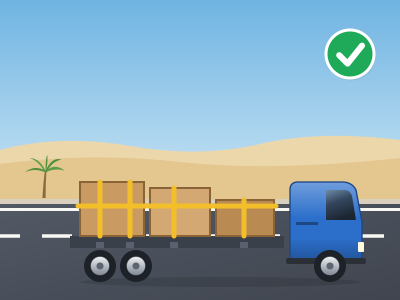
A truck's front steering axle has a maximum allowed axle weight of 6 tonnes. The axle is currently carrying 7.5 tonnes. What is the most likely consequence?
The other 12 questions in this test
Read them all. The answer and the reason for each, and the timed 22-question run, are in the Qatar Driving Theory Online Practice Bank.
- Q11Heavy vehicle
What is a range-change (high-low) gearbox, and when would a driver use the low range?
- AA gearbox with an overdrive top gear used to reduce engine revs at motorway speed
- BA two-speed rear axle that automatically shifts based on vehicle speed
- CA split transmission that doubles the number of usable ratios; low range is used for climbing steep hills, moving very heavy loads slowly, or starting from rest with a full trailer
- DA separate reverse gearbox used only when uncoupling a trailer in a tight space
Answer and explanation in the bank
- Q12Heavy vehicle
While descending a steep hill, a driver finds the truck is gaining speed despite applying the brakes. What should they do?
- AApply the park brake fully at speed to bring the vehicle to a stop
- BShift into neutral to reduce engine braking resistance and allow the brakes to work alone
- CEngage a lower gear immediately if safely possible, apply the exhaust brake, and look for an emergency escape ramp
- DSteer into the oncoming lane where the road is wider
Answer and explanation in the bank
- Q13Heavy vehicle
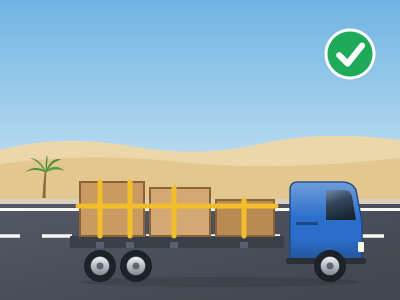
What does 'gross vehicle weight' (GVW) mean?
- AThe weight of the empty vehicle without any load
- BThe weight of the cargo only, not including the vehicle structure
- CThe weight permitted on any single axle regardless of vehicle type
- DThe total weight of the vehicle including the vehicle itself, all cargo, passengers, fuel, and driver
Answer and explanation in the bank
- Q14Heavy vehicle
A load is wider than the normal legal width for a goods vehicle. What is needed before it can be moved on public roads?
- ANothing, provided the driver drives slowly
- BOnly a red flag on each side of the load
- CA special permit from the traffic authorities, with any escort and travel times it sets
- DApproval from the company that owns the load
Answer and explanation in the bank
- Q15Heavy vehicle
What warning must be displayed at the rear of an oversized load that projects beyond the rear of a truck?
- AA green light to indicate the load is approved by the authorities
- BA white reflective panel is sufficient for all conditions
- CNo marking is required if the projection is less than one metre
- DA red flag or board during the day and a red light at night, plus a rear-facing reflective warning marker
Answer and explanation in the bank
- Q16Heavy vehicle
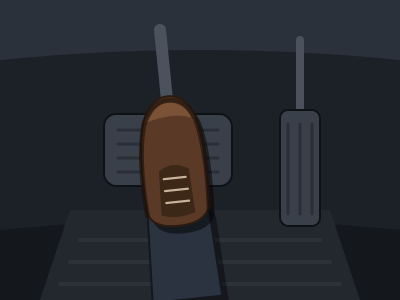
A truck driver notices the air pressure warning buzzer sounds during a journey. What must they do?
- ADrive to the next town where a mechanic is available, as the warning indicates a minor system alert
- BPump the brake pedal rapidly to build pressure and continue at reduced speed
- CSwitch off the engine and restart it; the compressor will rebuild pressure during idling
- DPull over and stop safely as soon as possible; do not continue until the fault is diagnosed and repaired
Answer and explanation in the bank
- Q17Heavy vehicle
What is the difference between the primary and secondary air tanks on a dual-circuit air brake system?
- AThe primary circuit serves the rear brakes and the secondary serves the front brakes; if one circuit fails the other still provides partial braking
- BThe secondary tank is a reserve that automatically recharges the primary tank if pressure drops
- CBoth tanks supply the same brake circuit; the secondary is purely a backup for the parking brake
- DThe secondary tank controls the exhaust brake independently of the service brake system
Answer and explanation in the bank
- Q18Heavy vehicle
How should a heavy vehicle driver adjust their following distance compared to a car driver in the same conditions?
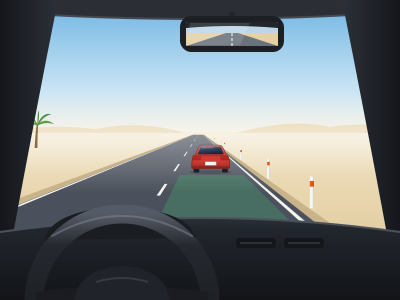
- AUse the same two-second rule as car drivers
- BGreatly increase following distance to allow for the longer stopping distance of the heavy vehicle
- CReduce following distance so other vehicles do not cut in front
- DFollowing distance is irrelevant for heavy vehicles because they have more powerful brakes
Answer and explanation in the bank
- Q19Heavy vehicle
What pre-trip check should a driver perform on the truck's lights and indicators?
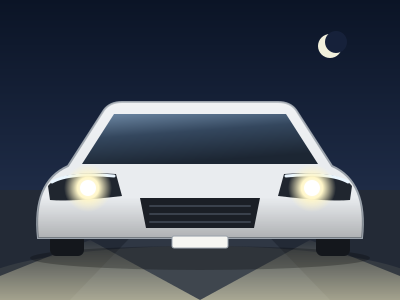
- ATest only the headlights and brake lights; indicators are optional on trucks
- BCheck lights once a week during a scheduled maintenance visit
- CWalk around the vehicle with a helper and confirm all headlights, tail lights, brake lights, indicators, and hazard lights are working on both the tractor and trailer
- DTurn on the headlights and look in the mirror; if you can see a reflection the rear lights are working
Answer and explanation in the bank
- Q20Heavy vehicle
During a pre-trip inspection, a driver finds a cracked wheel nut on a rear hub. What should they do?
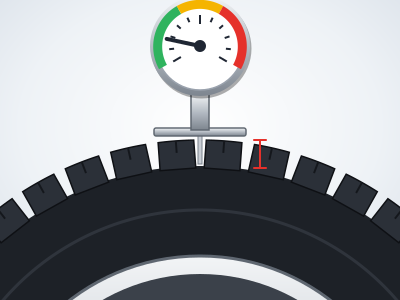
- ATighten the cracked nut as much as possible and check it again after 50 km
- BDrive only on local roads at reduced speed until reaching a garage
- CReplace it with a spare nut from the toolbox without seeking mechanical advice
- DReport it immediately and refuse to drive the vehicle until the nut is replaced by a qualified mechanic
Answer and explanation in the bank
- Q21Heavy vehicle
What does a convex (wide-angle) mirror on a heavy truck provide that a flat mirror cannot?
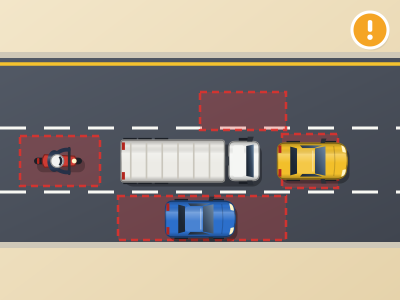
- AA magnified view of objects directly behind the truck for accurate distance judging
- BA wider field of view to reduce blind spots at the sides and rear, though objects appear smaller and further away than they actually are
- CA colour-corrected view in low-light conditions to improve visibility at night
- DThe same field of view as a flat mirror but with anti-glare properties
Answer and explanation in the bank
- Q22Heavy vehicle
How should a driver position a truck's mirrors before a journey?
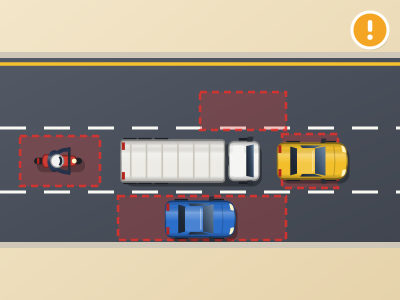
- AAdjust all mirrors when seated in the normal driving position so each mirror covers the maximum useful area with minimal overlap and the rear tyres are visible at the lower edge of the side mirrors
- BSet the mirrors to the previous driver's preference to save time
- CPosition mirrors to show the sky above the trailer so overhead obstacles can be spotted
- DMirror adjustment is only required after coupling a new trailer
Answer and explanation in the bank
Every answer above, with the rule it comes from, plus the full 22-question timed test.
Get the Qatar Driving Theory Online Practice Bank - QAR 39What this test covers
Topics include road signs, traffic signals, right of way, roundabouts, speed limits, seat belts, fines and penalties, and the safe-driving rules specific to your vehicle category. Full question-by-question feedback with explanations is shown immediately after you finish the test above.
Frequently asked questions
How many questions is the Al Shahaniya General Directorate of Traffic truck & bus theory test?
The official General Directorate of Traffic truck & bus theory test in Al Shahaniya has 40 questions and you need 37 correct (92.5%) to pass. This practice test has 22 questions.
Is this the real exam?
These are practice questions to help you revise, written to the published rules and to what candidates report from the real test. They are not the official Qatar exam and the real question bank, format, fees and pass mark are set by the General Directorate of Traffic (Ministry of Interior) and the driving schools, and can change. Always confirm the current requirements with your driving school or the traffic department (for example via the Metrash service).
Is this practice test free?
The first 10 questions are free, with no signup, and each shows the answer and the reason. The full 22-question test, timed, is in the Qatar Driving Theory Online Practice Bank (QAR 39, one payment), with every question in the bank.
What does the Al Shahaniya truck & bus theory test cover?
Road signs, traffic signals, right of way, roundabouts, speed limits, seat belts, penalties and safe-driving rules, plus the handling and safety topics specific to your vehicle.