

Doha General Directorate of Traffic Truck & Bus
Practice mode· Heavy vehicle skillsDoha General Directorate of Traffic - Qatar Heavy Vehicle Skills Test 1
First set of questions on truck and bus operation: braking distances, load stability, blind spots, turning space and vehicle checks. Master the skills unique to heavy vehicles.
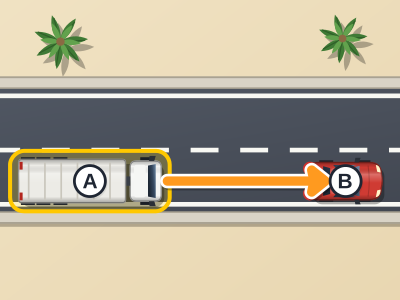
Why does a fully loaded heavy truck need a much longer stopping distance than a car travelling at the same speed?
The other 12 questions in this test
Read them all. The answer and the reason for each, and the timed 22-question run, are in the Qatar Driving Theory Online Practice Bank.
- Q11Heavy vehicle
A bridge sign shows a 10-tonne maximum weight limit. Your fully loaded truck weighs 14 tonnes. What must you do?
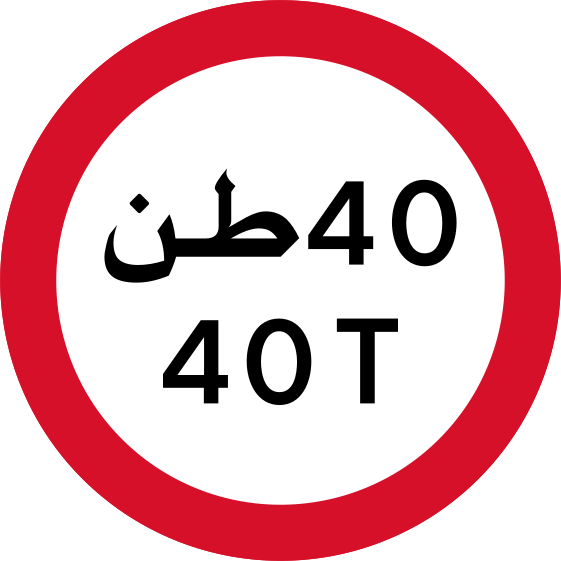
- ACross slowly in first gear to minimise impact force on the bridge
- BFind an alternative route; you must not cross the bridge at your current weight
- CCross if no other vehicles are on the bridge at the same time
- DThe limit applies only to unladen weight, so a 14-tonne GVW is acceptable
Answer and explanation in the bank
- Q12Heavy vehicle
How should a truck driver make sure the vehicle can pass under bridges, tunnels and gantries on a route?
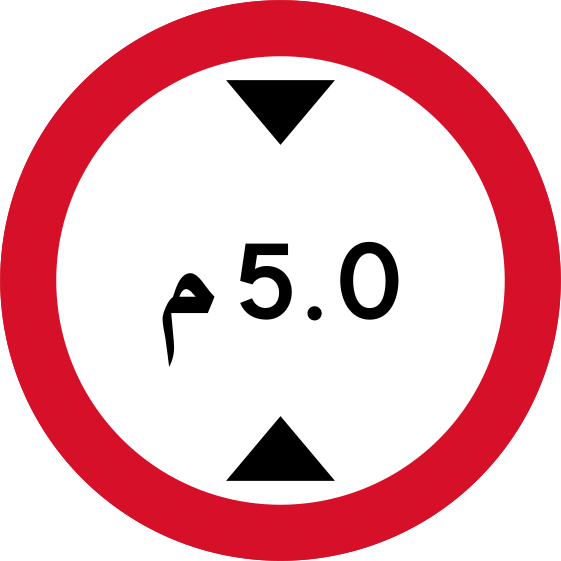
- AKnow the vehicle's loaded height and compare it with the height-limit signs before reaching each structure
- BAssume every bridge in Qatar is high enough for any truck
- CDrive slowly under low structures so any contact is gentle
- DOnly check the height when carrying containers
Answer and explanation in the bank
- Q13Heavy vehicle
What action must a heavy vehicle driver take when approaching a height-restriction gantry that is lower than the vehicle's loaded height?
- AFold any roof-mounted equipment and attempt to pass slowly
- BFlash headlights at oncoming traffic and proceed quickly
- CStop before the gantry and find a suitable alternative route
- DSound the horn and wait for a traffic officer to guide through
Answer and explanation in the bank
- Q14Heavy vehicle
Which mirrors are most critical for a truck driver to check before making a left turn at an intersection?
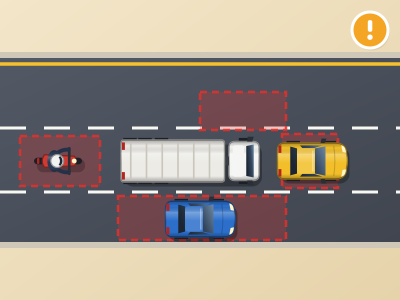
- AThe left-side wide-angle (convex) and close-proximity mirrors to check for cyclists, motorcyclists, and pedestrians in the blind zone
- BOnly the interior rear-view mirror
- CThe right-side mirror only, because left turns are away from oncoming traffic
- DNo mirror check is needed; indicators give other road users sufficient warning
Answer and explanation in the bank
- Q15Heavy vehicle
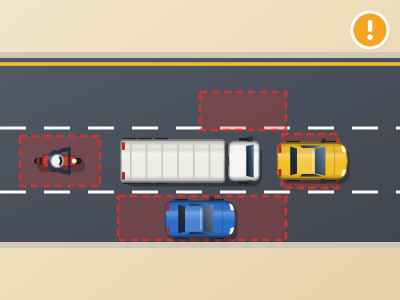
A large truck has a blind spot directly in front of the cab extending several metres ahead. What should the driver do before moving off from a stop?
- ASound the horn twice and move off slowly; this is sufficient warning
- BWalk around the vehicle to check for children, animals, or obstacles before climbing into the cab and moving off
- CUse only the side mirrors; the front blind spot cannot be managed on commercial vehicles
- DRoll forward a few centimetres, pause, then continue; this allows time for pedestrians to move
Answer and explanation in the bank
- Q16Heavy vehicle
What is tail swing, and why is it dangerous when a truck makes a sharp right turn?
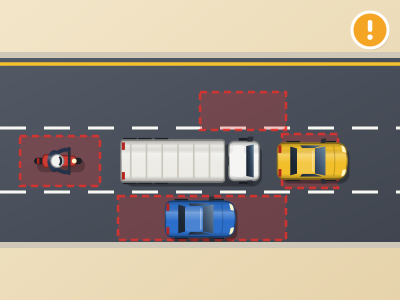
- AThe rear of the trailer swings left as the front turns right, potentially striking pedestrians or vehicles on the left side
- BThe drive axle loses traction and the rear of the truck slides forward
- CThe trailer hitch swings upward when the truck accelerates out of a turn
- DThe steering wheel swings back to centre after a turn, causing loss of directional control
Answer and explanation in the bank
- Q17Heavy vehicle
Why do articulated trucks need extra road width when making tight turns?
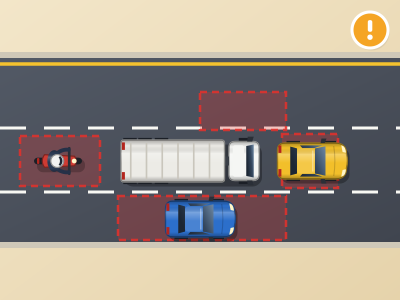
- AThe trailer's rear wheels follow a smaller radius than the tractor's front wheels, cutting the corner inward
- BThe long wheelbase makes the steering wheel difficult to turn quickly
- CThe fifth wheel joint allows the trailer to slide outward beyond the tractor's path
- DWide tyres on the drive axle increase the turning radius on both sides equally
Answer and explanation in the bank
- Q18Heavy vehicle
Which combination of conditions most increases rollover risk for a high-sided curtain-sided trailer?
- ALow speed, gradual steering, and a uniformly distributed load
- BHigh speed, sudden steering input, and a raised centre of gravity from a top-heavy load
- CFull air-tank pressure and a fully loaded trailer on a straight motorway
- DUsing engine braking on a downhill gradient with a lightly loaded trailer
Answer and explanation in the bank
- Q19Heavy vehicle
Strong crosswinds are forecast on a coastal expressway. How should a driver of a high-sided trailer adjust their driving?
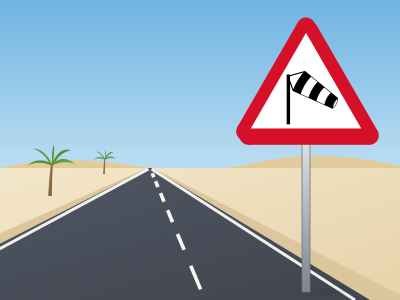
- AIncrease speed to get through the exposed section quickly
- BDrive closer to the central barrier to use it as a windbreak
- CWind only affects empty trailers; a fully loaded vehicle is stable in any wind
- DReduce speed, increase following distance, and be prepared for sudden lateral gusts especially when passing gaps between buildings or bridges
Answer and explanation in the bank
- Q20Heavy vehicle
What is the function of the fifth wheel on an articulated truck?
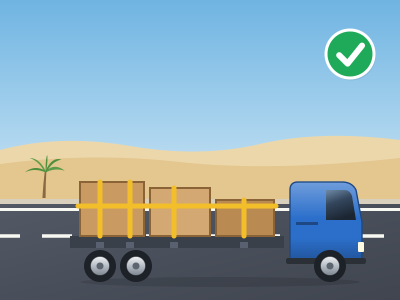
- AIt is an additional spare tyre mounted under the tractor unit
- BIt is the coupling plate on the tractor that accepts and locks the trailer's kingpin, allowing articulation
- CIt is a secondary steering axle fitted behind the drive axles to help with cornering
- DIt is the fifth gearbox ratio in a range-change transmission
Answer and explanation in the bank
- Q21Heavy vehicle
What checks must a driver complete after coupling a trailer to confirm the fifth wheel has locked correctly?
- ATug test: attempt to drive forward with the trailer brakes applied and visually inspect that the kingpin jaw is fully closed around the kingpin
- BDrive slowly in a circle and listen for clicking sounds from the coupling
- CCheck that the trailer reversing lights illuminate when the indicator is activated
- DConfirm the fifth wheel grease nipple is visible through the tractor bodywork access panel
Answer and explanation in the bank
- Q22Heavy vehicle
When uncoupling a trailer on level ground, what must be done before releasing the fifth wheel lock?
- ARelease the air lines and electrical connections first, then pull the kingpin release handle
- BDrive the tractor slowly forward until the kingpin is pushed out of the fifth wheel
- CSound the horn to alert yard personnel and release the lock while stationary
- DApply the trailer park brakes, chock the trailer wheels, and lower the landing legs to take the weight off the fifth wheel
Answer and explanation in the bank
Every answer above, with the rule it comes from, plus the full 22-question timed test.
Get the Qatar Driving Theory Online Practice Bank - QAR 39What this test covers
Topics include road signs, traffic signals, right of way, roundabouts, speed limits, seat belts, fines and penalties, and the safe-driving rules specific to your vehicle category. Full question-by-question feedback with explanations is shown immediately after you finish the test above.
Frequently asked questions
How many questions is the Doha General Directorate of Traffic truck & bus theory test?
The official General Directorate of Traffic truck & bus theory test in Doha has 40 questions and you need 37 correct (92.5%) to pass. This practice test has 22 questions.
Is this the real exam?
These are practice questions to help you revise, written to the published rules and to what candidates report from the real test. They are not the official Qatar exam and the real question bank, format, fees and pass mark are set by the General Directorate of Traffic (Ministry of Interior) and the driving schools, and can change. Always confirm the current requirements with your driving school or the traffic department (for example via the Metrash service).
Is this practice test free?
The first 10 questions are free, with no signup, and each shows the answer and the reason. The full 22-question test, timed, is in the Qatar Driving Theory Online Practice Bank (QAR 39, one payment), with every question in the bank.
What does the Doha truck & bus theory test cover?
Road signs, traffic signals, right of way, roundabouts, speed limits, seat belts, penalties and safe-driving rules, plus the handling and safety topics specific to your vehicle.