

Ajman Traffic Light vehicle
Practice mode· Right of way & safetyAjman Traffic - UAE Right of Way Practice Test
Tests your understanding of priority rules: unmarked junctions, roundabouts, emergency vehicles, merging lanes and more. Getting right of way right can prevent serious accidents.
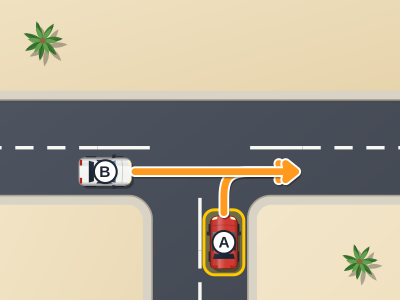
You want to turn across the path of oncoming traffic to reach a side road or entrance. When should you turn?
The other 12 questions in this test
Read them all. The answer and the reason for each, and the timed 22-question run, are in the Ajman Traffic Theory Test Questions PDF.
- Q11Right of way
You are on a highway off-ramp decelerating to leave the motorway. A vehicle behind you is still at motorway speed and wants to pass. What should you do?
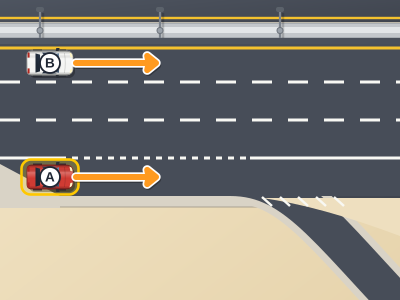
- ADecelerate steadily on the ramp and let faster traffic pass safely if there is room
- BSpeed up to match motorway traffic so you do not impede anyone
- CStop at the bottom of the ramp and wait for motorway traffic to clear
- DMove back onto the motorway to avoid blocking the ramp
Answer and explanation in the bank
- Q12Right of way
A pedestrian has reached the middle of a crossing and your light turns green. The pedestrian is still on your half of the crossing. What should you do?
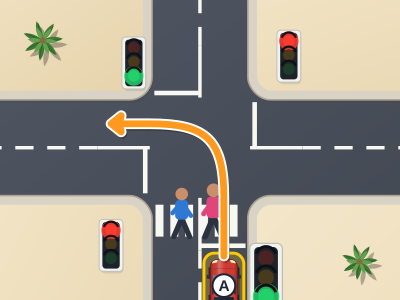
- AMove forward slowly because the pedestrian should have crossed sooner
- BStay stopped and wait for the pedestrian to fully clear your path before moving
- CEdge forward carefully to encourage the pedestrian to speed up
- DSound the horn once and then proceed
Answer and explanation in the bank
- Q13Right of way
You approach a marked school crossing with flashing amber lights indicating children are crossing. What is required?
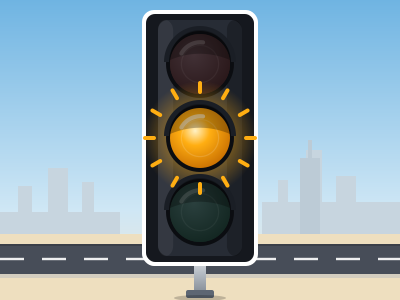
- ASlow down significantly and give way to any children crossing
- BMaintain normal speed and sound the horn as a warning
- COnly slow down if you can see a child actively crossing
- DThe flashing lights are advisory only and have no legal effect
Answer and explanation in the bank
- Q14Right of way
An ambulance is directly behind you at a red light and you cannot safely pull over because vehicles are tight on both sides. What is the best action?
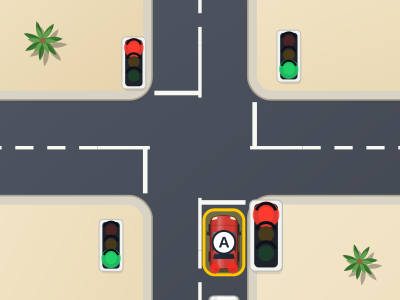
- ARun the red light fully and clear the junction as fast as possible
- BStay exactly where you are, as you cannot move safely
- CReverse into the ambulance path to create room ahead
- DMove forward carefully into the space available at the junction to help create a gap, without running the red or endangering pedestrians
Answer and explanation in the bank
- Q15Right of way
A car is reversing out of a parking space onto a road you are travelling on. Who has priority?
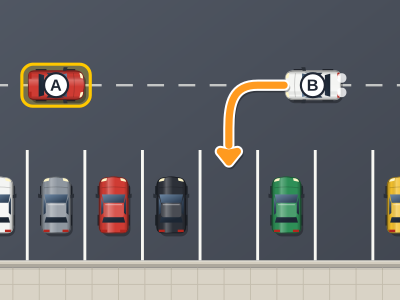
- AThe reversing car because it started moving first
- BNeither, you must both stop and work it out
- CThe reversing car because it is in the right
- DYou do, as the driver on the road; the reversing car must give way
Answer and explanation in the bank
- Q16Right of way
A vehicle is exiting a private driveway or car park and pulls partly across the footpath onto the road you are on. Who yields?
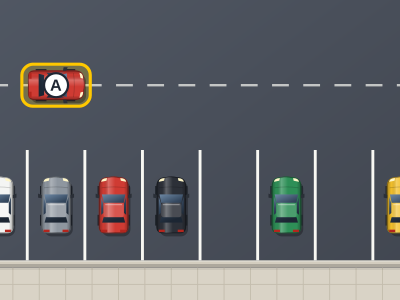
- ATraffic on the road must slow for the vehicle leaving the driveway
- BThe exiting vehicle must give way to traffic on the road and pedestrians on the footpath
- CPedestrians must stop for any vehicle crossing the footpath
- DWhoever is already halfway out has priority
Answer and explanation in the bank
- Q17Right of way
Three vehicles arrive simultaneously at an unmarked four-way junction. Vehicle A is to your right, Vehicle B is straight ahead, and you want to go straight. Who moves first?
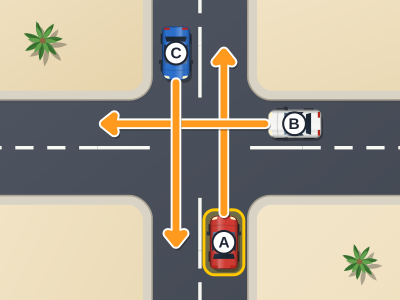
- AVehicle A on your right moves first, then you or Vehicle B may proceed when safe
- BYou go first because you are going straight, not turning
- CVehicle B straight ahead has priority because it faces you
- DAll three move simultaneously if you all go slowly
Answer and explanation in the bank
- Q18Right of way
A pedestrian is crossing the road that runs across the entrance of a roundabout as you are about to enter. Who has priority?
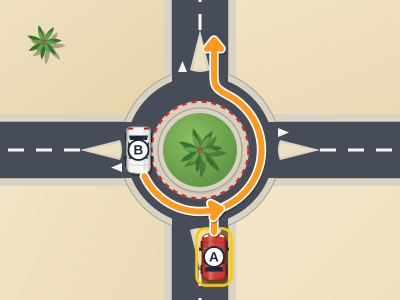
- AYou, because you are entering a roundabout which is a priority road
- BNeither, you both proceed slowly together
- CThe pedestrian crossing the road at the roundabout entry
- DThe vehicle already on the roundabout has priority over the pedestrian
Answer and explanation in the bank
- Q19Right of way
An emergency vehicle is using a dedicated emergency lane (hard shoulder) at speed to pass stationary motorway traffic. What should nearby drivers do?
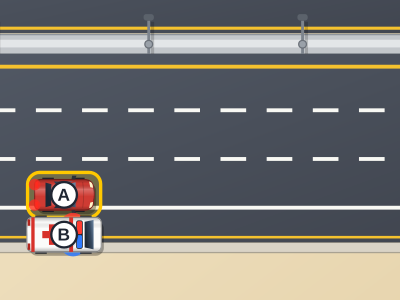
- AMove onto the hard shoulder to get out of the emergency vehicle's way
- BStop your vehicle in any lane immediately
- CFollow the emergency vehicle along the hard shoulder
- DStay in your lane, keep clear of the hard shoulder, and do not pull onto it
Answer and explanation in the bank
- Q20Right of way
You are travelling on a highway and see a vehicle broken down on the hard shoulder ahead with hazard lights on. What is the correct action?
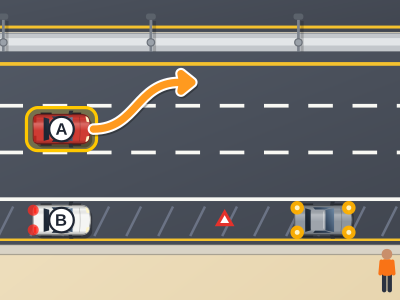
- AMove to the left lane away from the hard shoulder if it is safe, and pass with caution
- BStop on the hard shoulder next to the broken-down car to help
- CSound the horn as a warning to the broken-down driver
- DMaintain speed and stay in the rightmost lane
Answer and explanation in the bank
- Q21Right of way
You meet oncoming traffic on a narrow road near a blind bend where neither of you can see far ahead. What is the safest approach?
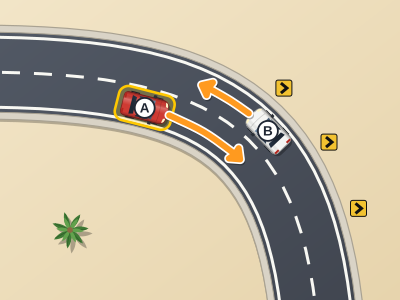
- ABoth vehicles should slow right down, keep well to the right and be ready to stop
- BThe vehicle closest to the bend has priority
- CFlash headlights to claim priority and proceed at speed
- DSound the horn and accelerate to clear the blind section quickly
Answer and explanation in the bank
- Q22Right of way
You are overtaking a slow vehicle on a two-lane road and a cyclist is ahead of the vehicle you are passing. How do you proceed?
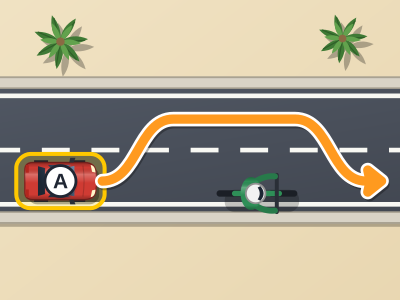
- ASqueeze between the vehicle you are overtaking and the cyclist
- BAbort the overtake or delay it until you have enough space to clear both the vehicle and the cyclist safely
- CSound the horn so the cyclist pulls fully off the road
- DComplete the overtake at speed and pass the cyclist with minimal clearance
Answer and explanation in the bank
Every answer above, with the rule it comes from, plus the full 22-question timed test.
Get the Ajman Traffic Theory Test Questions - AED 29What this test covers
Topics include road signs, traffic signals, right of way, roundabouts, speed limits, seat belts, fines and penalties, and the safe-driving rules specific to your vehicle category. Full question-by-question feedback with explanations is shown immediately after you finish the test above.
Frequently asked questions
How many questions is the Ajman Traffic light vehicle theory test?
The official Ajman Traffic light vehicle theory test in Ajman has 40 questions and you need 30 correct (75%) to pass. This practice test has 22 questions.
Is this the real exam?
These are practice questions for study only, written from the public RTA handbook and UAE traffic rules and to what candidates report from the real test. They are not the official exam questions and Wathim is not affiliated with the RTA, ITC, SRTA or any UAE government body. Test format, question count and pass mark can change and vary by emirate, so always confirm the current requirements with the licensing authority before your real test.
Is this practice test free?
The first 10 questions are free, with no signup, and each shows the answer and the reason. The full 22-question test, timed, is in the Ajman Traffic Theory Test Questions PDF (AED 29, one payment), with every question in the bank.
What does the Ajman light vehicle theory test cover?
Road signs, traffic signals, right of way, roundabouts, speed limits, seat belts, penalties and safe-driving rules, plus the handling and safety topics specific to your vehicle.