

What the Dallah driving test is
The Dallah driving test is the computer-based theory test you sit at Dallah Driving School before you are allowed to move on to in-car training and the road test. It is not a separate government exam with its own name. It is the Saudi driving theory (knowledge) test, delivered at a Moroor-approved school, and Dallah is the best-known school that runs it, mainly in Riyadh.
The format most often reported for the Dallah paper is 35 questions, about 30 minutes, 22 correct to pass. That is roughly 63%. The questions come one per screen, you can skip and return, and your result is shown at the end. About 40% of the paper is sign recognition and about 60% is traffic rules.
Who sits it
Anyone starting a first Saudi licence at the school: Saudi nationals, residents with an Iqama, men and women. If you are converting a foreign licence you may be exempt from some stages, so ask the school what applies to you. The General Department of Traffic (Moroor) sets the rules, and the school runs the test. You can see the overall country picture on the Saudi driving theory test hub.
What is confirmed and what is not
Be clear about one thing before you plan your revision. Moroor does not publish an official question count or pass mark. The 35 and 22 figures come from candidate reports and prep sites that describe the Dallah paper, and other sites give 20 to 32 questions. Schools can differ and formats change. We practise to the Dallah figures because they are the strictest specific numbers reported: if you clear 22 of 35 comfortably, you are covered for the shorter formats too. The Saudi pass mark guide goes through every figure in circulation.
Dallah test format at a glance
This table is the quickest way to see what you are preparing for. Treat the numbers as the reported Dallah format and confirm them with your branch when you book.
| Item | What is reported |
|---|---|
| Delivery | Computer at the driving school, one question per screen |
| Questions | 35 |
| Correct answers to pass | 22 (about 63%) |
| Time | About 30 minutes |
| Question split | About 40% signs, about 60% rules |
| Skipping | You can skip a question and come back |
| Result | Shown on screen at the end |
| Languages | Arabic and English confirmed; other languages vary by branch |
Thirty minutes for 35 questions gives you a little under a minute per question. That is generous for a sign you know and tight for a long rule question you have never seen, so the skip button matters. Answer the easy ones first, flag the slow ones, and use the last five minutes to clear the skipped screens.
Why 22 is closer than it sounds
You can miss 13 questions and still pass, which feels like a lot. In practice a candidate who has not studied the points and fines schedule can drop 8 or 9 marks on that topic alone, then lose 4 or 5 more on look-alike warning signs. That is the whole margin gone. The people who pass comfortably are the ones who score 28 or more on a full practice paper, not the ones who aim for exactly 22.
What the questions look like
Dallah questions are short, direct and multiple choice. Rule questions are text-based with three or four options, and some are true or false. Sign questions show the sign and ask what it means or what you must do. Candidates report that wording follows the classic Dallah question set, which is why the same phrasing appears across prep sites.

Sign recognition questions
These cover warning, regulatory, guide and work-zone signs. The traps are look-alikes: a speed limit sign against a minimum speed sign, a no stopping sign against a no parking sign, a give way triangle against a stop octagon. Practise them on the road signs practice test 1 and road signs practice test 2.
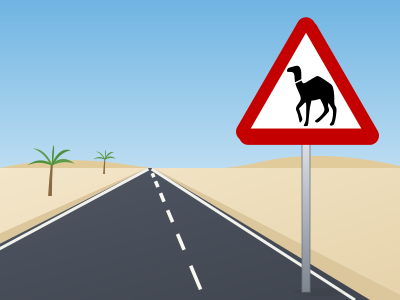
Rule and scenario questions
Rule questions describe a situation: a red light, a school bus, an emergency vehicle behind you, a tyre burst at speed. You pick the correct action. Scenario questions test priority at roundabouts and junctions, which you can drill with the right of way practice test. Do not memorise the position of the right answer. Candidates report that the order of options changes, and the wording of the correct choice often includes phrases like "all of the above".
Topics and how they are weighted
No one publishes an official weighting, but candidate reports of the Dallah paper are consistent. Signs make up about 40% of the questions. Of the remaining rule questions, the largest single block is the points and fines schedule, with other topics spread across the list below. The table gives a working estimate to plan your revision time around, not an official breakdown.
| Topic | Share of effort | What to learn |
|---|---|---|
| Road signs | About 40% of the paper | Warning, regulatory, guide and work-zone signs, and their shapes and colours |
| Points and fines | Heaviest rules topic | Which violations carry points, and the current schedule |
| Overtaking and line markings | High | Solid, broken and double lines, and when passing is allowed |
| Roundabouts and junctions | High | Who gives way, lane choice, signalling |
| Speed, seat belts, children | Medium | Limits by road type, seat belt and child seat rules |
| Lights and weather | Medium | Headlights at night, fog, rain, dust |
| Emergencies | Medium | Tyre burst, skids, first aid, breakdowns |
| Camels, school buses, work zones | Smaller but recurring | Specific Saudi hazards and the correct response |
A warning about old fine figures
Many fine and point numbers in the widely shared Dallah question PDFs date from 2014 to 2016. Saudi penalties have been revised since then. If a practice source gives you a number, check it against the current violations schedule from the Ministry of Interior before you learn it. Our fines and black points test 1 and test 2 are written to the published rules and explain every answer, so you learn the reason as well as the figure.
How you reach the Dallah test: the process and booking
You do not book the computer test on your own. It sits inside your course. The usual order for a first-time applicant is below, and the school schedules the theory test for you once you have attended the theory classes.
- Absher account. Create or log in to your Absher Individual account (absher.sa or the app) and use the traffic services to start your driving licence request or book your school slot.
- Medical and eye test. Get the medical fitness certificate from an approved clinic. It includes a vision check and colour vision.
- Register at the school. Take your Iqama or national ID, passport, medical certificate and photographs to the branch. Pay the school registration fee.
- Theory classes. Attend the classroom sessions. Expats report that on class day you are given a printed sheet of signs. Keep it and learn it.
- Computer test. The school schedules your slot. You sit the test on a school computer.
- Practical training and road test. After the theory stage you move to in-car hours and then the road test with a Moroor examiner.
Documents to carry
A valid Iqama or Saudi ID, your passport, the medical certificate, recent photographs and the Absher confirmation where applicable. Requirements can change, so check with the branch and with Moroor through Absher. For the rest of the licence journey, our region pages such as Riyadh and Makkah list the practice tests for each area, and Eastern Province candidates use the same questions.
Saudi question bank + printable papers
568 questions with the answer and the rule, 3 full papers at the real length. One payment, no account.
Fail on the day
SAR 115-500
Pass first time
SAR 19
- 3
- Full papers
- 568
- Questions
- 35
- question timed mocks
That's 3.3 halala a question, every answer explained.
Fees and what failing really costs
Fees vary by school, city and package, and Moroor and the schools revise them. Treat the figures below as reported indications, not a price list. Always get the amount in writing from your branch before you pay.
| Item | What is reported | Confidence |
|---|---|---|
| Dallah 30-hour private licence course | SAR 456.75 in one expat guide, government issuing fees on top | May be out of date |
| Medical and eye test | Roughly SAR 50 to 200 at an approved clinic | Varies by clinic |
| Theory retest fee | One guide reports about SAR 86; other sites quote different figures | Not published by Moroor, ask your branch |
| Practical retest | Set by Moroor and the school | Ask your branch |
The cost is mostly time
Even if a retest fee is small, a fail pushes your whole timeline. You wait for a new theory slot, your training hours start later, and your road test slot slips with them. For a working resident that can mean extra weeks of paying for taxis or asking colleagues for lifts, plus the risk that your medical certificate or other paperwork lapses before you finish. Candidates who pay for the full course are often most annoyed by this: you have already paid for the classes and then lose time on a paper you could have prepared for in a week.
That is the argument for over-preparing. Do the free Saudi theory mock test 1 first. If you score below 28 of 35, keep practising before you sit the real one.
If you fail the Dallah test
Failing the Dallah computer test is common, and it is recoverable. You do not lose the course. You are given another attempt, scheduled by the school after a waiting period. Moroor and Dallah do not publish a fixed waiting period or a fee for the theory retest, and sources conflict, so ask your branch for the date and any charge on the same day you fail, while your file is still active.
What to do in the first 24 hours
- Ask the desk for your next available slot and the retest fee, in writing if possible.
- Write down every topic you remember struggling with while it is fresh.
- Do not re-sit on a guess. Sit a full timed practice paper that same evening to see how far you were from 22.
How to decide you are ready
Go back to the school when you score 28 or more out of 35 on two different full timed mocks. That gives you a margin of about six marks above the line. Our mock test 2 and mock test 3 are separate papers so you are not just remembering answers. For a full retest plan, read the failed Saudi theory test guide.
If you are failing by only a few marks, the likely cause is signs or points and fines. If you are failing by a lot, you probably need to go back to the rules from the start rather than just doing more mocks.
Mistakes that fail Dallah candidates
These are the patterns candidates describe most often when they talk about the Dallah computer test. Each has a fix you can apply this week.
| Mistake | Fix |
|---|---|
| Skipping the sign sheet because "I drive already" | Learn every sign on the sheet. Signs are about 40% of the paper |
| Memorising answer letters from a PDF | Learn the reason. Option order changes and wording differs |
| Learning old fine numbers | Check against the current Ministry of Interior schedule |
| Confusing no stopping and no parking | Compare the two signs side by side until the difference is automatic |
| Wrong priority at roundabouts | Drill the right of way test and read each explanation |
| Spending too long on one question | Skip, move on, return with the time left |
| Sitting after one practice run | Wait for two good scores on separate full mocks |

The speed question trap
Speed limit questions tend to ask for the limit on a specific road type when no sign is present. Do not guess from experience, because local limits you see on the road may differ from the default in the rules. Learn the default limits from the traffic rules and use the road rules test 1 to check them.
A one-week study plan for the Dallah test
If your test date is close, this plan gets a first-time candidate to a safe score in seven days with about 45 to 60 minutes a day. If you have more time, stretch each stage and add extra mocks.
- Day 1, signs. Learn the sign sheet from class. Then take road signs test 1 and note every sign you missed.
- Day 2, signs again. Take road signs test 2. Redo yesterday's misses. Aim for 17 of 22.
- Day 3, right of way. Roundabouts, junctions and emergency vehicles with the right of way test.
- Day 4, rules. Overtaking, lines, lights and speed using road rules test 1 and test 2.
- Day 5, fines and points. Both fines tests and the safe driving topics in safe driving.
- Day 6, full timed mock. Mock test 1 in 30 minutes with no pausing. Review every wrong answer.
- Day 7, second mock. Mock test 2. If you score 28 or more, you are ready. If not, move your test date if the school allows.
If you have only two days
Spend day one entirely on signs and day two on one full timed mock and the review. Signs are the fastest marks to gain because they are visual and finite.
Test day checklist
On the day, small things cost marks. This list covers the practical side.
- Documents. Iqama or ID, school file or receipt, and any Absher confirmation, as the branch requires.
- Arrive early. Branches can be busy and the school may call candidates in a queue.
- Language. Choose the language you read fastest. Arabic and English are confirmed. If you want another language, check with the branch beforehand.
- Read each question fully. The words "not", "except" and "all of the above" decide many answers.
- Use the skip. Skip any question that takes more than a minute and come back at the end.
- Check the count. Before you submit, make sure there are no unanswered screens.
- Stay calm after a wrong answer. You can miss 13 and still pass. One hard question does not decide the paper.
Women candidates
Women sit the same theory test as men at women's driving schools and sections. The questions, signs and pass line are the same. Saudi women have been able to hold licences since 2018, and the same free practice applies to you.
Motorcycle and heavy vehicle candidates
If you are sitting a different licence category, use the right paper. There are motorcycle tests and truck and bus tests built to the same 35-question format.
How to practise before you sit the Dallah test
The most reliable way to pass is to remove the surprise. Our free practice is written to the published Saudi traffic rules and to what candidates report from the real test, in the same format as the Dallah paper. It is not the official question bank, and we say so plainly, but the topics, the sign types and the 35-question timed format match what you will face.
The practice route
- Take the free 10-question test above to see where you stand in three minutes.
- Work through the topic tests: signs, right of way, rules and fines.
- Sit full timed mocks: 1, 2, 3 and 4.
- Only book your slot when two mocks in a row are above 28 of 35.
When you want more than the free tests
The free mocks are enough to find your weak spots. If you want volume, the printable Saudi papers give you a zip of separate papers with answer keys and score bands, and the full online Saudi bank lets you drill the whole question set in your browser. Compared with the cost of an extra retest, extra weeks and a delayed road test, a few more evenings of practice is a cheap way to protect your timeline. You can also see the Saudi hub for every region and vehicle type.
Free Riyadh mock tests and topic tests
Every test opens on ten free questions. Pick a full mock at the real length, or drill one topic.
- Saudi Theory Mock Test 1Mock · 35 questions
- Saudi Theory Mock Test 2Mock · 35 questions
- Saudi Theory Mock Test 3Mock · 35 questions
- Saudi Theory Mock Test 4Mock · 35 questions
- Saudi Road Signs Practice Test 1Topic · 22 questions
- Saudi Road Signs Practice Test 2Topic · 22 questions
- Saudi Road Rules Test 1Topic · 20 questions
- Saudi Road Rules Test 2Topic · 20 questions
- Saudi Right of Way Practice TestTopic · 22 questions
- Saudi Safe Driving Practice TestTopic · 22 questions
- Saudi Fines & Black Points Test 1Topic · 20 questions
- Saudi Fines & Black Points Test 2Topic · 20 questions
Practise for your region
The rules are national, but the test centre, booking and fees can differ by area.
Frequently asked questions
35 is the figure reported for the Dallah paper, with about 30 minutes to answer. Moroor publishes no official count, and other prep sites give anything from 20 to 32 questions, so confirm with your branch when you book.
22 correct out of 35, about 63%, is the figure reported for Dallah. It is not officially published. Because formats can differ by school, aim for 28 or more in practice so you have a safe margin whichever format you meet.
Yes. Arabic and English are confirmed for the computer test. Some sites list Urdu, Hindi, Malayalam or Bengali, but that varies by branch and is not consistently reported, so ask the school which languages your branch offers.
No. The school schedules the computer test once you have attended the theory classes. You start through Absher, get the medical certificate, register at the branch and the school gives you your test slot.
Yes. Women take the same computer theory test at women's driving schools and women's sections. The questions, the signs and the pass line are the same, so the same practice applies.
The school books you another attempt after a waiting period. Moroor and Dallah do not publish a fixed wait or retest fee, and sources conflict, so ask your branch for the date and cost the same day. Revise your weak topics and retake only after two good mocks.
No. They are original practice questions in the same format and on the same topics, written to the published rules and to what candidates report from the real test, with an explanation for every answer. They are not the official question bank.
About 40% of the paper is sign recognition, roughly 14 of 35 questions, according to the candidate report most often cited. The rest is traffic rules, with points and fines being the heaviest rules topic.
Most candidates with some driving experience need about a week of 45 to 60 minutes a day: signs first, then right of way, rules and fines, then two full timed mocks. If you are a new driver, allow two weeks.
Saudi question bank + printable papers
568 questions with the answer and the rule, 3 full papers at the real length. One payment, no account.
Fail on the day
SAR 115-500
Pass first time
SAR 19
- 3
- Full papers
- 568
- Questions
- 35
- question timed mocks
That's 3.3 halala a question, every answer explained.