

Al Batinah South Royal Oman Police Light vehicle
Practice mode· Right of way & safetyAl Batinah South Royal Oman Police - Oman Safe Driving Practice Test
Covers defensive driving, following distances, fatigue, visibility, adverse weather and hazard awareness. Safe driving habits save lives and keep your licence clean.
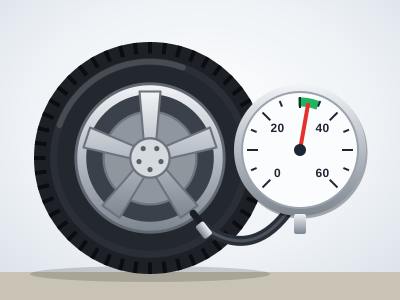
When is the best time to check your tyre pressure in Oman's summer heat?
The other 12 questions in this test
Read them all. The answer and the reason for each, and the timed 22-question run, are in the Oman Driving Test Questions PDF (ROP).
- Q11Safe driving
On a mountain descent in Oman your vehicle begins to pick up speed despite you holding the brake pedal. The most likely cause and correct action is:
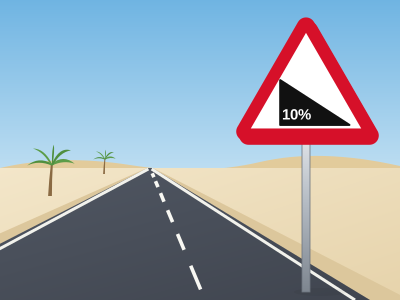
- ABrake fade from overheating; select a lower gear immediately to use engine braking and reduce reliance on the brakes
- BABS has activated and released the brakes; pump the pedal harder
- CThe accelerator pedal has stuck; push the brake harder and continue downhill
- DThe tyres have overheated; continue braking until they cool down
Answer and explanation in the bank
- Q12Safe driving
Which of the following actions reduces the risk of a crash when overtaking a long vehicle such as a tanker on an Omani two-lane road?
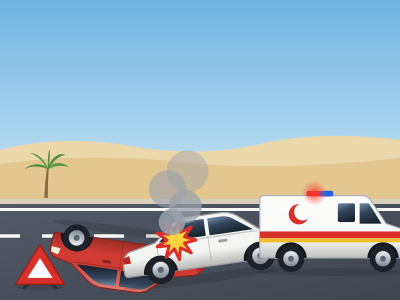
- ADrop back further than normal before overtaking to see past the vehicle, signal clearly, and ensure you have a very large clear gap before committing to the manoeuvre
- BMove close behind the tanker so you can accelerate into the gap more quickly
- COvertake in stages, pulling alongside the trailer first and waiting for the cab to clear
- DFlash your headlights and the tanker driver will move over to make space
Answer and explanation in the bank
- Q13Safe driving
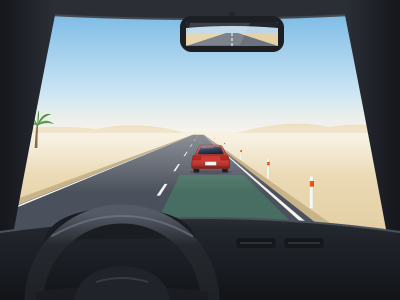
What does it mean to 'drive to the conditions' on an Omani road?
- AAlways drive at the posted speed limit regardless of conditions
- BFollow the vehicle ahead and match their speed as a guide to safe conditions
- CAdjust your speed and following distance to suit the actual road, weather, visibility, and traffic conditions, even if this means driving well below the posted speed limit
- DDrive faster in good weather to compensate for time lost when conditions are poor
Answer and explanation in the bank
- Q14Safe driving
What is the correct hand position on the steering wheel for good control and safety?
- ABoth hands on the wheel at the 9 o'clock and 3 o'clock positions (or 8 and 4 if the vehicle has an airbag)
- BOne hand at the 12 o'clock position so the other is free for the gear lever
- COne hand resting on the door and the other loosely at the bottom of the wheel
- DHand position does not affect safety provided you can steer the vehicle
Answer and explanation in the bank
- Q15Safe driving
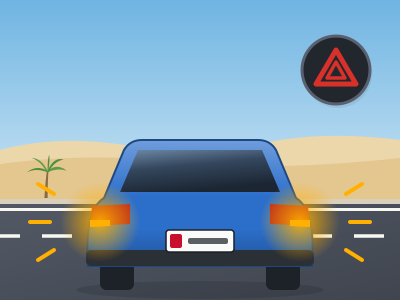
You are driving on Oman's coastal road in heavy rain. You notice the vehicle in front has its hazard lights flashing while moving slowly. What does this indicate and how should you respond?
- AFlashing hazards mean the driver is about to turn; move to the other lane immediately
- BThe driver may be warning of a hazard ahead or the vehicle is in difficulty; increase following distance, reduce speed, and be prepared to stop
- CHazard lights on a moving vehicle always indicate the driver is about to pull over; continue at normal speed
- DIgnore hazard lights on other vehicles; they are often used incorrectly and give no useful information
Answer and explanation in the bank
- Q16Safe driving
A car approaches you on a narrow mountain road in Oman and there is not enough space for both vehicles. What should you do?
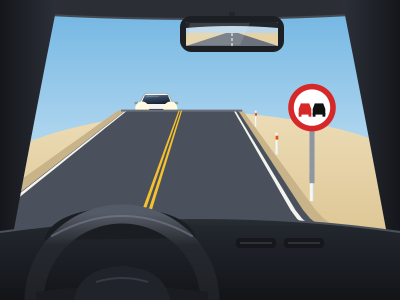
- AThe vehicle that has a safe place to pull in should do so; generally uphill traffic has priority but yield to the vehicle closest to a safe passing place
- BThe larger vehicle always has priority on mountain roads
- CBoth drivers must stop and wait for a third driver to mediate
- DThe vehicle travelling downhill always has priority
Answer and explanation in the bank
- Q17Safe driving
What should you check before undertaking any long journey across Oman to ensure your vehicle is roadworthy?
- AOnly the fuel level; modern vehicles alert you to all other issues via dashboard warning lights
- BOnly the tyre pressure and fuel level
- CNothing specific; if the vehicle has been serviced within the year it is ready
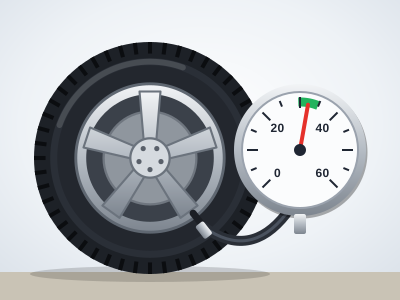
- DTyre pressure and condition, engine oil, coolant, brake fluid, lights, fuel level, windscreen washer fluid, and that all mirrors are adjusted correctly
Answer and explanation in the bank
- Q18Safe driving
Why is it especially important to carry extra drinking water in your vehicle when driving through remote areas of Oman?
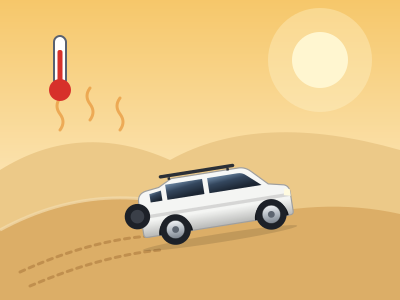
- AOmani law requires all vehicles to carry a minimum of 2 litres of water
- BWater helps cool the engine if it overheats and should be kept ready to pour in the radiator
- CIn case of a breakdown or emergency in a remote area, you may have to wait hours in extreme heat before help arrives
- DWater is only necessary in summer months; the rest of the year temperatures are mild enough
Answer and explanation in the bank
- Q19Safe driving
You are driving at 100 km/h on a dry Omani highway. Roughly how much total distance do you need to stop completely, including reaction time?
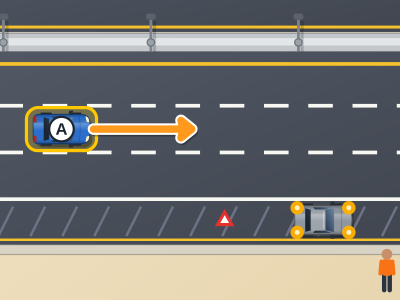
- AAround 140 metres (about 35 car lengths)
- BAround 40 metres
- CAround 80 metres
- DAround 200 metres
Answer and explanation in the bank
- Q20Safe driving
Why are stopping distances longer on wet roads than on dry roads?
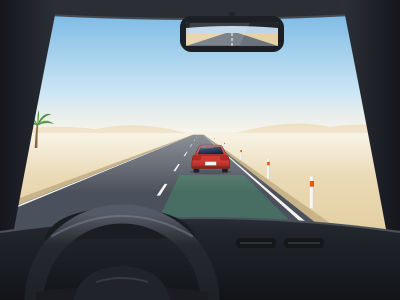
- AWater reduces friction between the tyres and road surface, so brakes take longer to slow the vehicle
- BRain makes drivers press the brake pedal more gently
- CWet roads make ABS switch off automatically
- DHeavy rain increases the weight of the vehicle
Answer and explanation in the bank
- Q21Safe driving
You turn onto a gravel track on the edge of a desert in Oman. How should your braking technique change compared to driving on tarmac?
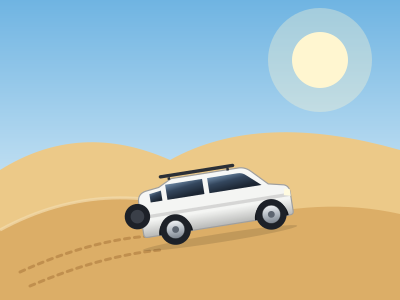
- ABrake harder and faster to compensate for the loose surface
- BUse the handbrake instead of the footbrake on gravel
- CBrake earlier and more gently, as gravel provides far less grip and the vehicle can slide sideways
- DNo change is needed; modern ABS handles gravel automatically
Answer and explanation in the bank
- Q22Safe driving
It is mid-summer in Oman and temperatures are above 40 degrees Celsius. What effect does high heat have on tyre pressure?
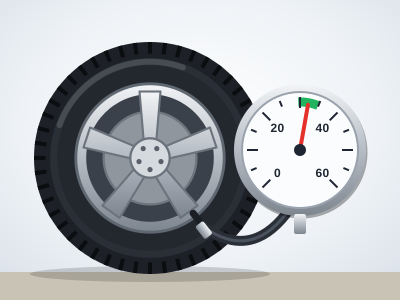
- AHeat makes the tyre rubber expand, reducing internal pressure
- BTyre pressure is unaffected by ambient temperature
- CHeat causes air inside the tyre to expand, raising tyre pressure
- DHeat lowers tyre pressure by causing air molecules to slow down
Answer and explanation in the bank
Every answer above, with the rule it comes from, plus the full 22-question timed test.
Get the Oman Driving Test Questions PDF (ROP) - OMR 3What this test covers
Topics include road signs, traffic signals, right of way, roundabouts, speed limits, seat belts, fines and penalties, and the safe-driving rules specific to your vehicle category. Full question-by-question feedback with explanations is shown immediately after you finish the test above.
Frequently asked questions
How many questions is the Al Batinah South Royal Oman Police light vehicle theory test?
The official Royal Oman Police light vehicle theory test in Al Batinah South has 30 questions and you need 23 correct (75%) to pass. This practice test has 22 questions.
Is this the real exam?
These are practice questions to help you revise, written to the published rules and to what candidates report from the real test. They are not the official Oman exam and the real question bank, format, fees and pass mark are set by the Royal Oman Police, and can change. Always confirm the current requirements with your driving school or the Royal Oman Police.
Is this practice test free?
The first 10 questions are free, with no signup, and each shows the answer and the reason. The full 22-question test, timed, is in the Oman Driving Test Questions PDF (ROP) (OMR 3, one payment), with every question in the bank.
What does the Al Batinah South light vehicle theory test cover?
Road signs, traffic signals, right of way, roundabouts, speed limits, seat belts, penalties and safe-driving rules, plus the handling and safety topics specific to your vehicle.