

Al Buraimi Royal Oman Police Truck & Bus
Timed mock exam· Full mock examsAl Buraimi Royal Oman Police - Oman Truck & Bus Theory Mock Test 1
A full 30-question timed practice exam for the Oman heavy-vehicle (truck and bus) theory test. Covers shared road rules and signs plus heavy-vehicle handling and safety. Aim for 23/30 (75%) to pass.
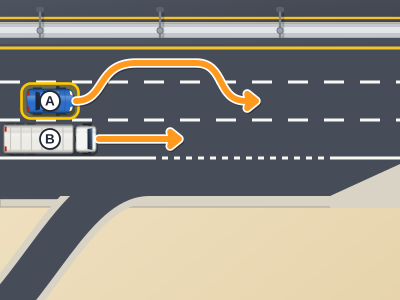
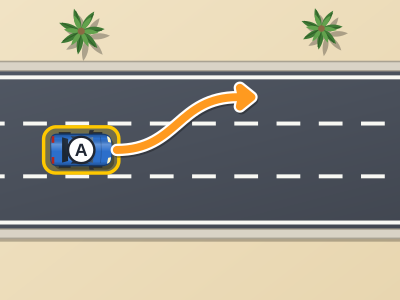
You are on a three-lane Oman highway and have just finished overtaking. Where should you go next?
The other 20 questions in this test
Read them all. The answer and the reason for each, and the timed 30-question run, are in the Oman Driving Test Questions PDF (ROP).
- Q11Road signs and signals
You are approaching a roundabout. Traffic is already circulating inside. Who has priority?
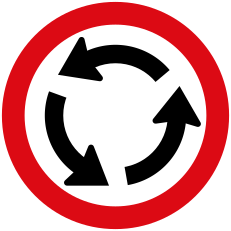
- AVehicles already circulating inside the roundabout
- BVehicles entering from the right
- CVehicles entering from the left
- DThe first vehicle to reach the roundabout entry
Answer and explanation in the bank
- Q12Traffic rules
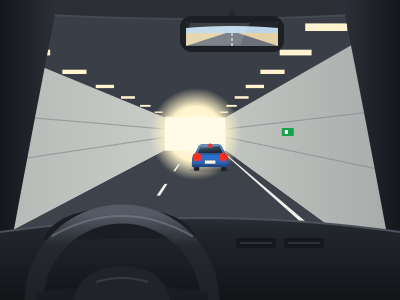
At which of these locations is a U-turn always forbidden in Oman?
- AOnly on highways with a speed limit above 100 km/h
- BOnly in school zones during school hours
- CU-turns are not forbidden at any specific location type
- DOn a bridge, inside a tunnel, at a pedestrian crossing, or where a bend restricts vision
Answer and explanation in the bank
- Q13Right of way
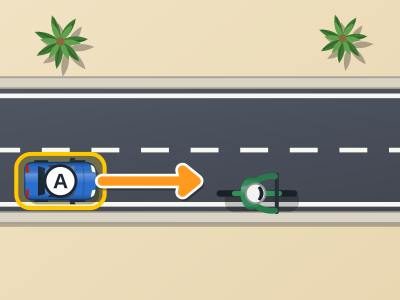
A cyclist is travelling straight on at a junction where you want to turn right. Who has priority?
- AYou have priority because you are in a motor vehicle
- BYou both have equal priority; whoever moves first goes first
- CThe cyclist must stop and let you complete your right turn
- DThe cyclist going straight on has priority over you turning right
Answer and explanation in the bank
- Q14Safe driving
A seat belt is positioned incorrectly and the shoulder strap runs behind the wearer's back. How does this affect safety in a crash?
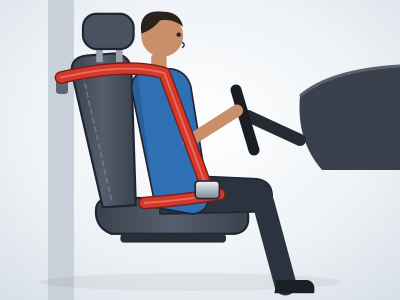
- AIt is extremely dangerous: the wearer will not be restrained and may be thrown forward or out of the vehicle
- BIt is slightly less effective but still provides most of the protection
- CIt is safer because it prevents chest injury from the belt
- DIt makes no difference; the lap belt alone provides sufficient restraint
Answer and explanation in the bank
- Q15Penalties and fines
Many drivers in Oman believe there is a guaranteed tolerance margin above the posted speed limit before a radar camera issues a fine. What should you understand about this?
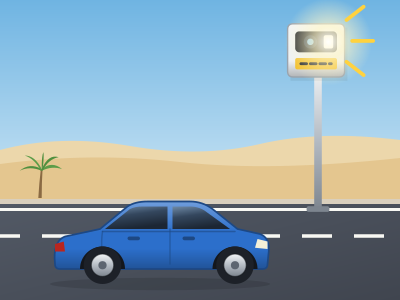
- AAny operational tolerance can be changed or removed at any time; obeying the posted limit is the only safe approach
- BA tolerance of 20 km/h above the limit is officially guaranteed by law
- CRadar cameras only activate if you exceed the limit by 30 km/h
- DThere is no radar enforcement on roads with limits below 80 km/h
Answer and explanation in the bank
- Q16Heavy vehicle
A heavy vehicle's load shifts toward the right during a left-hand curve. What is the greatest risk?
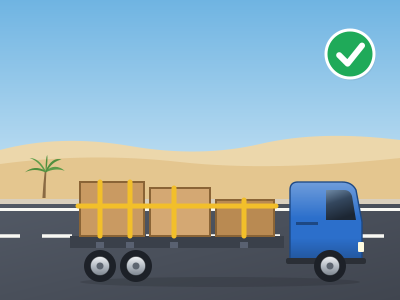
- AThe right-side tyres bursting from the sudden weight transfer
- BSteering lock due to the shift overloading the front axle
- CRollover due to a raised centre of gravity combined with centrifugal force pushing the vehicle outward
- DThe trailer uncoupling from the fifth wheel because of side load
Answer and explanation in the bank
- Q17Road signs and signals
You are at a roundabout in Oman and need to take the third exit. Where should you position your vehicle on entry, and how should you signal when leaving?
- AEnter in the left lane, signal left before your exit
- BEnter in any lane, no signal is required
- CEnter in the right lane, signal left before your exit
- DEnter in the right lane, signal right before your exit
Answer and explanation in the bank
- Q18Traffic rules
How far in advance must you signal before turning or changing lanes in Oman?
- AOnly at the exact moment you start to turn the wheel
- BThere is no legal requirement to signal in Oman
- CSignalling is only required on roads with more than two lanes
- DEarly enough to give other road users time to react before the manoeuvre begins
Answer and explanation in the bank
- Q19Right of way
You are reversing out of a private driveway onto a public road. Who has priority?
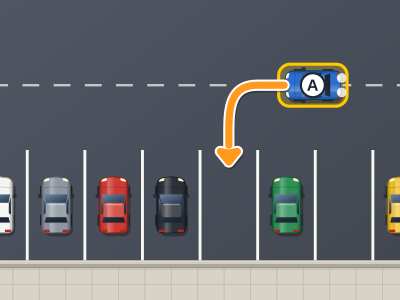
- AYou have priority because you were in the driveway first
- BPriority is equal; sound your horn and reverse slowly
- CPedestrians must give way to you while you reverse
- DTraffic on the public road has priority; you must give way
Answer and explanation in the bank
- Q20Safe driving
At what age can a child legally sit in the front seat of a vehicle in Oman?
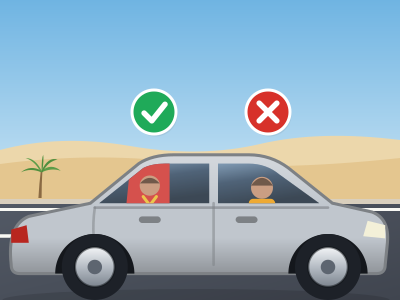
- AFrom birth, provided they are in a rear-facing car seat in the front
- BFrom age 10; children under 10 must not sit in the front seat
- CFrom age 3, if they use a booster seat
- DThere is no age restriction in Oman
Answer and explanation in the bank
- Q21Penalties and fines
Which of the following describes the types of speed enforcement used on Oman's roads?
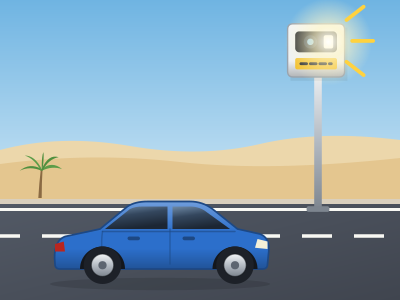
- AFixed radar cameras at well-known locations only
- BSpeed enforcement is only carried out by officers on motorcycles
- CSpeed checks happen only at night when traffic is light
- DA combination of fixed radar cameras, mobile units and average-speed systems
Answer and explanation in the bank
- Q22Heavy vehicle
Which condition most increases the rollover risk of a high-sided heavy vehicle?
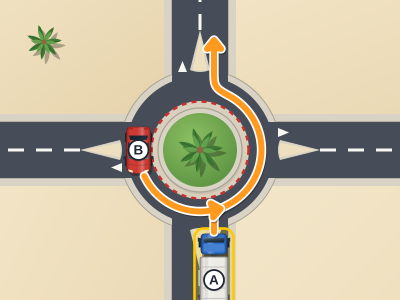
- ATaking a roundabout or bend at excessive speed with a high centre of gravity load
- BDriving in a straight line on a level road while fully loaded
- CAscending a steep hill in a low gear with a partial load
- DOperating the air-suspension system on an uneven surface
Answer and explanation in the bank
- Q23Road signs and signals
This warning sign is displayed on the road ahead. What does it tell you?
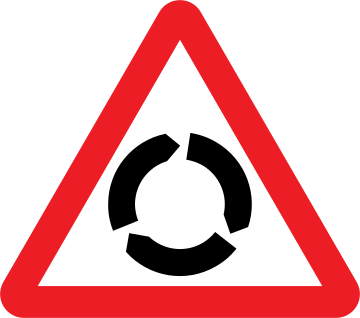
- AA signalised junction is ahead
- BA roundabout is ahead - prepare to give way
- CThe road divides into two lanes ahead
- DU-turns are permitted ahead
Answer and explanation in the bank
- Q24Traffic rules
When should you cancel your indicator after completing a turn in Oman?
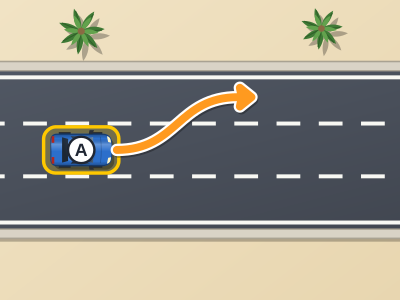
- AImmediately after completing the turn or lane change
- BAfter travelling at least 100 metres in the new direction
- COnly when another driver signals to acknowledge you
- DThere is no need; modern cars always cancel it automatically
Answer and explanation in the bank
- Q25Right of way
Two lanes merge into one ahead. How should drivers handle the merge correctly?
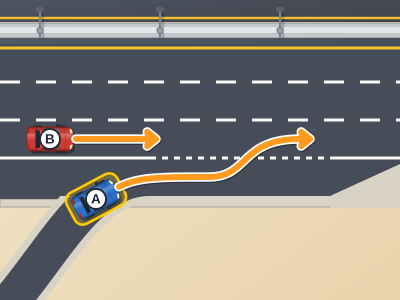
- AThe right lane has absolute priority and the left lane must stop
- BThe vehicle that was furthest ahead in its lane always has full priority
- CUse a zip-merge: each lane takes turns alternately at the merge point
- DDrivers in the closing lane must stop and wait until the road is completely clear
Answer and explanation in the bank
- Q26Safe driving
A parent places a rear-facing infant seat in the front passenger seat where an active airbag is fitted. Why is this dangerous?
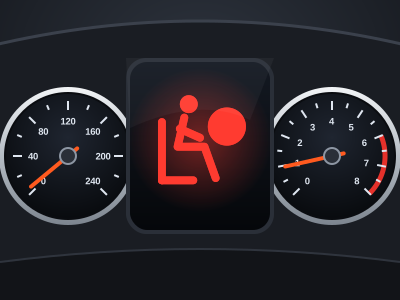
- AIt is perfectly safe because airbags only deploy in severe crashes
- BModern airbags detect child seats and do not deploy
- CIf the airbag deploys, it will strike the back of the child seat with enormous force, potentially killing the infant
- DRear-facing seats are only dangerous in the rear of the vehicle
Answer and explanation in the bank
- Q27Penalties and fines
A driver is caught travelling at a speed so far above the posted limit that it is classified as dangerous in Oman. What is the most serious possible consequence?
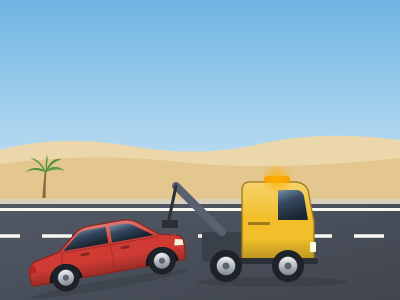
- AA warning notice with no financial penalty
- BA fine, vehicle impoundment and referral to the courts on criminal charges
- CA fine only, with no other consequences
- DLoss of licence for 30 days and nothing further
Answer and explanation in the bank
- Q28Heavy vehicle
Strong cross-winds pose a particular risk to which type of heavy vehicle?
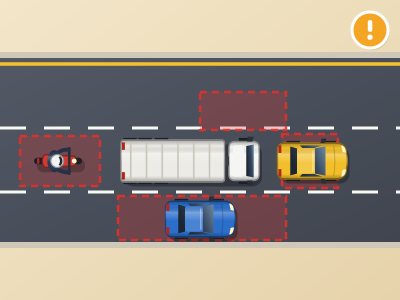
- ALow-loader trailers carrying construction machinery, because of their wide stance
- BHigh-sided vehicles such as curtainsiders, box trailers, and car transporters, especially when unladen
- CTanker trucks carrying liquids, because the liquid increases the sail area
- DFlatbed trucks, because the load is not enclosed and catches wind from below
Answer and explanation in the bank
- Q29Road signs and signals
What does this sign warn you about?
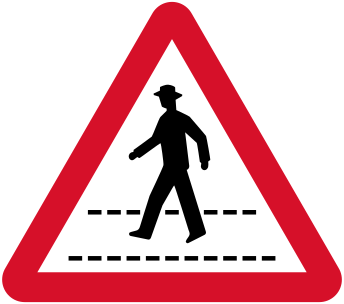
- AA pedestrian crossing is ahead
- BA school zone is ahead
- CPedestrians are not allowed on this road
- DA cycle crossing is ahead
Answer and explanation in the bank
- Q30Traffic rules
When should you use hazard warning lights while driving in Oman?
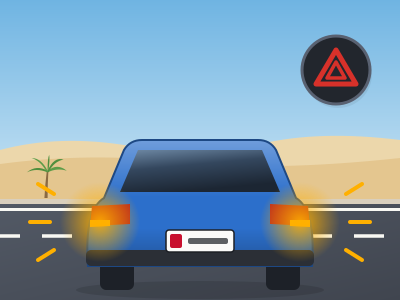
- AWhen the vehicle is stationary and causing an obstruction, or in a genuine emergency
- BTo signal to following traffic that you are turning
- CWhenever you are driving slowly in traffic
- DTo thank another driver for giving way
Answer and explanation in the bank
Every answer above, with the rule it comes from, plus the full 30-question timed test.
Get the Oman Driving Test Questions PDF (ROP) - OMR 3What this test covers
Topics include road signs, traffic signals, right of way, roundabouts, speed limits, seat belts, fines and penalties, and the safe-driving rules specific to your vehicle category. Full question-by-question feedback with explanations is shown immediately after you finish the test above.
Frequently asked questions
How many questions is the Al Buraimi Royal Oman Police truck & bus theory test?
The official Royal Oman Police truck & bus theory test in Al Buraimi has 30 questions and you need 23 correct (75%) to pass. This practice test has 30 questions.
Is this the real exam?
These are practice questions to help you revise, written to the published rules and to what candidates report from the real test. They are not the official Oman exam and the real question bank, format, fees and pass mark are set by the Royal Oman Police, and can change. Always confirm the current requirements with your driving school or the Royal Oman Police.
Is this practice test free?
The first 10 questions are free, with no signup, and each shows the answer and the reason. The full 30-question test, timed, is in the Oman Driving Test Questions PDF (ROP) (OMR 3, one payment), with every question in the bank.
What does the Al Buraimi truck & bus theory test cover?
Road signs, traffic signals, right of way, roundabouts, speed limits, seat belts, penalties and safe-driving rules, plus the handling and safety topics specific to your vehicle.