

General Department of Traffic (Moroor)
Saudi Arabia Driving Theory Test
Practice for the Saudi driving theory test (the computer-based knowledge test taken at approved driving schools such as Dallah and through the General Department of Traffic). Timed mock exams and topic tests with the answer and an explanation for every question, written from the public Saudi traffic rules and the standard GCC road signs.
- 35 questions · 22 to pass (63%)
- 30 minutes
- 13 wrong allowed
- English, Arabic, Urdu
First 10 questions of every test free, answer and reason shown. No signup. Road signs quiz
Try one now
From the Saudi bank · road signs
What does this sign mean?

Pick an answer to see the reason.
Every question in the bank is explained like this.
All 568 Saudi questions, SAR 19 →Reported format. This format, 35 questions with 22 correct to pass (about 63%) in about 30 minutes, is the one reported for the Dallah Driving School computer test by lifeinsaudiarabia.net and saudicomputertest.com; other prep sites give 20 to 32 questions, and Moroor publishes no official count or pass mark, so the format can vary by school. About 40% of the questions are sign recognition and 60% traffic rules.
Pass first time, not on the retake
PDF + onlineSaudi Driving Theory Test Questions PDF
Every question in the Saudi bank as timed mock exams at the Dallah computer-test length, topic drills, and a list of the questions you keep getting wrong, on your phone.
- Questions in the bank
- 568
- questions, all explained
- Real test
- 35 Q · 30m
- real test, 63% to pass
- Full exam papers
- 3 × 35
- full exam papers
- Timed online mocks at the 35-question length, marked against 63%
- Your weak topics tracked on your phone, no account
- The printable pack included: 3 full exam papers, plus all 485 questions by topic
A retake
SAR 115-500
The bank, once
SAR 19
SAR 19one payment, no subscription
3 full papers + 568 questions, timed mocks
Get the Saudi bankPractice questions written from the public rules, not the authority's own bank.
Choose your region
The theory test is run by each region’s own authority, so pick where you are testing. Every region gets its own branded practice with a distinct set of questions.
How to prepare in three steps
Pick your region
Choose where you are testing so the branding and questions match your licensing authority (General Dept. of Traffic).
Drill and mock
Warm up by topic with instant feedback, then sit a full timed mock exam just like the real test.
Review and retake
Read the explanation for every miss, then retake until you clear the pass mark comfortably.
Saudi driving test questions with answers
Practice questions with the answer and the reason, from the free sample of the same bank our Saudi tests run on. Four are about right of way, because the intersection and roundabout priority rule is the single biggest cause of failure for expatriate candidates; then come signs, overtaking, braking and Saher.
Right of way: the questions behind most failures
Many expatriate candidates arrive with a priority habit learned somewhere else, and the Saudi test asks the same rule from several directions until the habit shows.
You arrive at an unmarked crossroads at the same time as another vehicle coming from your right. Who has priority?
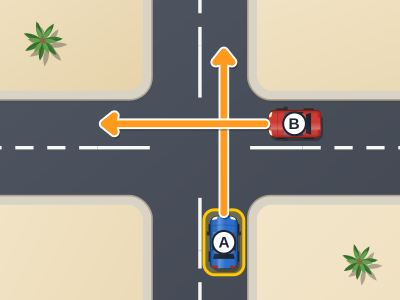
Pick an answer to see the reason.
At an unmarked equal junction, three vehicles arrive at the same time from the north, east, and west (there is no vehicle from the south). Under the give-way-to-the-right rule, which vehicle has priority to go first?
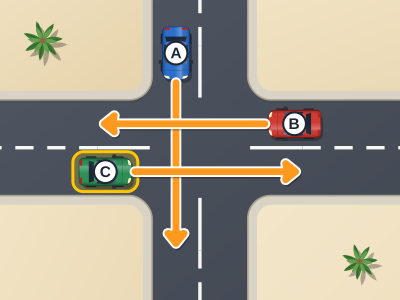
Pick an answer to see the reason.
At a three-lane roundabout you want to take the second exit (straight ahead). Which lane should you use?
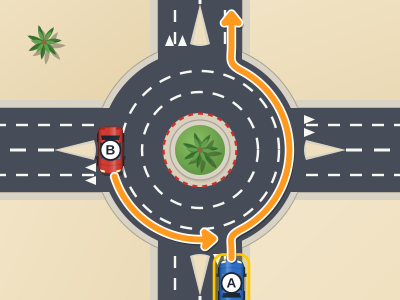
Pick an answer to see the reason.
You are turning left at a junction where a dedicated right-turn filter lane exists for oncoming traffic. The filter light is green for oncoming drivers. What should you do?
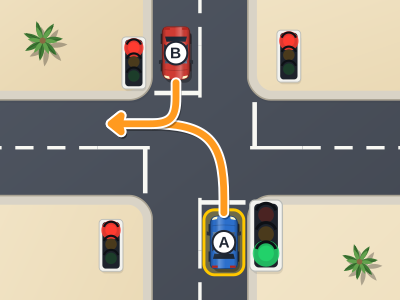
Pick an answer to see the reason.
The three-vehicle junction is the one people find hardest, and the most useful in the set. If three cars arrive together, apply the rule car by car: whoever has nobody on their right goes first. Draw it on paper once and it will never confuse you again.
The pattern behind all four: at an unmarked junction, the car on your right goes first; at a roundabout, the traffic already circulating goes first; and a green filter for someone else is a red light for you. Every right-of-way question on the paper is one of these rules wrapped in a scenario.
Road sign questions
Sign questions on the Saudi paper come from three families: warning signs (red triangles), regulatory signs (red and blue circles) and guide signs. These test the distinctions that matter.
How is this No Stopping sign stricter than a No Parking sign?

Pick an answer to see the reason.
What does this blue circular sign at a roundabout require of drivers?
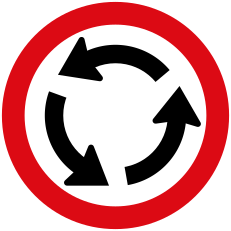
Pick an answer to see the reason.
Where would you most commonly see this warning sign in Saudi Arabia?
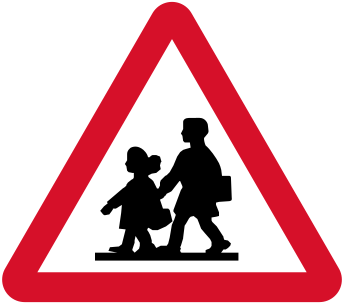
Pick an answer to see the reason.
What is the significance of this sign on a Saudi expressway?
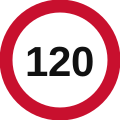
Pick an answer to see the reason.
The No Stopping question is the one to fix in your head. No Parking is one red bar and may allow a brief stop to drop off a passenger; No Stopping is two crossed bars and allows nothing. The test asks the difference directly, and it also shows up in scenario questions about dropping someone off.
Overtaking, braking and Saher
On a Saudi highway, when are you allowed to overtake on the right side of another vehicle?
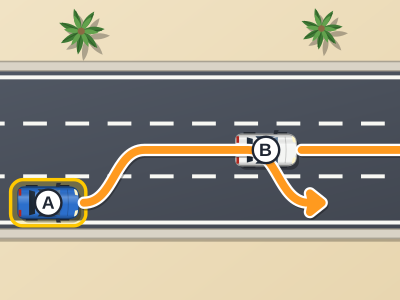
Pick an answer to see the reason.
How does braking distance change when you double your speed from 60 km/h to 120 km/h?
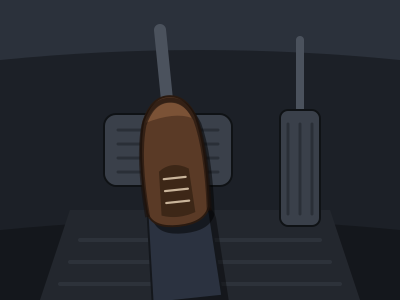
Pick an answer to see the reason.
A Saher camera captures a speeding violation. How does the registered vehicle owner typically find out about the fine and pay it?

Pick an answer to see the reason.
Penalty questions on the Saudi paper lean on how the system works - Saher cameras, Absher, licence and registration validity - more than on memorising amounts. Our Saudi traffic fines check guide covers how fines are recorded and paid, which is also what the test expects you to know.
These come from the free sample. Get all 568 Saudi questions in the online bank · SAR 19 →
35, 30 or 20 questions? The Saudi format dispute
The Saudi theory test is a computer-based multiple-choice test set to the Moroor standard and taken at Dallah or another approved driving school or digital test centre. It is the most inconsistently reported theory test in the Gulf:
| What you need to know | The figure | How sure it is |
|---|---|---|
| Questions | 35, multiple choice | Our published figure; other sites give 20 or 30 |
| Pass mark | 26 of 35 (75%) | Other sites give 17 of 20, 21 of 30 and 22 of 35 |
| Time | 30 minutes | Our published figure |
| Languages | English, Arabic and Urdu | Confirm at your test centre |
| Where | On computer at Dallah or an equivalent approved school or test centre | Booked through Absher or the school |
| Fee | Reported from SAR 115 to SAR 500, depending on what the figure includes | drivingtestksa.com and autoviatest.com, October 2026 |
| After a fail | The full fee again; about a two-week wait, per one source | autoviatest.com, October 2026 |
| Reported format | Pass mark | Mistakes allowed |
|---|---|---|
| 35 questions, 26 to pass (our published figure) | 75% | 9 |
| 35 questions, 22 to pass | about 63% | 13 |
| 30 questions, 21 to pass | 70% | 9 |
| 20 questions, 17 to pass | 85% | 3 |
Disputed format. Our own licence notes record that the test has historically had around 30 questions and a pass mark in the 75-80% range, and that Moroor can revise both. We publish 35 and 26, verified July 2026, and you should confirm the format for your file on Absher or with your school.
The practical answer: prepare to clear 80% or better on full timed papers. That passes every version above except the 17-of-20 one, and if you are scoring 85% you pass that too. Preparing for the strictest version costs you a few more days; preparing for the most lenient one can cost you a retest fee and a two-week wait.
What the Saudi computer test covers
The test covers Saudi traffic law, road signs and markings, speed limits, right of way, vehicle safety and penalties. Our bank is built in the same shape; these are the car (light vehicle) counts, read straight from the bank:
| Topic | Questions in our bank | What it tests | Free practice |
|---|---|---|---|
| Road signs and signals | 65 | Warning, regulatory and guide signs | Road signs test 1 |
| Traffic rules | 70 | Lanes, overtaking, U-turns, lights, indicators | Road rules test 1 |
| Right of way | 70 | Junctions, roundabouts, emergency vehicles, pedestrians | Right of way test |
| Safe driving | 70 | Distance, braking, heat, sand, mirrors | Safe driving test |
| Penalties and fines | 70 | Saher, licences, registration, phones, seatbelts | Fines and violations test |
Right of way carries more weight in the Saudi bank than in most of the region, because it is where most candidates go wrong. Riders and heavy-vehicle drivers start with the shared material, then the motorcycle tests or the truck and bus tests.
A two-week plan for the Saudi computer test
| Days | Focus | Practise with |
|---|---|---|
| 1-3 | Right of way until every scenario is automatic | Right of way test |
| 4-6 | Signs: warning, regulatory and guide families | Road signs test 1 |
| 7-8 | Rules: lanes, overtaking, U-turns, lights | Road rules test 1 |
| 9 | Safe driving: distance, braking, heat and sand | Safe driving test |
| 10 | Penalties and Saher | Fines and violations test |
| 11-14 | Full timed papers, then your wrong answers only | Mock test 1 and mock test 2 |
Right of way goes first, not last, because it is where most candidates fail and because it takes longest to make automatic. Book when you clear 80% on full timed papers twice in a row; that covers every reported version of the format except the strictest, and gives you margin on the day.
Choose your language when you book. Sitting the test in your strongest of English, Arabic and Urdu removes a whole category of avoidable mistakes. If you have been preparing in English but will sit in Urdu, practise a few papers in English anyway: the signs and rules are the same, and you will know the terms either way.
Saudi theory test fee and what a fail costs
The Saudi fee is reported across a four-fold range, and the reason is definitions rather than disagreement:
| Figure you will see | What it is described as |
|---|---|
| SAR 115 | The computer test fee on its own |
| SAR 200-400 | Test plus licence |
| SAR 500 | An application fee |
Sources: drivingtestksa.com and autoviatest.com, October 2026. Your school will give you the figure that applies to your file.
On a fail, no reduced retest rate has been reported: you pay the full fee again. One source (autoviatest.com, October 2026) describes a wait of around two weeks before a retake, and no source gives a firm limit on attempts. Three attempts at the reported rates come to SAR 345-1,500, plus six weeks you did not plan for.
Is there a Saudi computer test questions PDF?
- "Leaked" or "official" banks. Moroor does not publish its live question bank. A file claiming to be the real Dallah paper is not.
- School study material. Approved schools provide traffic-law materials, and the Moroor and Elm platforms carry official information. Use what your school gives you.
- Free lists online. Usually undated and unexplained, and often written for a different format from the one you will sit.
Before you pay a school, check whether you need the test at all: Saudi Arabia lets holders of licences from a list of countries exchange them without the full training and test programme, and the list changes. Run yours through the driving licence conversion checker and see the Saudi driving licence guide. Booking runs through Absher; our Absher registration guide walks through setting up the account.
How to get your Saudi Arabia driving licence
Obtaining a light-vehicle driving licence in Saudi Arabia is governed by the General Department of Traffic (Moroor) under the Ministry of Interior. The journey for a first-time applicant (Saudi national or resident holding an Iqama) typically involves a medical and eye examination, enrolment at a Moroor-approved driving school, a digital theory (knowledge) test, mandatory practical training hours, and a road test. Appointments at most stages are booked through the Absher e-government platform (absher.sa) or the driving school's own portal. Requirements, fees, and procedures are subject to change; always confirm the current requirements with the General Department of Traffic (Moroor) via Absher before proceeding.
The step‑by‑step journey
- 1
Book via Absher and prepare documents
Create or log in to your Absher Individual account (absher.sa or the Absher mobile app). Navigate to 'Traffic Services' to locate driving-licence services and, where available, book a Moroor appointment or a slot at an approved driving school. Saudi nationals and Iqama holders may use the platform; verify current eligibility rules with Moroor. Gather all required documents before attending any appointment. Confirm the current requirements with the General Department of Traffic (Moroor) via Absher.
- 2
Medical and eye examination
Attend a Moroor-approved medical centre (often an Efada-linked or Ministry of Health-approved clinic) to obtain a medical fitness certificate. The examination typically includes a vision (eye) acuity test, colour-vision screening, blood-group determination, and a general health check. The certificate is usually issued on the day if you pass. Some driving schools can direct you to approved clinics near their premises. Confirm which clinics are currently recognised, as the approved-provider list is periodically updated by Moroor.
- 3
Open a file at a Moroor-approved driving school
Visit a Moroor-approved driving school -- prominent examples include Dallah Driving School (multiple branches in Riyadh), and schools operated by or linked to Elm in various cities. Submit your documents, pay the school registration fee, and have your file opened in the Moroor system. The school will assign you to theory and practical training tracks. Confirm current school availability in your city (Riyadh, Jeddah, Dammam/Eastern Province, Madinah, etc.) via the Moroor or Absher portals.
- 4
Theory (knowledge) test
The theory test is a computer-based multiple-choice examination administered at the driving school or a Moroor-approved digital test centre. Questions cover Saudi traffic laws, road signs, safe-driving principles, and driving etiquette. The number of questions and the passing mark are set by Moroor and vary by school and region; the most specific reports, for the Dallah computer test, give 35 questions with 22 correct needed in about 30 minutes, while other sources give 20 to 32 questions, so check the format with your driving school. The test is offered in many languages -- Arabic, English, Urdu, Hindi, Bengali, and Tagalog are commonly reported -- so verify current language options with the test centre. If you fail, a waiting period applies before a re-sit; confirm retake rules with Moroor.
- 5
Mandatory practical training hours
After (or alongside) the theory test, many schools give an initial internal assessment or trial drive, then assign in-car training hours with a licensed instructor based on your demonstrated ability. The required hours vary by prior experience and by school. At Dallah in Riyadh, for example, applicants are commonly categorised into tiers such as roughly 6 hours (passes the trial test), around 12 hours (intermediate ability), or around 30 hours (beginner) -- other schools use different thresholds. Holders of a valid foreign licence from a recognised country may qualify for a reduced programme, and GCC-licence conversions may follow a different pathway. Your driving school will confirm the exact hours assigned to your profile. Confirm the current mandatory minimums with the General Department of Traffic (Moroor) via Absher, as these figures are subject to revision.
- 6
Practical road test
Once your training hours are logged and approved, the driving school schedules your practical road test with a Moroor examiner. The test typically includes a manoeuvring yard section (e.g. parking, three-point turn, hill start) and an on-road driving section assessed against Saudi traffic regulations. Common reasons for failure include: failure to check mirrors adequately, improper lane discipline, not yielding correctly at junctions, excessive hesitation, or committing a traffic violation during the test. The number of permitted attempts and the waiting period between attempts are determined by Moroor -- confirm these with your driving school and Moroor before the test.
- 7
Licence issuance and printing
Upon passing the road test, the Moroor system records the result and the licence can be printed. In many cases the card is printed at the Moroor office or via an approved printing point the same day or within a short period. The licence is typically a smart-card format. Moroor commonly offers multiple validity periods (for example 5-year or 10-year options) at different government fees; the exact durations and charges are set by Moroor and may change. Confirm the collection process, any outstanding fees, and validity period with the issuing office. You can also check licence status via Absher.
What to bring: documents checklist
- Iqama (residence permit) -- for non-Saudi residents; must be valid
- Saudi National ID (for Saudi nationals)
- Valid passport
- Medical fitness certificate from a Moroor-approved clinic (including eye test result)
- Recent passport-size photographs, white background (number and specification as required by the driving school or Moroor -- confirm current requirements)
- Sponsor or employer letter (may be required for certain categories of Iqama holders -- confirm with Moroor)
- Original foreign driving licence (if applicable, for conversion or reduced-hours track)
- Certified translation of foreign driving licence (if not in Arabic or English -- confirm requirement with Moroor)
- Driving school registration form and fees receipt
- Absher-generated appointment confirmation (where applicable)
Each stage in detail
Eye test
The eye test is part of the mandatory medical examination conducted at a Moroor-approved medical centre. It typically assesses minimum visual acuity (sharpness of vision), colour vision (ability to distinguish traffic-signal colours), and sometimes field of vision. If you wear glasses or contact lenses, bring them to the appointment; if you pass only with correction, this will be noted on your licence as a condition. Specific minimum acuity thresholds are set by Moroor and may be updated; confirm the current standards with the medical centre or Moroor before your appointment.
Theory (knowledge) test
The Saudi driving theory (knowledge) test is a computer-based, multiple-choice examination conducted at digital test centres operated by Elm or other Moroor-approved providers. It covers Saudi traffic laws, road signs and markings, speed limits, right-of-way rules, vehicle safety, and responsible driving behaviour. Historically the test has comprised approximately 30 questions and required a passing score in the range of 75 to 80 percent, but Moroor may revise the question count and pass mark -- confirm the current format with your driving school or Moroor before sitting the test. The test is offered in Arabic and English and may be available in additional languages including Urdu; verify current language availability with the test centre. A digital result is issued immediately. If you fail, a waiting period is required before a re-sit -- confirm retake policies with Moroor. Confirm the current requirements with the General Department of Traffic (Moroor) via Absher.
Road test
The practical road test is conducted by or under the supervision of a Moroor traffic examiner, typically arranged through your driving school. It is usually divided into two parts: a controlled manoeuvres section in a yard or car park (which may include reverse parking, parallel parking, a three-point turn, and a hill or slope start) and an on-road driving section on public roads near the test centre. Examiners assess adherence to Saudi traffic law, mirror and observation habits, smooth vehicle control, lane discipline, correct signalling, speed management, and response to road signs and signals. Common reasons for failure reported by candidates include: insufficient mirror checks before manoeuvres, poor lane positioning, failure to yield at junctions or roundabouts, braking too sharply or too late, driving too slowly or too fast for conditions, and committing any moving traffic violation. A serious or dangerous error typically results in immediate termination of the test. The number of attempts permitted and the waiting period between attempts are defined by Moroor; confirm these rules with your driving school and via Absher.
Converting a foreign licence
Saudi Arabia permits holders of driving licences from a defined list of countries (reported by various guides as roughly 40 to 50 countries, but not officially fixed) to exchange their licence for a Saudi one without completing the full training and testing programme. The exact eligibility criteria and the list of recognised countries are set by Moroor and are subject to change. As a general guide: holders of driving licences issued by other GCC member states are commonly eligible for a direct exchange or simplified process. Holders of licences from certain other countries (often cited as including the USA, UK, most EU states, Canada, Australia, New Zealand, Japan, and South Korea) have historically been able to convert with a reduced or waived practical training requirement, but this varies by nationality and licence type and the list changes. The conversion process generally involves presenting the original valid foreign licence, a certified translation if required, your Iqama or national ID, passport, and medical/eye test certificate. An administrative fee applies. Critically, the list of eligible countries and the specific exchange conditions change periodically; do not assume eligibility based on older guidance. Confirm the current requirements with the General Department of Traffic (Moroor) via Absher before submitting any documents.
How to book
The primary booking channel for Moroor services is the Absher e-government platform, accessible via absher.sa or the official Absher mobile application (available for iOS and Android). After logging in with your Absher Individual account, navigate to 'Traffic Services' or 'Driving Licence Services' to find available appointment slots at Moroor offices or linked test centres. Approved driving schools such as Dallah Driving School (Riyadh) and others also have their own online booking systems and may accept walk-in enrolments at some branches; check the school's website or call their customer service line directly. For Elm-administered theory tests, slots may be booked through the Elm platform (elm.sa) or via the driving school's coordination. If Absher slots are fully booked, check regularly as cancellations open new slots, or ask your driving school to assist with booking on your behalf.
Fees
Fees across the Saudi driving licence process are set by Moroor and the individual driving schools and are subject to periodic revision. As a general guide only: the medical examination fee at an approved clinic is typically in the range of SAR 50 to SAR 200; driving school registration and the full training package (theory plus practical hours) can range broadly from several hundred SAR to over SAR 2,000 depending on the school, the city, the number of training hours required, and whether package deals are offered; the theory test fee and the practical test fee are set by the provider and Moroor; and the licence printing/issuance fee is a Moroor-set government charge. Foreign licence conversion fees differ from the full programme fees. All figures are indicative ranges only and may not reflect current pricing. Confirm all current fees with the General Department of Traffic (Moroor) via Absher and directly with your chosen driving school before committing.
Typical timeline
The total time from starting the process to holding a Saudi driving licence varies considerably based on appointment availability, how quickly you pass each stage, and your prior driving experience. As a rough guide: candidates with no prior driving experience who must complete the maximum training hours may take anywhere from two to six months or longer, depending on how frequently they can attend lessons and how quickly they pass the theory and road tests. Candidates converting a qualifying foreign licence may complete the process in a matter of weeks if all appointments are available promptly. Peak periods (school holidays, religious calendar periods such as Ramadan) can extend waiting times for Moroor appointments and test slots. These are indicative estimates only; confirm expected timelines with your chosen driving school and via Absher when booking.
Tips to pass
- Create your Absher Individual account well before you need it; some services require a verified Saudi mobile number linked to your Iqama, which can take time to set up.
- Book your medical appointment early -- it is usually the first practical step and approved clinics can get busy, particularly at the start of a week or month.
- Study the official Saudi traffic-law materials provided by your driving school or available via the Moroor and Elm platforms; the theory test questions are drawn from these official sources.
- Attend driving lessons consistently and communicate with your instructor about any manoeuvres you find difficult before the road test -- instructors at approved schools are familiar with the test route and examiner expectations.
- Keep certified copies of all your documents (Iqama, passport, medical certificate, foreign licence if applicable) in a folder; you will be asked to present them at multiple stages.
- Check Absher regularly for appointment slots, especially if the first attempt shows no availability -- slots open up as other applicants cancel or reschedule, and early morning or mid-week slots tend to become available more quickly.
Passing the Saudi Arabia theory test
The Saudi Arabia theory (knowledge) test is 35 multiple-choice questions with a 63% pass mark, so you need 22 correct answers. This format, 35 questions with 22 correct to pass (about 63%) in about 30 minutes, is the one reported for the Dallah Driving School computer test by lifeinsaudiarabia.net and saudicomputertest.com; other prep sites give 20 to 32 questions, and Moroor publishes no official count or pass mark, so the format can vary by school. About 40% of the questions are sign recognition and 60% traffic rules. It is administered by each region’s own authority, so where you test matters. Start with road signs and signals, then move on to right of way, roundabouts, speed limits and penalties, and finish with full timed mock exams so the 30-minute format feels familiar on the day.
Every question here comes with the correct answer and a short explanation drawn from the public traffic rules, so you learn the reasoning rather than memorising answers. Pick your region above to get practice matched to your licensing authority.
Other GCC countries
Testing elsewhere in the Gulf? Practise for another country’s theory test.
Saudi Arabia driving test guides
Saudi Arabia theory test FAQs
The Saudi Arabia light-vehicle theory test has 35 multiple-choice questions and you need 22 correct to pass, which is 63%. You get about 30 minutes to complete it. The question count and pass mark can vary by region and by vehicle class, so confirm the details with your region's authority. This format, 35 questions with 22 correct to pass (about 63%) in about 30 minutes, is the one reported for the Dallah Driving School computer test by lifeinsaudiarabia.net and saudicomputertest.com; other prep sites give 20 to 32 questions, and Moroor publishes no official count or pass mark, so the format can vary by school. About 40% of the questions are sign recognition and 60% traffic rules.
You need 63% to pass, which is 22 of 35 questions correct. Our mock exams score you against the same 63% pass mark so you always know where you stand before the real test.
The Saudi Arabia theory test is commonly available in English, Arabic and Urdu. Exact language and interpretation options are set by the licensing authority, so confirm what is offered at your test centre when you book.
The theory test is run by each region's own authority: Riyadh (General Dept. of Traffic), Makkah (General Dept. of Traffic), Madinah (General Dept. of Traffic), Eastern Province (General Dept. of Traffic), Asir (General Dept. of Traffic), Qassim (General Dept. of Traffic), Hail (General Dept. of Traffic), Tabuk (General Dept. of Traffic), Jazan (General Dept. of Traffic), Najran (General Dept. of Traffic), Al Bahah (General Dept. of Traffic), Al Jouf (General Dept. of Traffic) and Northern Borders (General Dept. of Traffic). Choose your region above to get practice matched to that authority's branding, question count and pass mark.
Fees are set by the region's authority and approved driving schools and can change, so we do not quote a fixed price. In most cases you register with an approved driving school or the traffic department, complete the required lectures, then sit the theory (knowledge) test at an approved centre. Always confirm the current fee and steps with your driving school or the authority before booking.
The first 10 questions of every Saudi Arabia mock exam and topic test are free, with no account or signup, and each shows the answer and the reason. The full tests, timed at the real length and marked against the pass mark, are in the Saudi Arabia question bank, for one payment.
Multiple-choice questions on Saudi traffic law, road signs and markings (warning, regulatory and guide), speed limits, right of way at junctions and roundabouts, safe driving, and penalties including Saher cameras, licence and registration validity.
The content is standard, but right of way trips up many expatriate candidates because they bring a priority habit from home. If you can answer unmarked-junction and roundabout scenarios without hesitating, the rest of the paper is mostly recognition.
Moroor does not publish its live question bank, so any file claiming to be the official paper is not. This page has practice questions with answers and reasons, every Wathim practice test shows its first 10 questions free, and the Saudi pack is the full bank as a printable PDF with explanations, for one payment.
You pay the full fee again; no reduced retest rate has been reported. One source describes a wait of around two weeks before you can retake, and no source gives a firm limit on attempts. Moroor sets both.
Yes. We publish 35 questions with 26 needed to pass, a 75% pass mark, in 30 minutes, verified July 2026. Other sites give 17 of 20, 21 of 30 and 22 of 35 for the same exam, and Moroor can revise the format. Confirm on Absher or with your driving school, and prepare to score 80% or better.
The vehicle coming from your right. If several vehicles arrive together, the one with no vehicle on its right goes first, and the others follow the same rule in turn. At a roundabout, traffic already circulating has priority.
No. The live bank is not published. These are original practice questions written to the same format and syllabus, from the public Saudi traffic rules and the standard GCC road signs.
Ready for the real licence?
Practise here, then let Wathim handle the paperwork. We manage Saudi Arabia driving-licence issuance, transfer and conversion for expats, end to end.