

Northern Borders General Dept. of Traffic Light vehicle
Practice mode· Right of way & safetyNorthern Borders General Dept. of Traffic - Saudi Right of Way Practice Test
Tests your understanding of priority rules: unmarked junctions, roundabouts, emergency vehicles, merging lanes and more. Getting right of way right can prevent serious accidents.
Two lanes of traffic merge into one due to roadworks. What is the correct zip-merge behaviour?
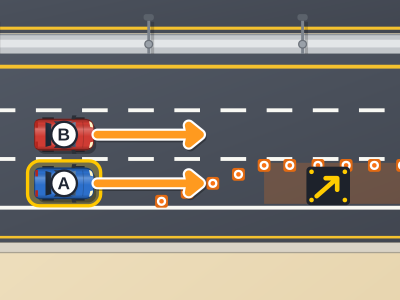
The other 12 questions in this test
Read them all. The answer and the reason for each, and the timed 22-question run, are in the Saudi Driving Theory Online Practice Bank.
- Q11Right of way
You are in a convoy of civilian vehicles and an emergency vehicle with sirens approaches from behind the convoy. What should every convoy driver do?
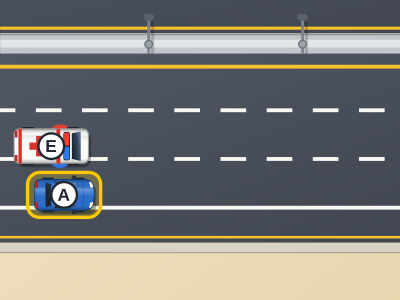
- AOnly the last vehicle in the convoy needs to move aside
- BEach driver in the convoy must independently make way for the emergency vehicle
- CThe convoy leader decides and signals other drivers
- DThe convoy continues; the emergency vehicle will find a way around
Answer and explanation in the bank
- Q12Right of way
A pedestrian steps off the pavement between parked cars at a point that is not a crossing. Who is at fault if a collision occurs?
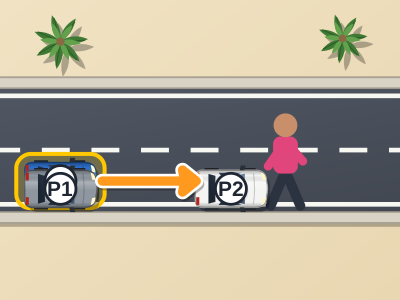
- AAlways the driver, because pedestrians always have right of way
- BAlways the pedestrian, because crossing outside a crossing is illegal
- CNeither party; it is an unavoidable accident
- DPrimarily the pedestrian, but the driver also has a duty to anticipate hazards and may share responsibility
Answer and explanation in the bank
- Q13Right of way
A large truck is navigating a roundabout and its rear swings wide into the outer lane due to its length. What should you do if you are in the outer lane alongside it?
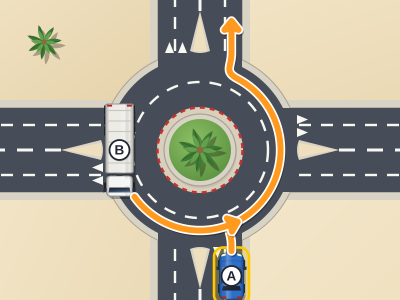
- AGive way to the truck; drop back to avoid being in its blind spot and swing path
- BHold your position; the truck must not cross your lane
- CAccelerate to pass the truck before it swings
- DSound your horn to warn the truck driver and proceed normally
Answer and explanation in the bank
- Q14Right of way
An emergency vehicle is parked on the hard shoulder with its warning lights flashing. You are in the lane nearest the hard shoulder. What should you do?
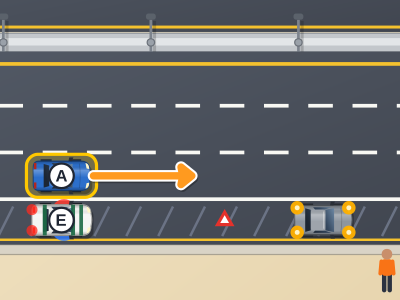
- AMaintain your speed and position
- BMove to a lane further from the hard shoulder if safe to do so, or slow down significantly
- CSpeed up to pass the stationary vehicle quickly
- DStop on the hard shoulder behind the emergency vehicle
Answer and explanation in the bank
- Q15Right of way
You are in the closing lane of a two-to-one merge caused by a lane drop. The lane next to you is the continuing lane. What is the correct zip-merge behaviour?
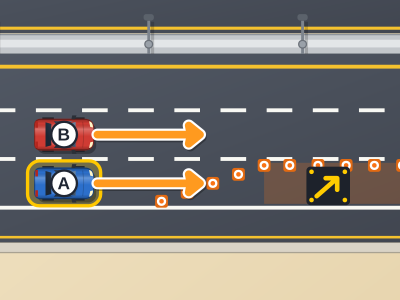
- AImmediately move to the continuing lane as soon as you see the signs
- BStop in your lane and wait for the continuing lane to clear completely
- CContinue to the merge point and then alternate with traffic in the continuing lane
- DAccelerate past as many vehicles as possible before the merge point
Answer and explanation in the bank
- Q16Right of way
You are leaving a private road and joining a public road. There is no GIVE WAY or STOP sign. Who has priority?
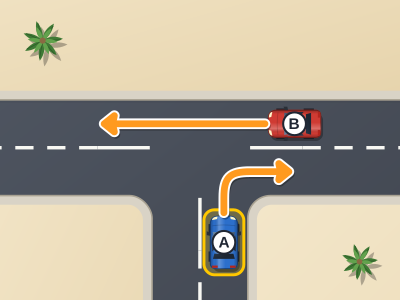
- AYou have priority because you are joining the road
- BTraffic already on the public road has priority
- CRight-hand priority applies so give way to traffic from your right only
- DBoth vehicles must stop and negotiate
Answer and explanation in the bank
- Q17Right of way
At a Y-junction a GIVE WAY line is marked across the branch you are on. The other branch has no marking. What does this mean?
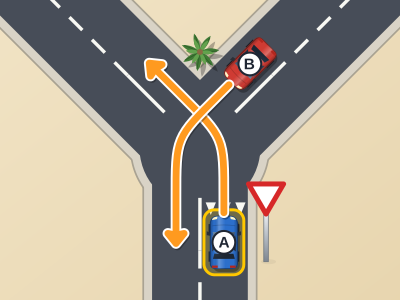
- AYou must give way to traffic on the other branch
- BYou and the other branch share equal priority
- CThe GIVE WAY line applies to both branches equally
- DYou only give way if a vehicle is already in the junction
Answer and explanation in the bank
- Q18Right of way
You are on a motorway and need to take the next exit. You are in lane 3, the leftmost (fast) lane. When should you start moving towards the exit?
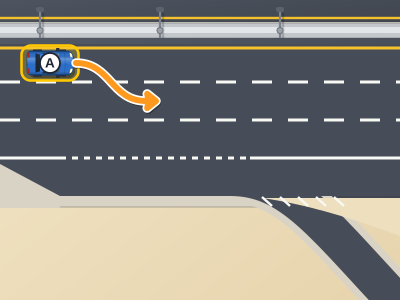
- ABegin moving right well in advance, lane by lane, giving way to traffic in each lane
- BSignal and move right all at once when you see the exit sign
- CContinue in lane 3 until the last moment, then cut across all lanes
- DOnly vehicles in lane 1 (the rightmost lane) may use exits; move when safe
Answer and explanation in the bank
- Q19Right of way
You are at a pelican crossing and the amber light is flashing. A pedestrian has just stepped onto the crossing. What must you do?
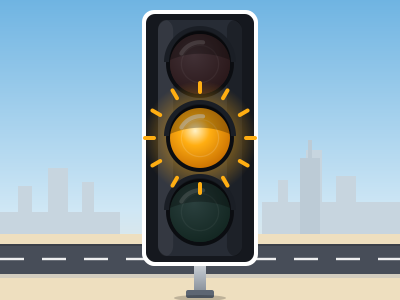
- AContinue because the amber phase means pedestrians should wait
- BGive way to the pedestrian already on the crossing
- CSound your horn to warn the pedestrian to hurry
- DStop and wait for the green light before proceeding
Answer and explanation in the bank
- Q20Right of way
A level crossing has two sets of tracks side by side. The barriers rise after the first train passes. Can you cross immediately?
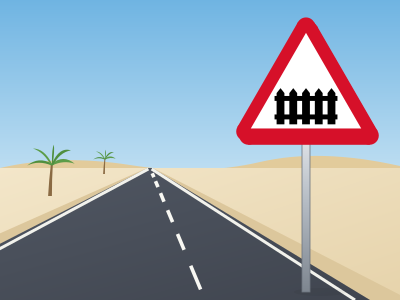
- ANo; check both tracks carefully before crossing because a second train may be on the adjacent track
- BYes, rising barriers mean it is safe to cross
- CYes, but only proceed at walking speed
- DYes, because the barrier system prevents two trains passing simultaneously
Answer and explanation in the bank
- Q21Right of way
You meet an oncoming lorry on a narrow road with a steep drop on your side. The lorry is partially on your side. What should you do?
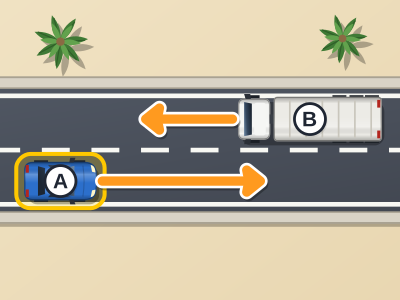
- ASound your horn and hold your position; the lorry must move back
- BAccelerate past the lorry before it can move further into your lane
- CSlow down, stay as far to the right as safely possible, and communicate calmly to find a solution
- DReverse at speed to the nearest junction
Answer and explanation in the bank
- Q22Right of way
A cyclist approaches a roundabout and continues to ride around it rather than dismounting. Who has priority between the cyclist inside the roundabout and a car trying to enter?
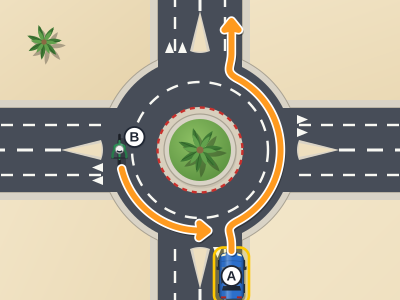
- AThe car entering the roundabout has priority because it is heavier
- BThe cyclist already in the roundabout has priority as circulating traffic
- CBoth have equal priority and must negotiate
- DThe car has priority because cyclists should dismount at roundabouts
Answer and explanation in the bank
Every answer above, with the rule it comes from, plus the full 22-question timed test.
Get the Saudi Driving Theory Online Practice Bank - SAR 39What this test covers
Topics include road signs, traffic signals, right of way, roundabouts, speed limits, seat belts, fines and penalties, and the safe-driving rules specific to your vehicle category. Full question-by-question feedback with explanations is shown immediately after you finish the test above.
Frequently asked questions
How many questions is the Northern Borders General Dept. of Traffic light vehicle theory test?
The official General Dept. of Traffic light vehicle theory test in Northern Borders has 35 questions and you need 22 correct (63%) to pass. This practice test has 22 questions.
Is this the real exam?
These are practice questions to help you revise, written to the published rules and to what candidates report from the real test. They are not the official Saudi exam and the real question bank, format, fees and pass mark are set by the General Department of Traffic (Moroor) and the driving schools, and can change. Always confirm the current requirements with your driving school or the traffic department.
Is this practice test free?
The first 10 questions are free, with no signup, and each shows the answer and the reason. The full 22-question test, timed, is in the Saudi Driving Theory Online Practice Bank (SAR 39, one payment), with every question in the bank.
What does the Northern Borders light vehicle theory test cover?
Road signs, traffic signals, right of way, roundabouts, speed limits, seat belts, penalties and safe-driving rules, plus the handling and safety topics specific to your vehicle.