

Qassim General Dept. of Traffic Light vehicle
Practice mode· Right of way & safetyQassim General Dept. of Traffic - Saudi Right of Way Practice Test
Tests your understanding of priority rules: unmarked junctions, roundabouts, emergency vehicles, merging lanes and more. Getting right of way right can prevent serious accidents.
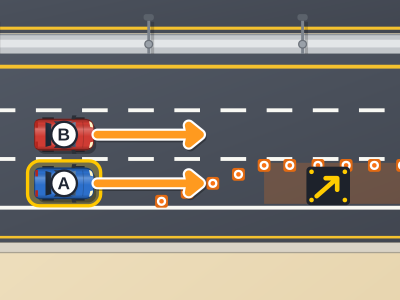
Two lanes of traffic merge into one due to roadworks. What is the correct zip-merge behaviour?
The other 12 questions in this test
Read them all. The answer and the reason for each, and the timed 22-question run, are in the Saudi Driving Theory Online Practice Bank.
- Q11Right of way
You are about to enter an unmarked crossroads from the south. A vehicle is approaching from the east and another from the north. Which vehicle do you give way to?
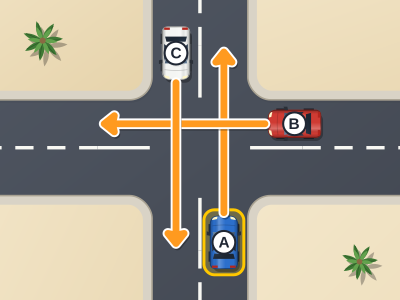
- AOnly the vehicle from the east, as it is on your right
- BOnly the vehicle from the north, as it is on your left
- CThe vehicle from the east, because it is on your right; the vehicle from the north has you on its right so it gives way to you
- DBoth vehicles, because you arrived last
Answer and explanation in the bank
- Q12Right of way
A GIVE WAY sign is posted at a roundabout entry. A vehicle is already circulating. What must you do?
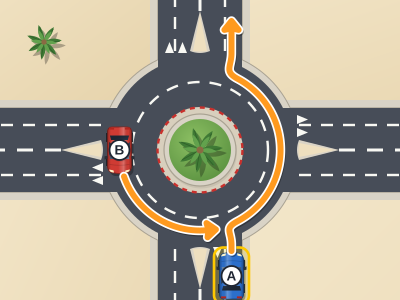
- AEnter and let the circulating vehicle adjust
- BFlash your headlights to indicate your intention to enter
- CGive way only if the circulating vehicle is to your right
- DStop or slow until the circulating vehicle has passed, then enter safely
Answer and explanation in the bank
- Q13Right of way
You wish to turn left across oncoming traffic. How large a gap in oncoming traffic do you need?
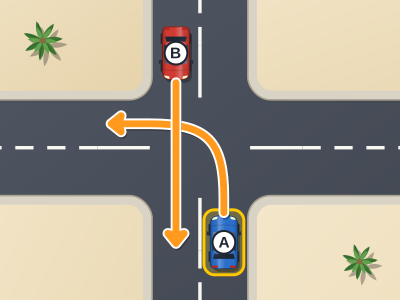
- AA gap just large enough to complete the turn without braking
- BAny gap; the oncoming traffic must brake if needed once you have begun turning
- CA gap of exactly 4 seconds at the speed limit
- DA gap large enough to turn comfortably with a margin of safety for an unexpected delay
Answer and explanation in the bank
- Q14Right of way
A dedicated left-turn slip lane at a junction has its own set of traffic lights showing green. The main junction lights show red. Can you use the slip lane?
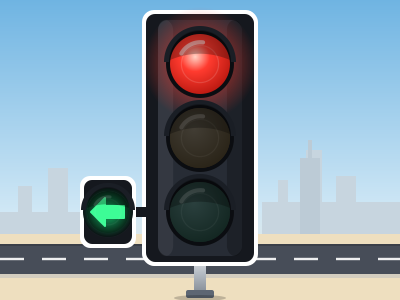
- ANo; you must wait for the main junction lights to turn green
- BYes; the slip lane has no signals so you follow your own judgement
- CNo; slip lanes are only for emergency vehicles
- DYes; a green light on the slip lane means you may proceed, but give way to pedestrians crossing
Answer and explanation in the bank
- Q15Right of way
A bus lane is operational and you are joining it briefly to reach a left-turn exit. Who has priority in that lane?
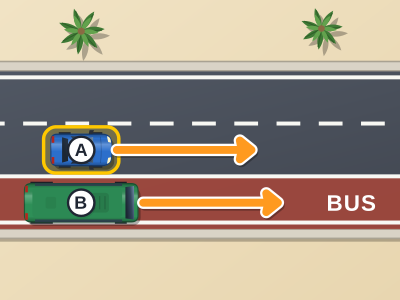
- AYou have priority because you are turning
- BBuses and other authorised vehicles in the lane have priority over you
- CYou share equal priority with buses in the lane
- DNo one has priority in a bus lane
Answer and explanation in the bank
- Q16Right of way
At a T-junction you are travelling straight along the top of the T. A vehicle from the base of the T wants to turn right into your road, crossing your path. Who has priority?
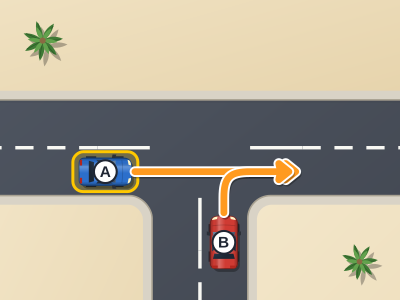
- AThe turning vehicle has priority because it is on a major road
- BYou have priority; the vehicle from the minor road must wait for you
- CBoth vehicles have equal priority
- DThe vehicle to your right has priority by default
Answer and explanation in the bank
- Q17Right of way
On a two-lane one-way street, the vehicle ahead of you in the left lane signals to turn left into a side road. How should you pass it?
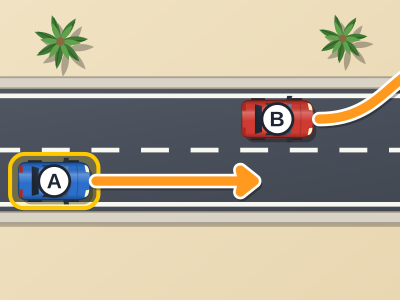
- AOn its left, between it and the kerb
- BSound your horn so it lets you through on either side
- CYou may never pass a vehicle that is turning
- DOn its right, once it is safe
Answer and explanation in the bank
- Q18Right of way
You want to change from the right lane to the middle lane on a motorway. A vehicle in the middle lane is overtaking you at speed. What should you do?
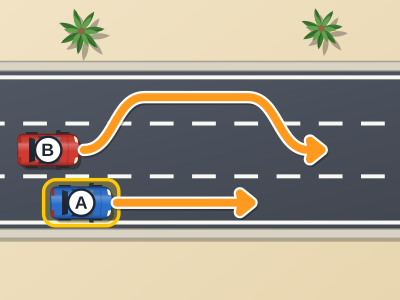
- AWait until the overtaking vehicle has passed before moving
- BMove into the middle lane because you were there first
- CSpeed up so the overtaking vehicle must hold back
- DSound your horn and move left to block the overtaking vehicle
Answer and explanation in the bank
- Q19Right of way
You reach a STOP sign but can clearly see the road is empty in both directions. Must you still stop completely?
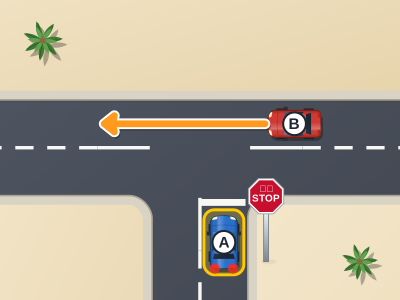
- ANo; you may proceed at reduced speed if the road is obviously clear
- BOnly if there is a white stop line on the road
- CYes; a STOP sign always requires a complete stop regardless of visibility
- DYou may slow to 10 km/h instead of stopping if conditions permit
Answer and explanation in the bank
- Q20Right of way
All four traffic signals at a crossroads have failed and show nothing. Four vehicles arrive simultaneously. How should they proceed?
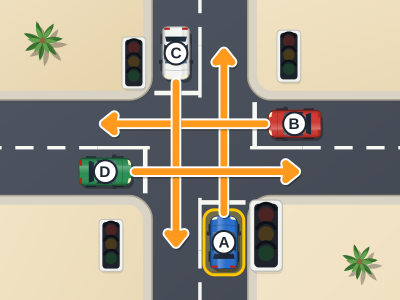
- AThe vehicle on the widest road goes first
- BEach driver applies right-hand priority in turn, treating it as an unmarked junction
- CAll four vehicles must wait until a police officer arrives
- DThe vehicle that arrived first has absolute priority
Answer and explanation in the bank
- Q21Right of way
You are waiting at a level crossing when you hear a second train coming after the first has passed. The barriers remain down. What must you do?
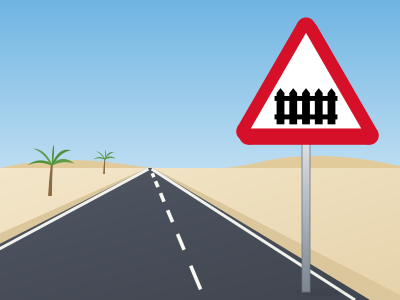
- AProceed as soon as the first train has cleared the crossing
- BCheck both directions and cross quickly between trains
- CSound your horn to alert the second train and proceed
- DWait until the barriers rise and it is fully safe before crossing
Answer and explanation in the bank
- Q22Right of way
On a narrow road you approach a blind crest (hill) at the same time as an oncoming vehicle appears over the top. There are no passing places visible. What is the safest action?
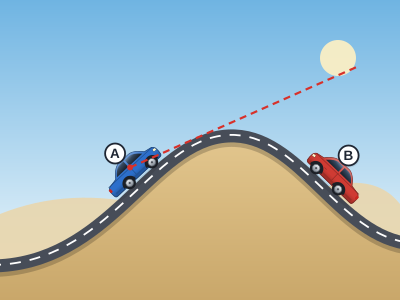
- ABrake and move as far to the right as possible, prepared to stop if necessary
- BSound your horn loudly and continue at the same speed
- CFlash your lights and accelerate past quickly
- DReverse immediately onto the crest
Answer and explanation in the bank
Every answer above, with the rule it comes from, plus the full 22-question timed test.
Get the Saudi Driving Theory Online Practice Bank - SAR 39What this test covers
Topics include road signs, traffic signals, right of way, roundabouts, speed limits, seat belts, fines and penalties, and the safe-driving rules specific to your vehicle category. Full question-by-question feedback with explanations is shown immediately after you finish the test above.
Frequently asked questions
How many questions is the Qassim General Dept. of Traffic light vehicle theory test?
The official General Dept. of Traffic light vehicle theory test in Qassim has 35 questions and you need 22 correct (63%) to pass. This practice test has 22 questions.
Is this the real exam?
These are practice questions to help you revise, written to the published rules and to what candidates report from the real test. They are not the official Saudi exam and the real question bank, format, fees and pass mark are set by the General Department of Traffic (Moroor) and the driving schools, and can change. Always confirm the current requirements with your driving school or the traffic department.
Is this practice test free?
The first 10 questions are free, with no signup, and each shows the answer and the reason. The full 22-question test, timed, is in the Saudi Driving Theory Online Practice Bank (SAR 39, one payment), with every question in the bank.
What does the Qassim light vehicle theory test cover?
Road signs, traffic signals, right of way, roundabouts, speed limits, seat belts, penalties and safe-driving rules, plus the handling and safety topics specific to your vehicle.