

Tabuk General Dept. of Traffic Truck & Bus
Practice mode· Heavy vehicle skillsTabuk General Dept. of Traffic - Saudi Heavy Vehicle Skills Test 1
First set of questions on truck and bus operation: braking distances, load stability, blind spots, turning space and vehicle checks. Master the skills unique to heavy vehicles.
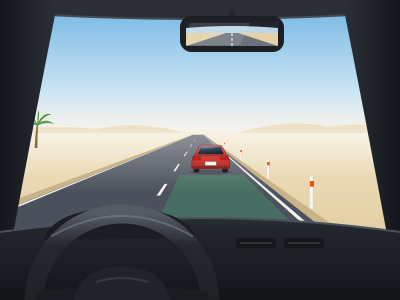
Why does a fully loaded articulated truck require a much greater stopping distance than a private car travelling at the same speed?
The other 12 questions in this test
Read them all. The answer and the reason for each, and the timed 22-question run, are in the Saudi Driving Theory Online Practice Bank.
- Q11Heavy vehicle
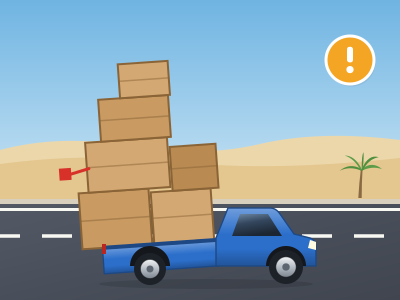
A driver is loading a curtain-sided trailer with pallets. To maintain proper weight distribution, the heaviest pallets should generally be placed
- AAt the very rear of the trailer for easy unloading at the delivery point
- BAs low as possible and centred lengthwise over the axles to keep the centre of gravity low and axle loads within limits
- CAt the very front of the trailer immediately behind the cab to improve steering
- DStacked as high as possible at the centre to maximise load space
Answer and explanation in the bank
- Q12Heavy vehicle
During a pre-departure check a driver notices that several load restraint straps have cuts and are fraying. What should the driver do?
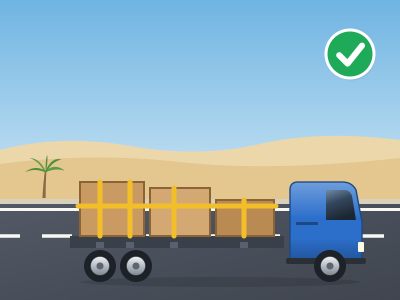
- AReplace the damaged straps immediately before moving the vehicle, as damaged straps can fail in transit and cause the load to shift or fall
- BUse the damaged straps for lighter items only and add extra undamaged straps over the heaviest loads
- CComplete the journey and report the damage on return, because the straps are unlikely to fail in normal conditions
- DWrap the frayed sections with adhesive tape and continue the journey
Answer and explanation in the bank
- Q13Heavy vehicle
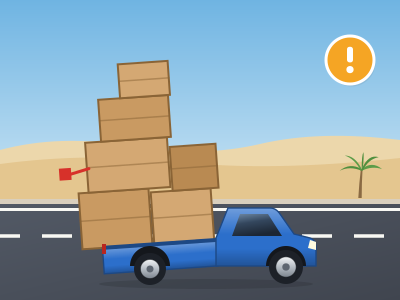
A heavy transport vehicle is carrying a load larger than the permitted dimensions. What fine applies?
- ASR 100-150
- BSR 300-500
- CNo fine if the load is tied down
- DSR 1,000-2,000
Answer and explanation in the bank
- Q14Heavy vehicle
Which axle load limit principle is most important when loading a tandem-axle trailer in Saudi Arabia?
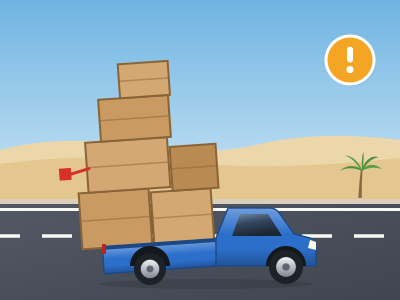
- AOnly the total GVW matters; individual axle loads are not regulated
- BThe heaviest axle can carry up to 50% of the total GVW without restriction
- CNo individual axle or axle group must exceed its rated limit, even if the total GVW is within the permitted maximum
- DAxle loads only matter on bridges, not on normal roads
Answer and explanation in the bank
- Q15Heavy vehicle
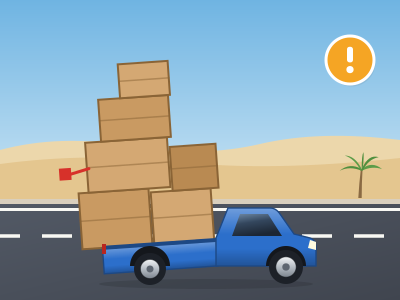
What is the most serious safety consequence of driving an overloaded heavy truck?
- ASlightly higher fuel consumption but no significant safety risk
- BIncreased stopping distances, greater rollover risk, tyre and brake overloading, and potential structural damage to roads and bridges
- CHigher engine temperature that triggers automatic speed limiting
- DThe vehicle's GPS tracking system alerts the traffic authority automatically
Answer and explanation in the bank
- Q16Heavy vehicle
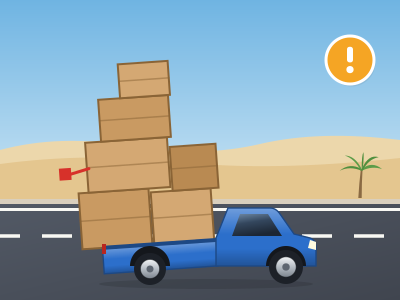
A truck driver is stopped at a weigh station and told that one drive axle group is over the permitted limit by 2 tonnes, even though the vehicle's total GVW is within the maximum. What must happen before the truck can continue its journey?
- AThe driver can pay the fine and continue immediately
- BNo action is needed because the total GVW is within limits
- CThe load must be redistributed or partially offloaded to bring the overloaded axle group within its permitted limit
- DThe truck may continue if the driver reduces speed to 60 km/h
Answer and explanation in the bank
- Q17Heavy vehicle
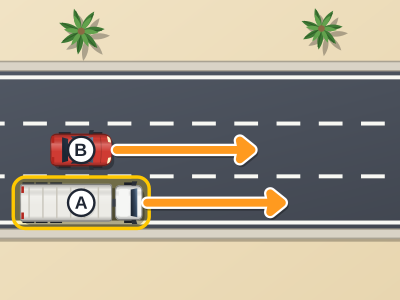
On a multi-lane road, which lane must trucks and heavy equipment use?
- AAny lane, as long as they keep to the speed limit
- BThe left lane, to keep away from the hard shoulder
- CThe right lane; not doing so is a SR 3,000-6,000 violation
- DThe middle lane, to leave the right lane for buses
Answer and explanation in the bank
- Q18Heavy vehicle
Before driving under a bridge or through a height-restriction gantry, what must a heavy truck driver do?
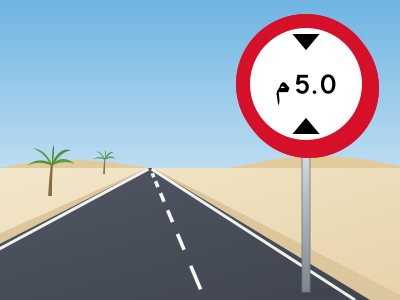
- ACheck the displayed clearance against the vehicle and load height, and only proceed if the clearance is safely greater than the vehicle height
- BSound the horn to warn oncoming traffic and then drive through slowly
- CDrive through in the centre of the lane to maximise clearance on both sides
- DThere is no need to check; all Saudi bridges are built to the national maximum vehicle height
Answer and explanation in the bank
- Q19Heavy vehicle
A truck enters a city at a time when trucks are not allowed in. What is the penalty?
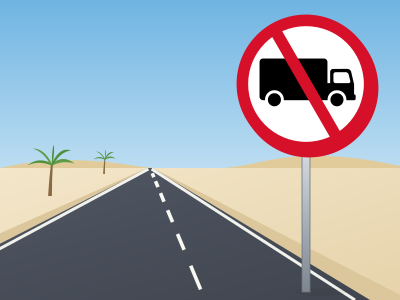
- AA SR 1,000-2,000 fine
- BA verbal warning only
- CA SR 100-150 fine
- DNo penalty if the truck is empty
Answer and explanation in the bank
- Q20Heavy vehicle
A driver is transporting a prefabricated concrete beam that extends beyond the rear of the trailer by 2 metres. What is required in Saudi Arabia before this vehicle is driven on a public road?
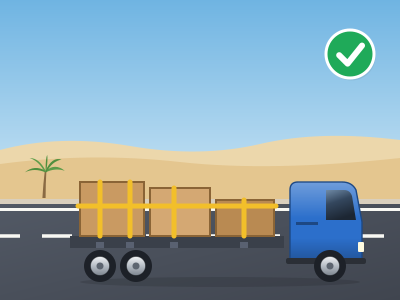
- AAn abnormal-load permit, rear overhang markers or flags, and an escort vehicle if the permit requires one
- BSimply attaching red tape to the end of the beam and driving at reduced speed
- CNo additional action is needed if the load does not exceed the maximum width
- DNotifying the nearest police station by phone is the only requirement
Answer and explanation in the bank
- Q21Heavy vehicle
Large mirrors are fitted to heavy trucks primarily to help the driver do what?
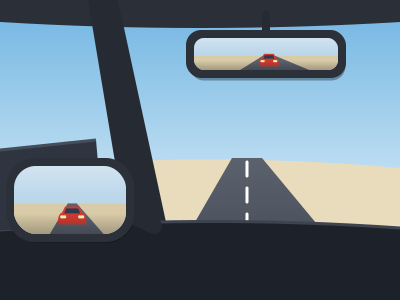
- ASee around blind spots that are much larger than those of a light vehicle, including the areas beside and behind the trailer
- BReflect sunlight to warn other road users of the truck's presence
- CMonitor the load to ensure it has not shifted during the journey
- DComply with a legal requirement that exists only for aesthetic reasons
Answer and explanation in the bank
- Q22Heavy vehicle
Where is the largest blind spot for a standard left-hand-drive heavy truck operating in Saudi Arabia?
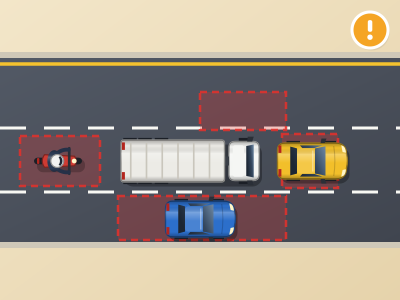
- ADown the right (passenger) side of the vehicle and immediately behind the trailer, where no mirror can give a complete view
- BDirectly in front of the cab, which is fully visible through the windscreen
- COn the driver's left side, right beside the driver's window
- DThere are no blind spots if the truck is fitted with two side mirrors
Answer and explanation in the bank
Every answer above, with the rule it comes from, plus the full 22-question timed test.
Get the Saudi Driving Theory Online Practice Bank - SAR 39What this test covers
Topics include road signs, traffic signals, right of way, roundabouts, speed limits, seat belts, fines and penalties, and the safe-driving rules specific to your vehicle category. Full question-by-question feedback with explanations is shown immediately after you finish the test above.
Frequently asked questions
How many questions is the Tabuk General Dept. of Traffic truck & bus theory test?
The official General Dept. of Traffic truck & bus theory test in Tabuk has 35 questions and you need 22 correct (63%) to pass. This practice test has 22 questions.
Is this the real exam?
These are practice questions to help you revise, written to the published rules and to what candidates report from the real test. They are not the official Saudi exam and the real question bank, format, fees and pass mark are set by the General Department of Traffic (Moroor) and the driving schools, and can change. Always confirm the current requirements with your driving school or the traffic department.
Is this practice test free?
The first 10 questions are free, with no signup, and each shows the answer and the reason. The full 22-question test, timed, is in the Saudi Driving Theory Online Practice Bank (SAR 39, one payment), with every question in the bank.
What does the Tabuk truck & bus theory test cover?
Road signs, traffic signals, right of way, roundabouts, speed limits, seat belts, penalties and safe-driving rules, plus the handling and safety topics specific to your vehicle.