

 NHRA
Bahrain NHRA · Bahrain · Physiotherapist
NHRA Physiotherapist Exam Practice Questions and Mock Papers (2026)
For physiotherapists sitting the National Health Regulatory Authority licensure examination at Prometric in Bahrain. The paper is timed to the 150 minutes of testing in the 3-hour seat, and none of its questions appear in any other country's paper.
Also known as: NHRA licensure exam physiotherapist, Bahrain Prometric physiotherapy exam, NHRA allied health exam physiotherapy
See inside the free sample
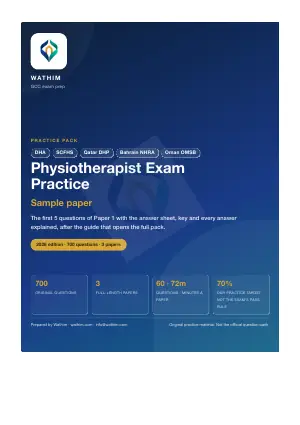
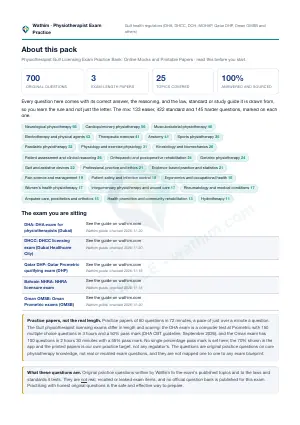
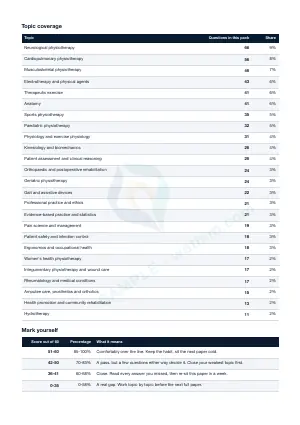
Every pack starts at 3 papers. Add up to 4.
- 3
- Full papers
- 450
- Printed Qs
- 700
- Online Qs
That's 33 fils a question, every answer explained.
- Access link emailed automatically the moment you pay
We never see your card details · One-time, no subscription
Look for WATHIM on your card statement
Original practice questions, a reference on every answer
Every answer explained
Payment or download problem? Message us or chat: a real person replies within 24 hours.
The NHRA physiotherapist exam in numbers
- 150
- questions
- 150 min
- on the clock
- 60 s
- per question
- 75 of 150
- right to pass (50%)
NHRA booklet: 50% for nursing, midwifery and allied health. The Prometric page says 60% for every exam.
Pacing to finish with time to review
Work at about 54 seconds a question and you keep a tenth of the clock spare to go back over flagged questions:
- Q42by 38 min
- Q83by 75 min
- Q125by 113 min
Your NHRA physiotherapist exam paper, section by section
Bahrain NHRA names the exam areas but publishes no count per area, so these counts are our estimate of the balance, built from the areas it lists. The last column is how many you need right in each section to reach 50% if your marks are spread evenly.
- Anatomy, Physiology & Basic Sciences 16
- Kinesiology, Biomechanics & Ergonomics 11
- Patient Assessment, Clinical Decision Making & Differential Diagnosis 11
- Musculoskeletal Physiotherapy & Rehabilitation 16
- Neurological Physiotherapy & Neurorehabilitation 16
- Cardiopulmonary / Cardiorespiratory Physiotherapy 11
- Electrotherapy, Physical Agents & Hydrotherapy 14
- Therapeutic Exercise & Exercise Prescription 14
- Physical Therapy in Special Populations 16
- Sports Physiotherapy 11
- Integumentary, Wound Care & Tissue Management 6
- Professional Practice, Ethics, Safety & Evidence-Based Practice 8
| Section | Questions | Share | Aim for |
|---|---|---|---|
| Anatomy, Physiology & Basic SciencesAnatomy, Physiology and exercise physiology | 16 | 11% | 8 right |
| Kinesiology, Biomechanics & ErgonomicsKinesiology and biomechanics, Ergonomics and occupational health, Gait and assistive devices | 11 | 7% | 6 right |
| Patient Assessment, Clinical Decision Making & Differential DiagnosisPatient assessment and clinical reasoning, Rheumatology and medical conditions | 11 | 7% | 6 right |
| Musculoskeletal Physiotherapy & RehabilitationMusculoskeletal physiotherapy, Orthopaedic and postoperative rehabilitation, Amputee care, prosthetics and orthotics, Pain science and management | 16 | 11% | 8 right |
| Neurological Physiotherapy & NeurorehabilitationNeurological physiotherapy | 16 | 11% | 8 right |
| Cardiopulmonary / Cardiorespiratory PhysiotherapyCardiopulmonary physiotherapy | 11 | 7% | 6 right |
| Electrotherapy, Physical Agents & HydrotherapyElectrotherapy and physical agents, Hydrotherapy | 14 | 9% | 7 right |
| Therapeutic Exercise & Exercise PrescriptionTherapeutic exercise | 14 | 9% | 7 right |
| Physical Therapy in Special PopulationsPaediatric physiotherapy, Geriatric physiotherapy, Women's health physiotherapy | 16 | 11% | 8 right |
| Sports PhysiotherapySports physiotherapy | 11 | 7% | 6 right |
| Integumentary, Wound Care & Tissue ManagementIntegumentary physiotherapy and wound care | 6 | 4% | 3 right |
| Professional Practice, Ethics, Safety & Evidence-Based PracticeProfessional practice and ethics, Patient safety and infection control, Evidence-based practice and statistics | 8 | 5% | 4 right |
NHRA publishes no question count and no section weights, so the 150 questions and the section split are estimates built from a generic profession blueprint, not regulator figures. The seat is 3 hours with 2.5 hours of testing; the mock uses the 150 minutes of testing time. The health promotion topic has no section in the generic blueprint and is left off the paper.
Source: NHRA licensure examination booklet and Decision No. 29 of 2020 (pass mark); Prometric NHRA exam page (seat and testing time). NHRA publishes no question count and no blueprint
A paper no other country gets
Of the 700 questions in the Physiotherapist exam bank, 150 are reserved for the NHRA physiotherapist exam, enough for one complete 150-question paper at the real section counts. None of them appears in the DHA physiotherapist exam, SCFHS physiotherapy exam, QCHP (DHP Qatar) physiotherapist exam, OMSB OEPH papers, so a colleague preparing for another Gulf exam is not practising your questions, and nothing in your paper repeats theirs.
A four-week NHRA physiotherapist exam plan
Three weeks by section, heaviest sections first and balanced so each week carries a similar share of the paper, then a week of full timed mocks. Stretch each week if you have longer.
Week 1: Anatomy, Physiology & Basic Sciences, Physical Therapy in Special Populations, Cardiopulmonary / Cardiorespiratory Physiotherapy, Integumentary, Wound Care & Tissue Management
49 of the 150 questions (33% of the paper). Drill these topics in the bank, then redo every question you got wrong before moving on.
Week 2: Musculoskeletal Physiotherapy & Rehabilitation, Electrotherapy, Physical Agents & Hydrotherapy, Kinesiology, Biomechanics & Ergonomics, Sports Physiotherapy
52 of the 150 questions (35% of the paper). Drill these topics in the bank, then redo every question you got wrong before moving on.
Week 3: Neurological Physiotherapy & Neurorehabilitation, Therapeutic Exercise & Exercise Prescription, Patient Assessment, Clinical Decision Making & Differential Diagnosis, Professional Practice, Ethics, Safety & Evidence-Based Practice
49 of the 150 questions (33% of the paper). Drill these topics in the bank, then redo every question you got wrong before moving on.
Week 4: full mocks
Sit the NHRA physiotherapist exam paper under the real 150-minute clock, mark it, and spend the next day on your weakest section. Then the second and third papers the same way. Aim for 50% with a margin before you book.
Try 4 free questions
Answer one and see the reason. These are free samples, not taken from your paid paper, written to the same standard.
A 17-year-old netballer's kneecap dislocated laterally when she twisted on a planted foot, and it relocated by itself. Now, with the knee relaxed in slight flexion, the examiner pushes the patella laterally and she becomes apprehensive and tightens her quadriceps to stop the movement. Which structure was most likely torn in the original dislocation?
Pick an answer to see the reason.
A 48-year-old roofer has pain on the inner side of the elbow that increases when he grips a hammer. Pain is reproduced by resisted wrist flexion and by resisted forearm pronation, and there is tenderness just distal to the medial epicondyle. Which structure is most likely affected?
Pick an answer to see the reason.
A 35-year-old skier falls with the pole strap pulling the thumb into abduction and has pain and swelling on the inner side of the thumb metacarpophalangeal joint. A radially directed (valgus) stress to this joint produces pain and more movement than on the other thumb. Which structure is injured?
Pick an answer to see the reason.
A 29-year-old runner has sharp pain at the outer side of the knee that begins after a set distance and is worse running downhill. There is tenderness over the lateral femoral epicondyle, no effusion or locking, a normal varus stress test and no joint line tenderness. Pain is reproduced when the examiner presses over the epicondyle while moving the knee from extension to about 30 degrees of flexion. What is the most likely diagnosis?
Pick an answer to see the reason.
What you get
- A full 150-question NHRA physiotherapist exam paper, dealt to the exam's areas, from 150 questions reserved for the NHRA physiotherapist exam alone: none of them is in any other country's paper
- Papers 2 and 3 (up to 4 if you choose more) at the same NHRA physiotherapist exam length and layout, drawn from the rest of the Physiotherapist exam bank of 700 questions, with no question repeated
- Timed online mocks at 150 questions in 150 minutes, marked against 50% with your score per section
- Every answer explained, with the textbook or guideline it comes from
- Topic drills, your mistakes and your weak sections tracked on your phone, with no account and no password
- The printable pack (a zip of PDFs with answer sheets and keys) emailed the moment you pay. Lifetime access, one payment
Booking, eligibility and fees
This page is about practising. For who can sit the NHRA physiotherapist exam, how to book it, what it costs and what happens after you pass, read our guide.
Read the NHRA licensure examination (Prometric), Physiotherapist guide →Questions
The NHRA booklet sets 50% for nursing, midwifery and allied health, while the Prometric page says 60% for every exam. Mocks here are marked against 50%; aim well above 60% so either figure is covered.
No. NHRA publishes neither a question count nor section weights, so the 150 questions and the 12 areas here are an estimate built from a physiotherapy blueprint.
The seat is 3 hours with 2.5 hours of testing. The mock uses the 150 minutes of testing time, about 60 seconds a question.
No. They are original practice questions written by Wathim for physiotherapists, checked by a second examiner and dealt to the NHRA physiotherapist exam layout. Bahrain NHRA does not release its live questions, so anyone selling real or recalled papers does not have them. Original questions are the safe way to prepare, and no practice bank can promise a result on the day.
One email with two things: a link that opens the online bank with its mocks fixed to the NHRA physiotherapist exam layout, and the printable NHRA physiotherapist exam pack to download and keep. No account, no password, no expiry. Lost the email, ask for a fresh link with the same address.
Sitting a different Gulf exam?
Each has its own paper, dealt to that regulator's layout.
 Estimated split
DHA
UAE
DHA physiotherapist exam
- 150
- questions
- 180m
- time
- 50%
- to pass
150 questions written for this exam alone, never in another country's paper.
See the DHA pack Official split
SCFHS
Saudi Arabia
SCFHS physiotherapy exam
- 150
- questions
- 180m
- time
- 60%
- to pass
150 questions written for this exam alone, never in another country's paper.
See the SCFHS pack Official split
Qatar DHP
Qatar
QCHP (DHP Qatar) physiotherapist exam
- 150
- questions
- 180m
- time
- 50%
- to pass
150 questions written for this exam alone, never in another country's paper.
See the QCHP pack Official split
Oman OMSB
Oman
OMSB OEPH
- 100
- questions
- 150m
- time
- 55%
- to pass
100 questions written for this exam alone, never in another country's paper.
See the OMSB pack