

Oman traffic signs and meanings: the short answer
This page is the reference chart for Oman road signs. It lists every sign family used on Omani roads, the shape and colour that identify it, and what each sign tells you to do. It is written for the Royal Oman Police (ROP) theory, or signal, test, which is the first exam of the licence route and the one where you must recognise signs, markings, traffic lights and police signals.
Oman uses the standard GCC sign system, so most signs will look familiar if you have driven in the UAE, Qatar or Saudi Arabia. The shapes and colours carry the meaning, and that is the fastest way to learn them: a red triangle warns, a red circle forbids, a blue circle orders, and a green or blue rectangle informs. Learn those four shapes and you can place almost any sign into a family before you read its picture.
Chart first, then the signs test
Read the chart to learn the signs, then test yourself. The free Oman signs test 1 has 22 questions with a picture for each, and signs test 2 gives you 22 more. They take about ten minutes each and show the explanation after every answer, so use them straight after each section below.
Which page is which
For the score you need, read the Oman theory test pass mark guide. For worked questions on every topic, read Oman driving test questions and answers. For the practical stage after the signs, see the drum and slope guide.
How the ROP signs test works
Be clear about what is known and what is not. The ROP does not publish the number of questions or the pass mark for the signal test, and we will not pretend otherwise. What is documented is the history of the format and the study material.
| Item | What is reported | How sure we are |
|---|---|---|
| Before 2021 | A short oral check by an ROP officer, who points to major signs from the ROP test book or the posters in the test area and asks you to name them | Reported in a 2019 expat guide |
| From January 2021 | The ROP moved the theory tests to an electronic system and applicants book online | Reported by Oman Observer and other outlets in January 2021 |
| Question count and pass mark | Not published by the ROP. Prep sites quote figures from 20 to 30 questions, and they disagree | Unconfirmed |
| Languages | Arabic and English are commonly reported | Likely, confirm when you book |
| Study material | The ROP Highway Code booklets for light vehicles and heavy vehicles, published in March 2024 in Arabic and English | Reported by Muscat Daily and Times of Oman |
| Our practice format | 22 questions per signs topic test with 17 correct to pass, and 30 questions per full mock with 23 correct to pass in 30 minutes | Our own standard |
What this means for how you study
Because the format has changed over the years and may differ by centre, prepare for both ways of being asked. You should be able to look at a picture and name the sign, and also read a sentence such as "a blue circle with a number" and know what it means without a picture. The signs test uses pictures, and the full mocks add rule questions around them.
Booking is done through your driving institute, the ROP mobile app or the portal at rop.gov.om. When you book, ask which language the test is in and how many questions it has, and write the answer down. The full process is laid out in our Oman driving licence guide for expats.
Every Oman sign family at a glance
Start with this table. If you can reproduce it from memory, you already know the structure of the whole signs test. The rows are the families, and the two columns that matter most are shape and colour, because they tell you the type of instruction before you read the symbol.
| Family | Shape and colour | What it tells you | Example |
|---|---|---|---|
| Warning | Triangle with a red border and a white face | A hazard ahead, so slow down and be ready | Pedestrian crossing, roundabout ahead, slippery road |
| Prohibition | Red circle, usually a white face with a black symbol | You must not do this | No entry, no overtaking, no left turn, speed limit |
| Mandatory | Blue circle with a white symbol | You must do this | Keep right, roundabout, minimum speed |
| Priority | Red octagon, inverted triangle, yellow diamond | Who goes first at the junction | Stop, give way, priority road |
| Direction and information | Green or blue rectangles | Where a road goes, which route you are on | Destination boards in Arabic and English |
| Temporary and roadworks | Often orange or yellow, on portable stands | Works, diversions, lane closures for a limited time | Lane closed ahead, diversion |
| Road markings | White and yellow lines, arrows, zigzags | Where you may cross, stop or park | Solid centre line, yellow box |
| Traffic lights | Red, amber, green, steady or flashing | When to stop and go | Flashing red, flashing amber |
| Police signals | Arm and hand positions of an officer | Overrides every sign and light | Raised hand, beckoning |
The four shapes that carry most of the test
Triangle means warning, red circle means prohibition, blue circle means a command, and rectangle means information. A candidate who has learned only those four rules can answer a large share of sign questions by elimination. Our tests deliberately include the exceptions, such as the red octagon and the yellow diamond, so that the shape rule is a tool and not a crutch.
The question bank names the family in the explanation of every answer. When you get one wrong in the signs test, say the family out loud before reading the explanation.
Warning signs: the red triangles
A warning sign does not give an order. It tells you what is coming so that you can slow down, look and be ready to stop. The face is white, the border is red, and the symbol is black. On the test you are almost never asked to recite a speed for a warning sign, only to say what the hazard is and what a careful driver does about it.
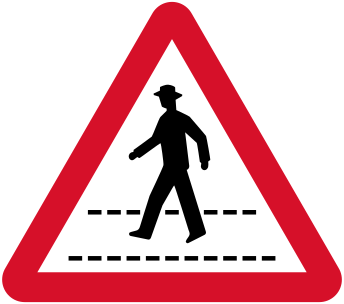
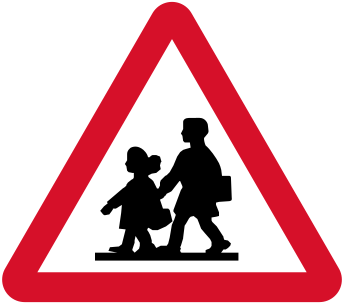
| Sign | Picture | What you do |
|---|---|---|
| Pedestrian crossing | Walking figure | Slow down, stop for anyone on the crossing |
| Children crossing | Two children holding hands | Cut speed significantly and watch both pavements |
| Slippery road | Car with wavy lines under the tyres | Reduce speed, avoid harsh braking and sharp steering |
| Traffic signals ahead | Three lights | Be ready to stop, especially on a fast road |
| Roundabout ahead | Three curved arrows in a circle | Prepare to give way to traffic already on the roundabout |
| Other danger | Exclamation mark | Something not covered by another sign, read any plate beneath it |
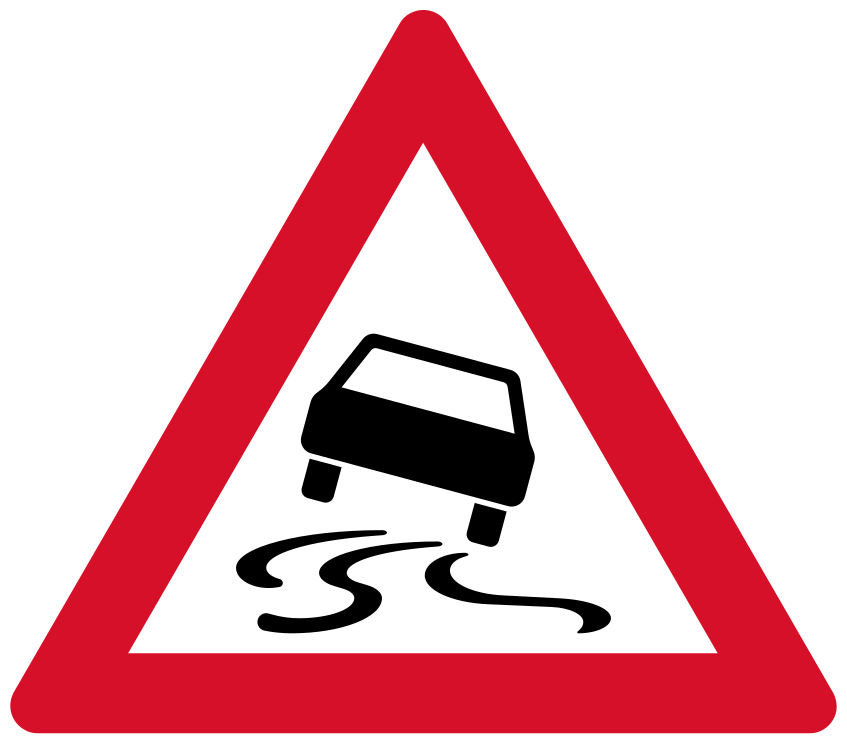
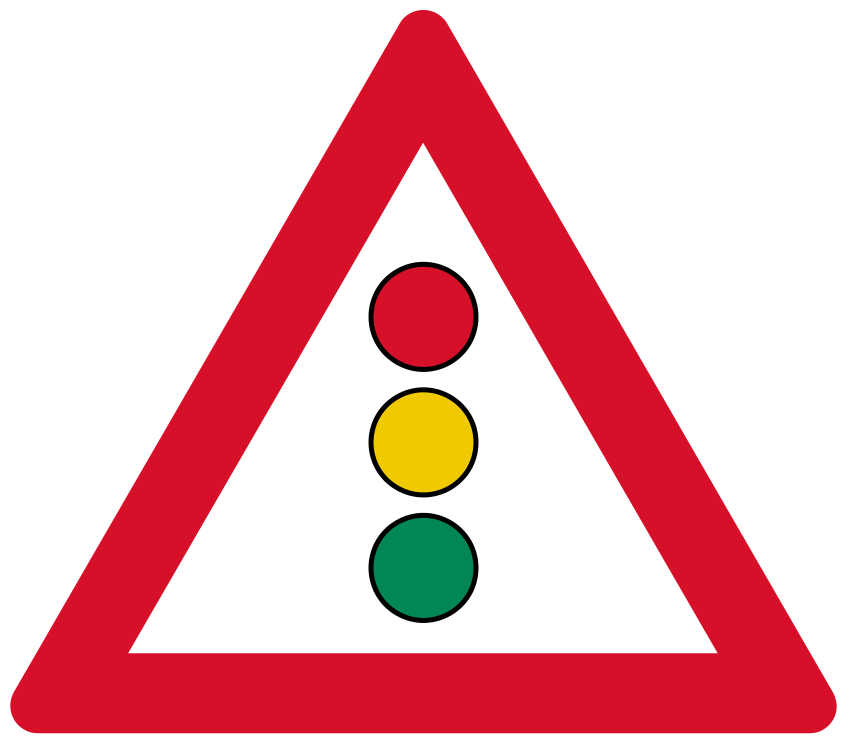
The warning sign trap
The most common slip is mixing the red triangle roundabout sign, which warns of a roundabout ahead, with the blue circle roundabout sign, which is a command. The first says "get ready", the second says "you are at it, go this way round". We come back to that pair in the look-alike section below.
Prohibition, priority and mandatory signs
These are the signs that tell you what you must or must not do, and they are where the test is strictest because the answer is a rule, not a judgement. Prohibitions are red circles. Commands are blue circles. Priority signs have their own shapes so that you can recognise them from far away or from behind.
Priority signs
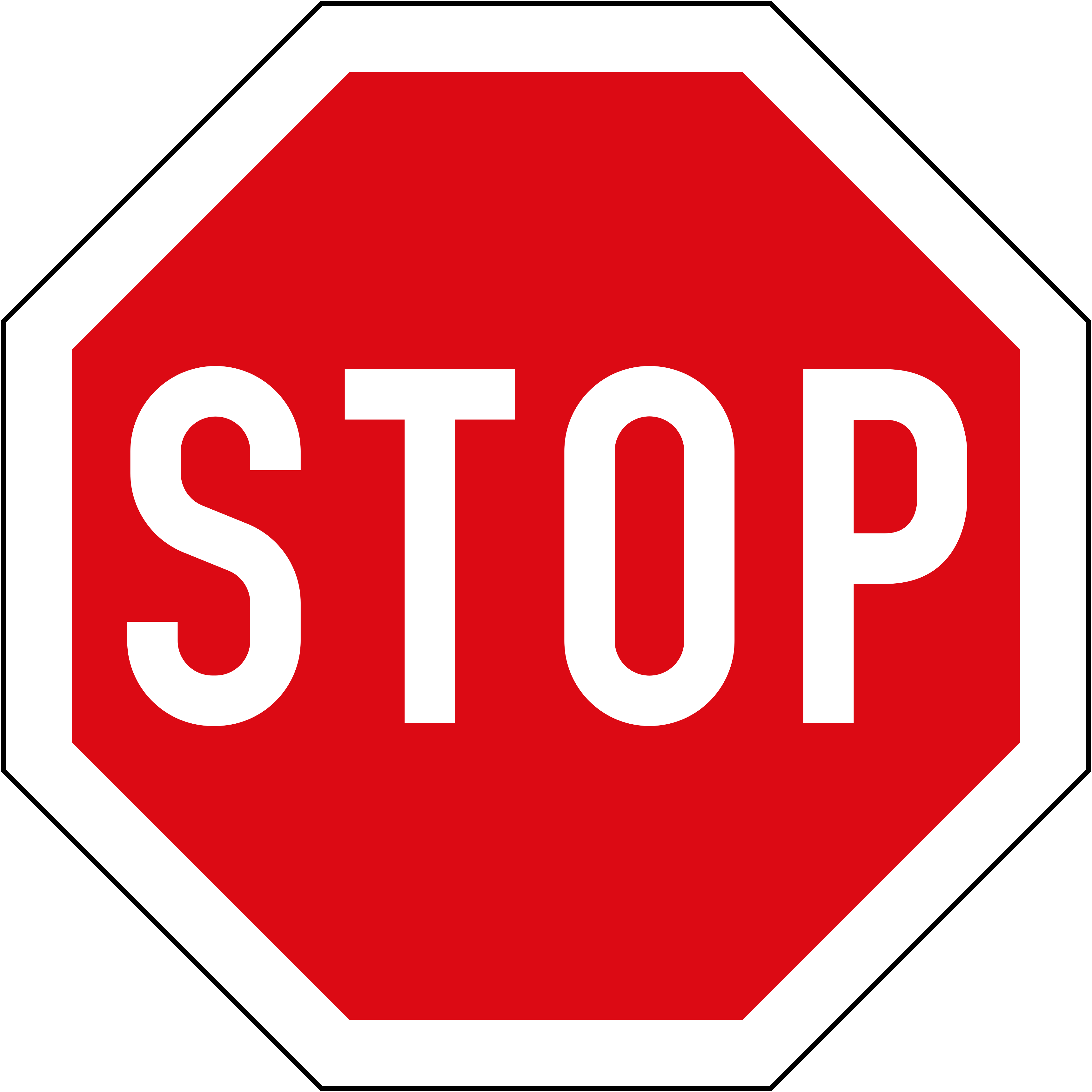
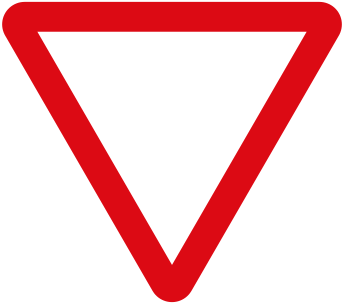
A stop sign means a full stop at the line, then give way to everything. A give way sign means yield, and you stop only if traffic demands it. On the test, "you may roll through a stop sign if it is empty" is always the wrong option. A yellow diamond marks a priority road, which gives you priority over side roads joining it. You can practise the junction side of this in the Oman right of way practice test.
Prohibition signs
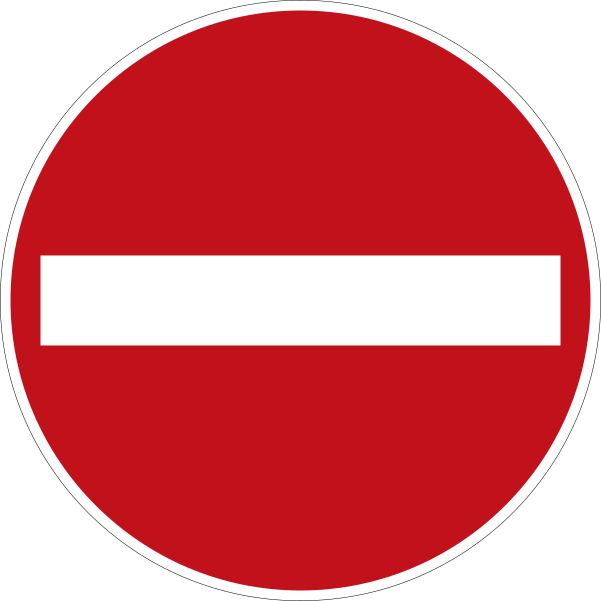
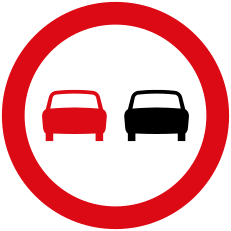
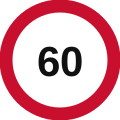
| Sign | Meaning | Detail the test likes |
|---|---|---|
| Red circle with a bar | No entry | For all vehicles, not only cars |
| Two cars in a red circle | No overtaking | Applies to the section even if visibility is good |
| Red circle with a number | Maximum speed | Stays in force until replaced or cancelled |
| Same number with a diagonal bar | End of that speed restriction | Not a new limit |
| Blue P crossed in red | No parking | Even for a two minute stop with the engine running |
| Arrow crossed in red | No left turn or no right turn | Read the direction of the arrow |
| Lorry with a weight figure | Vehicles over that weight prohibited | A 3.5 sign does not affect an ordinary car |
Mandatory signs
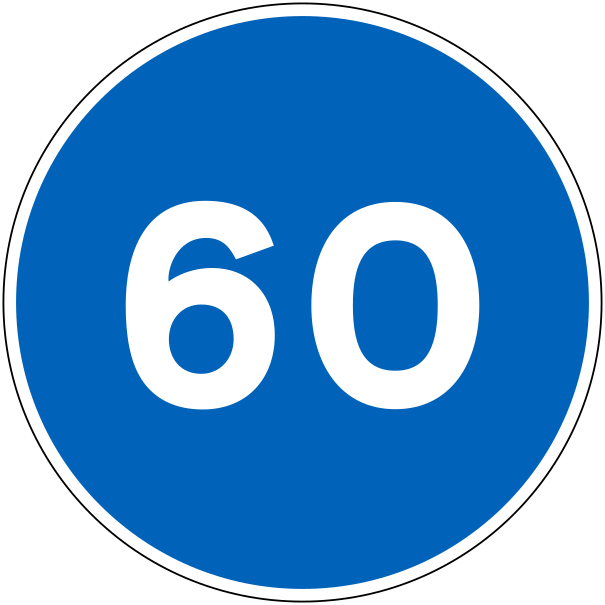
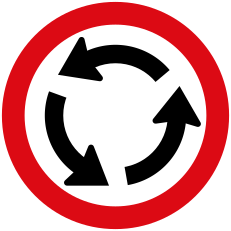
Blue circles include keep right, roundabout and minimum speed. A blue circle with the number 60 means at least 60 km/h, not at most. Minimum speed signs are common on expressways where slow vehicles create danger.
Direction, information and roadworks signs
The signs in this group give you facts and temporary instructions rather than permanent rules. They carry fewer exam questions than warning or prohibition signs, but the ones that do appear are usually easy marks if you know the colour code, and they matter a great deal once you are driving on your own on Omani highways.
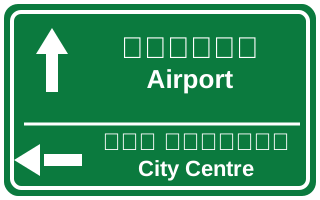
Direction and route signs
Direction signs are rectangular, with names in Arabic and English. In the GCC system green or blue is typical for direction and information, and a blue rectangle most commonly gives expressway or motorway route information. Tourist and facility signs sit in the same rectangular family. The test question is usually "what colour is this type of sign" or "what does this blue rectangle indicate", so learn the colour, not individual place names.
| Type | Usual look | Used for |
|---|---|---|
| Direction | Green rectangle, white text in Arabic and English | Destinations, exits, distances |
| Route information | Blue rectangle | Motorway or expressway information |
| Facilities and services | Rectangles with a symbol | Parking, fuel, hospital and similar |
| Temporary works | Often orange or yellow, on movable stands | Roadworks, diversions, lane closures |
Temporary and roadworks signs
Roadworks signs are temporary and override what you remember about a road. Where a temporary sign contradicts a permanent one, follow the temporary sign. Speed is usually cut, a lane may be closed, and workers can be close to traffic. The safe rule is the one the test rewards: slow down early, follow the diversion exactly and do not use the closed lane to jump a queue.
Speed limits you should know without a sign
The test asks about default limits. Our bank teaches 60 km/h as the general limit on urban main roads where nothing else is posted, 120 km/h on expressways where no lower limit is signed, and 40 km/h as the typical limit in a school zone during school hours. Always obey the posted figure first, and confirm current limits with the ROP, because they can change. The Oman road rules test drills these numbers.
Oman printable theory pack
485 questions with the answer and the rule, 3 full papers at the real length. One payment, no account.
Fail on the day
~OMR 25
Pass first time
OMR 1.5
- 3
- Full papers
- 485
- Questions
- printable
That's 3.1 baisa a question, every answer explained.
Road markings: lines, arrows and boxes
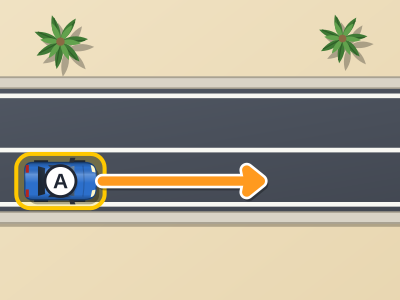
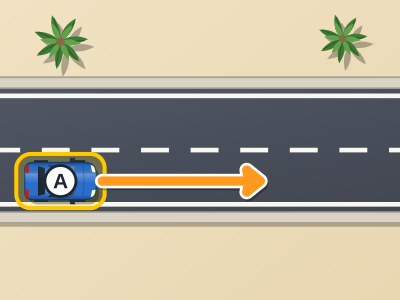
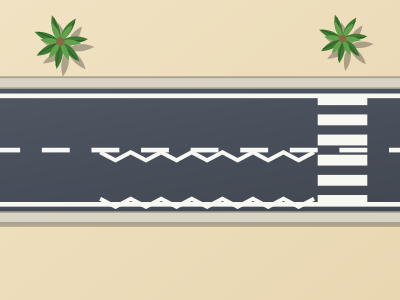
Markings are signs painted on the road, and candidates often forget that they count. Several of the trickiest sign questions are really about lines. The rule to hold on to is the same everywhere: a solid line is a wall you do not cross, a broken line is a permission, and yellow at the edge usually means a restriction on stopping or parking.
| Marking | Meaning | Common wrong answer |
|---|---|---|
| Solid white centre line | Do not cross or straddle | "You may cross briefly to overtake" |
| Broken white line between lanes | Change lanes when safe | "You may cross to the opposite carriageway" |
| Double yellow along the edge | No parking or no stopping, check any plate for hours | "Free parking for 30 minutes" |
| Yellow box junction | Enter only if your exit is clear | "Enter whenever the light is green" |
| Zigzag lines near a crossing | No stopping or parking | "Wait here for the school bus" |
| White arrows in your lane | The direction you must take from that lane | "A suggestion only" |
| Red and white kerb at a hydrant | Keep the hydrant clear, do not park in the zone | "Park if the cover is visible" |
Why markings cost marks
People who learn signs from a poster often have no picture of a line in their head. Practise them with the scene questions in the second Oman mock, where the road is drawn from above, and say what the line allows before you pick an option.
Traffic lights and police hand signals
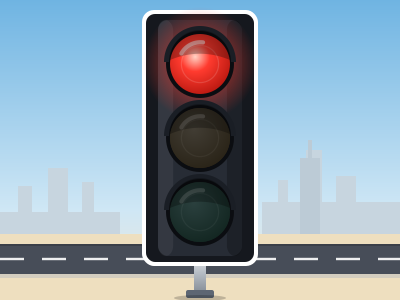
Lights and officers are the signs that change while you are looking at them, and that is why the exam likes them. The core is simple. Red means stop behind the line. Amber on its own means the light is about to turn red, so stop if you can do it safely. Green means go if the way is clear. What catches people are the flashing states and the power of a police officer.
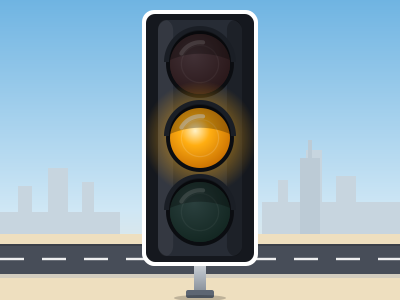
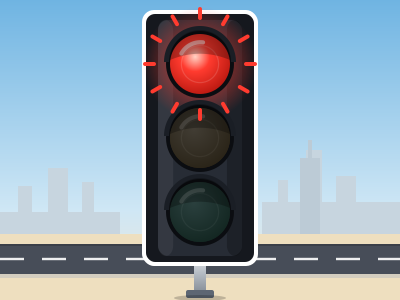
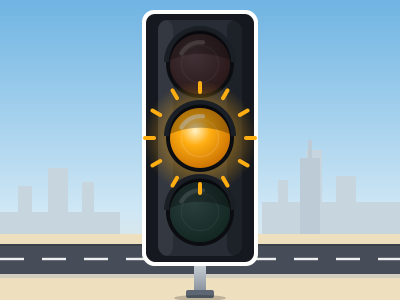
| Signal | What you do |
|---|---|
| Steady red | Stop behind the line. You may not go on red |
| Steady amber | Stop if safe. Do not accelerate to beat it |
| Steady green | Go when the way is clear, and watch for late pedestrians |
| Flashing red | Stop, give way to all, then proceed when safe. You do not wait for green |
| Flashing amber | Proceed with care, giving way to pedestrians and vehicles as needed |
| Signals dead | Treat the junction as unmarked and give way to traffic on your right |
Police hand signals
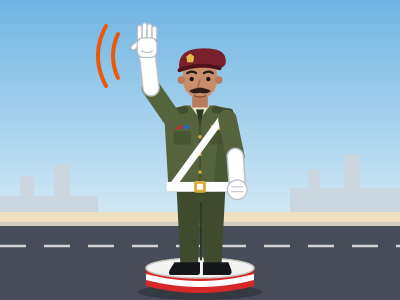
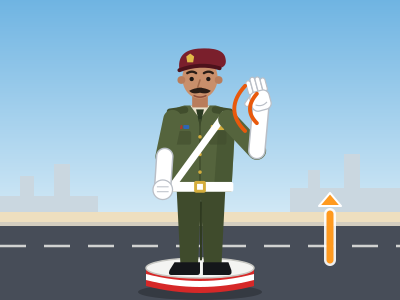
The rule is one sentence: a police officer directing traffic overrides every sign and every light. If the lights are red and the officer waves you through, you go. If the lights are green and the officer raises a hand at you, you stop. Practise these in the signs test and in the right of way test.
Look-alike pairs people confuse
Most lost marks on a signs test do not come from signs the candidate has never seen. They come from two signs the candidate has seen many times and swaps. Use this table as a checklist, and for each pair say aloud what separates them.
| Pair | How to tell them apart |
|---|---|
| Red circle number against blue circle number | Red is a maximum, blue is a minimum. Opposite instructions |
| Stop against give way | Octagon means a full stop. Inverted triangle means yield, stop only if needed |
| Roundabout ahead against roundabout | Red triangle is a warning of what is coming. Blue circle is the instruction at the roundabout |
| Speed limit against end of speed limit | A diagonal bar through the number cancels it. It is not a new limit |
| No entry against no parking | Bar across a red circle against a crossed P. One forbids driving in, the other forbids leaving a car |
| No left turn against keep right | A crossed arrow in a red circle forbids. A blue circle with an arrow commands |
| Pedestrian crossing against children crossing | One figure walking against two children. Both mean slow down, the children sign means school nearby |
| Flashing red against steady red | Steady means wait for green. Flashing means stop, then go when clear |
| Flashing amber against steady amber | Steady amber means stop if safe. Flashing amber means carry on with care |
| Solid against broken line | Solid is a barrier. Broken is a permission |
How to drill the pairs
Take one pair a day and write its row on a card with the picture on one side. Then take a timed paper and look for that pair in the questions. The mock tests deliberately put the second half of a pair among the wrong options, so each time you pick the right one over its twin you are doing the exact job the real test asks. Our third mock is a good place to check your result.
A seven day plan to learn every sign
You do not need weeks for signs, you need repetition with feedback. This plan takes about 30 to 40 minutes a day and ends with two timed papers, so that you finish above the line and not on it. Move the days around to fit your lessons.
| Day | Work | Check |
|---|---|---|
| 1 | Shape and colour table. Warning triangles and what to do about each | Cover the table and rebuild it from memory |
| 2 | Prohibition and mandatory circles, including speed signs | Signs test 1 |
| 3 | Priority signs, junction rules, direction and roadworks signs | Right of way test |
| 4 | Road markings and the yellow box | Redo any wrong answers from days 2 and 3 |
| 5 | Traffic lights, flashing states, police signals | Signs test 2 |
| 6 | Look-alike pairs table, one at a time | Mock test 1, timed |
| 7 | Weak points only, then a second timed paper | Mock test 4, aim above 26 of 30 |
Memory tricks that work
- Say the family first. Before the meaning, say triangle, red circle, blue circle or rectangle.
- Red takes, blue gives. Red circles take something away from you. Blue circles tell you what to do.
- Look for the bar. A diagonal bar usually cancels or forbids.
- Draw it. Sketching a sign from memory fixes it better than looking at it again.
Where the signs come from
The official reference is the ROP Highway Code, published as free PDFs in Arabic and English for light and heavy vehicles. Search the ROP site rop.gov.om for it, and use that for the exact artwork.
Oman traffic signs PDF and printable sheets
Many people search for this chart as a PDF so that they can print it, keep it on a phone or study on the way to a lesson. There are two sensible sources, and they do different jobs.
The official reference
The ROP published Highway Code booklets for light vehicles and for heavy vehicles in March 2024, free, in Arabic and English. They cover licensing, signs and the violations list. We could not confirm the exact download address, so look for them on rop.gov.om or ask your driving institute for the current copy. Treat the ROP booklet as the final word on how a sign looks.
Printable practice
Reading a chart does not tell you whether you can recall it under a clock. Our Oman printable papers give you question sheets with the pictures, in English and in an Arabic edition, that you can print and mark yourself. They are written to the published rules and to what candidates report from the real test, and they are practice, not the official exam.
How to use a printed sheet
- Print one paper and set a 30 minute timer.
- Answer without the chart in front of you.
- Mark it, and write the family beside every wrong answer.
- Go back to the right table on this page and read that family again.
For a quick check on screen instead, the first full mock gives you a score at once and shows the explanation for every question.
Mistakes that fail people on signs
These come from the patterns we see in what candidates report and in the wrong answers our own tests catch most often. None of them needs a better memory, they need a better habit.
Reading the picture and not the question
A speed sign question may really be asking "does the limit still apply 1.5 km later". It does, until a new sign or an end of restriction sign. Candidates see the 80 and answer "80" without checking what was asked. Read the last line of the question first.
Treating a sign as advice
No overtaking at the start of a bend does not depend on whether you can see the road. A no parking sign does not allow two minutes with the engine running. Options that start with "you may" or "only if" are usually wrong for a prohibition.
Forgetting the officer
Candidates who know the lights perfectly still answer "stay stopped" when an officer waves them through. The officer wins every time.
Ignoring markings
A line is as binding as a sign. Candidates who studied from a sign poster often have no answer ready for zigzags, the yellow box or arrows in a lane.
Cramming the night before
A night of reading does not give you the instant recognition the test needs. Use short daily sessions and timed papers, and your pass will not depend on how you slept. For the road test faults that follow this stage, read our guide to why candidates pass or fail the ROP road test.
What a fail costs and how to practise first
The Oman licence process has several separate fees and the theory test is typically charged per attempt. The government fee for each stage is reported as a few Omani rials, but exact current amounts are not confirmed, so we do not quote them. Ask the ROP or your driving institute for the current schedule. What is certain is the shape of the cost: a failed signs test means paying again, waiting for another slot, and pushing every later stage back.
The eye test certificate is time limited, reportedly around 30 days, so a long delay can force you to repeat that too. The practical stages have waits of several weeks between attempts, and the whole process often takes months for those who need training. It is hard to find a cheaper stage to get right first time, because you can prepare for it at home.
The practice route
- Take the free signs test 1 and test 2. Our pass line is 17 of 22.
- Take the free mock test 1. The line is 23 of 30 in 30 minutes. Aim for 26.
- When you keep seeing the same questions, move to the full bank and the printable papers, which give you far more variety.
- Check the Muscat light vehicle test list to find the topic that matches your weak area.
Practise wherever you live
The signs are national. A candidate in Dhofar, Al Batinah North or Musandam sees the same signs as one in Muscat. Our Oman theory test hub lists every test. These are practice questions written to the published rules and to what candidates report. They are not the official exam, and the ROP sets the real format.
Free Muscat mock tests and topic tests
Every test opens on ten free questions. Pick a full mock at the real length, or drill one topic.
- Oman Theory Mock Test 1Mock · 30 questions
- Oman Theory Mock Test 2Mock · 30 questions
- Oman Theory Mock Test 3Mock · 30 questions
- Oman Theory Mock Test 4Mock · 30 questions
- Oman Road Signs Practice Test 1Topic · 22 questions
- Oman Road Signs Practice Test 2Topic · 22 questions
- Oman Road Rules Test 1Topic · 20 questions
- Oman Road Rules Test 2Topic · 20 questions
- Oman Right of Way Practice TestTopic · 22 questions
- Oman Safe Driving Practice TestTopic · 22 questions
- Oman Fines & Black Points Test 1Topic · 20 questions
- Oman Fines & Black Points Test 2Topic · 20 questions
Practise for your governorate
The rules are national, but the test centre, booking and fees can differ by area.
Frequently asked questions
Oman uses the standard GCC system. Warning signs are red-bordered triangles, prohibitions are red circles, commands are blue circles, and direction and information signs are green or blue rectangles. Stop, give way and priority signs have their own shapes. Markings, traffic lights and police signals complete the set.
Before 2021 it was reported as a short oral check, where an ROP officer pointed to signs and asked you to name them. In January 2021 the ROP moved the theory tests to an electronic system. Ask your driving institute which format applies at your centre when you book.
The ROP published Highway Code booklets for light and heavy vehicles in March 2024, free in Arabic and English, which cover signs and the violations list. Look for them on rop.gov.om. For printable practice questions with the pictures, our printable papers for Oman are made for that.
The ROP does not publish a figure. Prep sites quote between 20 and 30 and disagree with each other. Our signs topic tests have 22 questions with 17 correct to pass, and our full mocks have 30 questions with 23 correct to pass in 30 minutes.
A blue circle with a number is a minimum speed sign. You must travel at least that speed unless conditions make it unsafe. It is the opposite of a red circle with a number, which is a maximum. Minimum speed signs are common on expressways.
Largely yes, because the GCC countries use a common sign system with Arabic and English text. The signs look alike, but rules and limits can differ by country, so learn Oman's figures for speed limits and priority from Oman material and confirm anything doubtful with the ROP.
Yes. An officer directing traffic has authority over signs and signals. If the light is red and the officer waves you on, you go. If the light is green and the officer raises a hand towards you, you stop. Not following a lawful instruction is an offence.
You need to book another attempt, which typically means another fee and a wait for a new slot, and your later stages move back with it. The ROP sets the exact retake rules, so ask your institute. Practising to a score well above the pass line before you book is the cheapest way to avoid it.
Most learners can cover every family in about a week with 30 to 40 minutes a day, if they check themselves with timed practice papers. The signs themselves are easy. The time goes on look-alike pairs, flashing lights and road markings, so spend your practice time there.
Oman printable theory pack
485 questions with the answer and the rule, 3 full papers at the real length. One payment, no account.
Fail on the day
~OMR 25
Pass first time
OMR 1.5
- 3
- Full papers
- 485
- Questions
- printable
That's 3.1 baisa a question, every answer explained.
Official sources
- Royal Oman Police (ROP) official website
- Oman Observer - ROP launches new online traffic services (6 Jan 2021)
- Muscat Daily - ROP publishes Highway Code handbooks (25 Mar 2024)
- Times of Oman - ROP launches 2 booklets on Highway Code for vehicles (Mar 2024)
- expat.com - Obtaining a driving license in Oman (2019)